


Anti-Epstein-Barr virus (EBV) activity of beta-L-5-iododioxolane uracil is dependent on EBV thymidine kinase
- PMID: 11083627
- PMCID: PMC90192
- DOI: 10.1128/AAC.44.12.3278-3284.2000
Anti-Epstein-Barr virus (EBV) activity of beta-L-5-iododioxolane uracil is dependent on EBV thymidine kinase
Abstract
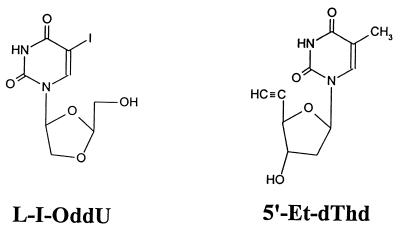
beta-L-5-Iododioxolane uracil was shown to have potent anti-Epstein-Barr virus (EBV) activity (50% effective concentration = 0.03 microM) with low cytotoxicity (50% cytotoxic concentration = 1,000 microM). It exerts its antiviral activity by suppressing replicative EBV DNA and viral protein synthesis. This compound is phosphorylated in cells where the EBV is replicating but not in cells where the EBV is latent. EBV-specific thymidine kinase could phosphorylate beta-L-5-iododioxolane uracil to the monophosphate metabolite. The K(m) of beta-L-5-iododioxolane uracil with EBV thymidine kinase was estimated to be 5.5 microM, which is similar to that obtained with thymidine but about fivefold higher than that obtained with 2' fluoro-5-methyl-beta-L-arabinofuranosyl uracil, the first L-nucleoside analogue discovered to have anti-EBV activity. The relative V(max) is seven times higher than that of thymidine. The anti-EBV activity of beta-L-5-iododioxolane uracil and its intracellular phosphorylation could be inhibited by 5'-ethynylthymidine, a potent EBV thymidine kinase inhibitor. The present study suggests that beta-L-5-iododioxolane uracil exerts its action after phosphorylation; therefore, EBV thymidine kinase is critical for the antiviral action of this drug.
Figures


 ), human cytosolic TK (○), and mitochondrial dPydK (▴). The
concentration of cold dThd in the reaction mix was 20 μM. (B)
Lineweaver-Burk plots of various L-I-OddU concentrations with or
without 5′-Et-dThd (large figure) and the replot (left-side inset). The
Ki value of 5′-Et-dThd obtained was 4 μM. The
5′-Et-dThd concentrations tested were 0 μM (●), 7.5 μM (▿), 15
μM (+), 30 μM (▴), and 60 μM (▪).
), human cytosolic TK (○), and mitochondrial dPydK (▴). The
concentration of cold dThd in the reaction mix was 20 μM. (B)
Lineweaver-Burk plots of various L-I-OddU concentrations with or
without 5′-Et-dThd (large figure) and the replot (left-side inset). The
Ki value of 5′-Et-dThd obtained was 4 μM. The
5′-Et-dThd concentrations tested were 0 μM (●), 7.5 μM (▿), 15
μM (+), 30 μM (▴), and 60 μM (▪). ).
).References
-
- Ambinder R F, Robertson K D, Moore S M, Yang J. Epstein-Barr virus as a therapeutic target in Hodgkin's disease and nasopharyngeal carcinoma. Semin Cancer Biol. 1996;7:217–226. - PubMed
-
- Chang C-N, Doong S-L, Zhou J H, Beach J W, Jeong L S, Chu C K, Tsai C-H, Cheng Y-C. Deoxycytidine deaminase-resistant stereoisomer is the active form of (±)-2′,3′-dideoxy-3′-thiacytidine in the inhibition of hepatitis B virus replication. J Biol Chem. 1992;267:13938–13942. - PubMed
-
- Cheng Y-C, Ostrander M. Deoxythymidine kinase induced in HeLa TK−cells by herpes simplex virus type I and type II. Purification and characterization. J BiolChem. 1976;251:2605–2610. - PubMed
Publication types
MeSH terms
Substances
Grants and funding
LinkOut - more resources
Full Text Sources
Other Literature Sources
