. 2000 Dec;68(12):7028-38.
doi: 10.1128/IAI.68.12.7028-7038.2000.

Molecular variation among type IV pilin (bfpA) genes from diverse enteropathogenic Escherichia coli strains

Affiliations

Molecular variation among type IV pilin (bfpA) genes from diverse enteropathogenic Escherichia coli strains

T E Blank et al. Infect Immun. 2000 Dec.

Abstract

Typical enteropathogenic Escherichia coli (EPEC) strains produce bundle-forming pili (BFP), type IVB fimbriae that have been implicated in EPEC virulence, antigenicity, autoaggregation, and localized adherence to epithelial cells (LA). BFP are polymers of bundlin, a pilin protein that is encoded by the bfpA gene found on a large EPEC plasmid. Striking sequence variation has previously been observed among type IV pilin genes of other gram-negative bacterial pathogens (e.g., Pseudomonas and Neisseria spp.). In contrast, the established sequences of bfpA genes from two distantly related prototype EPEC strains vary by only a single base pair. To determine whether bundlin sequences vary more extensively, we used PCR to amplify the bfpA genes from 19 EPEC strains chosen for their various serotypes and sites and years of isolation. Eight different bfpA alleles were identified by sequencing of the PCR products. These alleles can be classified into two major groups. The alpha group contains three alleles derived from strains carrying O55, O86, O111, O119, O127, or O128 somatic antigens. The beta group contains five alleles derived from strains carrying O55, O110, O128ab, O142, or nontypeable antigens. Sequence comparisons show that bundlin has highly conserved and variable regions, with most of the variation occurring in the C-terminal two-thirds of the protein. The results of multilocus enzyme electrophoresis support the hypothesis that bfpA sequences have spread horizontally across distantly related clonal lineages. Strains with divergent bundlin sequences express bundlin protein, produce BFP, and carry out autoaggregation and LA. However, four strains lack most or all of these phenotypes despite having an intact bfpA gene. These results have important implications for our understanding of bundlin structure, transmission of the bfp gene cluster among EPEC strains, and the role of bundlin variation in the evasion of host immune system responses.


Figures
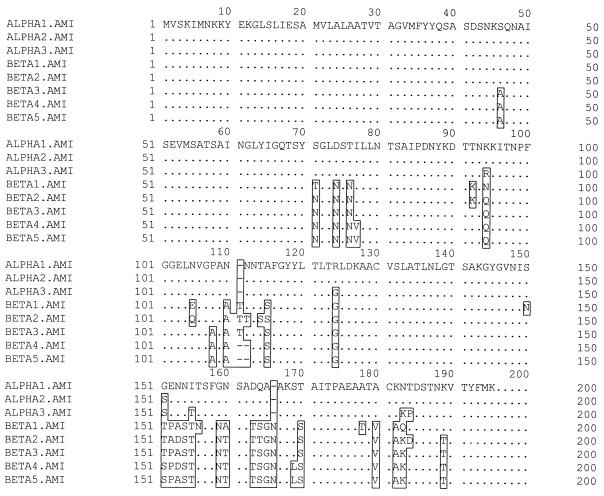
FIG. 1
FIG. 1
Variable amino acids are clustered in prebundlin. An alignment of the prebundlin amino acid sequences encoded by the eight bfpA alleles described in this study is shown. Note that amino acids 1 to 13 comprise the cleaved leader peptide. The α1 (ALPHA1.AMI) prebundlin prototype sequence is listed on the top line. In the remaining seven sequences (ALPHA2.AMI through ALPHA3.AMI and BETA1.AMI through BETA5.AMI), invariant amino acids are indicated by dots. Variant amino acids are boxed and indicated by single-letter abbreviations.
FIG. 2
FIG. 2
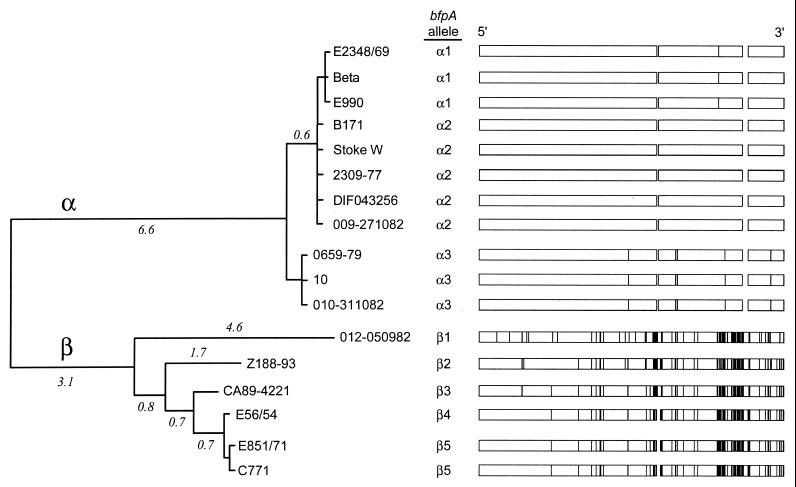
Eight bfpA alleles cluster into two major groups. To the left is a phylogenetic tree for the bfpA gene from 17 EPEC strains constructed by the neighbor-joining algorithm based on the gamma distance with α = 2. Branch lengths in terms of nucleotide substitutions per 100 sites are given above the major branches. Allele designations are listed for each strain. To the right is a graph of the locations of polymorphic nucleotide sites, which are marked as vertical lines that indicate nucleotides differing from those of the α2 allele at each position. Gaps indicate codons absent from specific alleles.
FIG. 3
FIG. 3
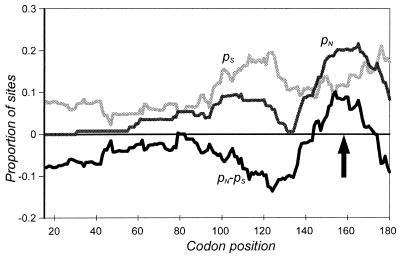
Evidence for diversifying selection near the 3′ end of the bfpA gene. A sliding-window plot of the proportions of synonymous and nonsynonymous sites (pS and pN, respectively) that have mutated among eight bfpA alleles is shown. The difference (pNpS) is a measure of the level of selective constraint on various parts of the molecule. Note that pNpS > 0 for codons 143 to 174 (indicated by the arrow), a pattern consistent with the effect of diversifying selection.
FIG. 4
FIG. 4
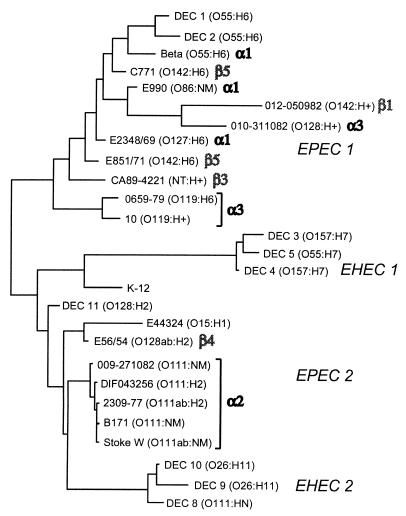
The alleles of bfpA identified in EPEC strains do not correlate precisely with the overall clonal lineage. Shown is a dendrogram of genetic relationships of EPEC strains from this study and representative DEC strains (79). The genetic distance was estimated in terms of electrophoretically detectable codon differences per enzyme locus for 20 enzymes. Previously identified DEC clusters (EPEC 1 and 2 and EHEC 1 and 2) are indicated (54, 78). Strain serotypes are in parentheses. Alleles of bfpA identified in specific EPEC strains are displayed in large, shaded type.
FIG. 5
FIG. 5
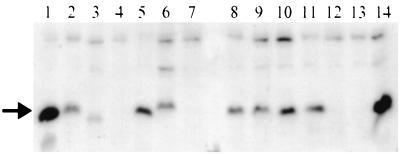
Immunoblot of bundlin protein from EPEC whole-cell extracts. The arrow indicates the position of bundlin. The extracts are from the following strains: lane 1, E2348/69; lane 2, 0659-79; lane 3, E851/71; lane 4, 2309-77; lane 5, 10; lane 6, 012-050982; lane 7, 009-271082; lane 8, 010-311082; lane 9, DIF043256; lane 10, β; lane 11, Stoke W; lane 12, E56/54; lane 13, C771; lane 14, E990. The remaining strains exhibited detectable bundlin but are not shown here.
FIG. 6
FIG. 6
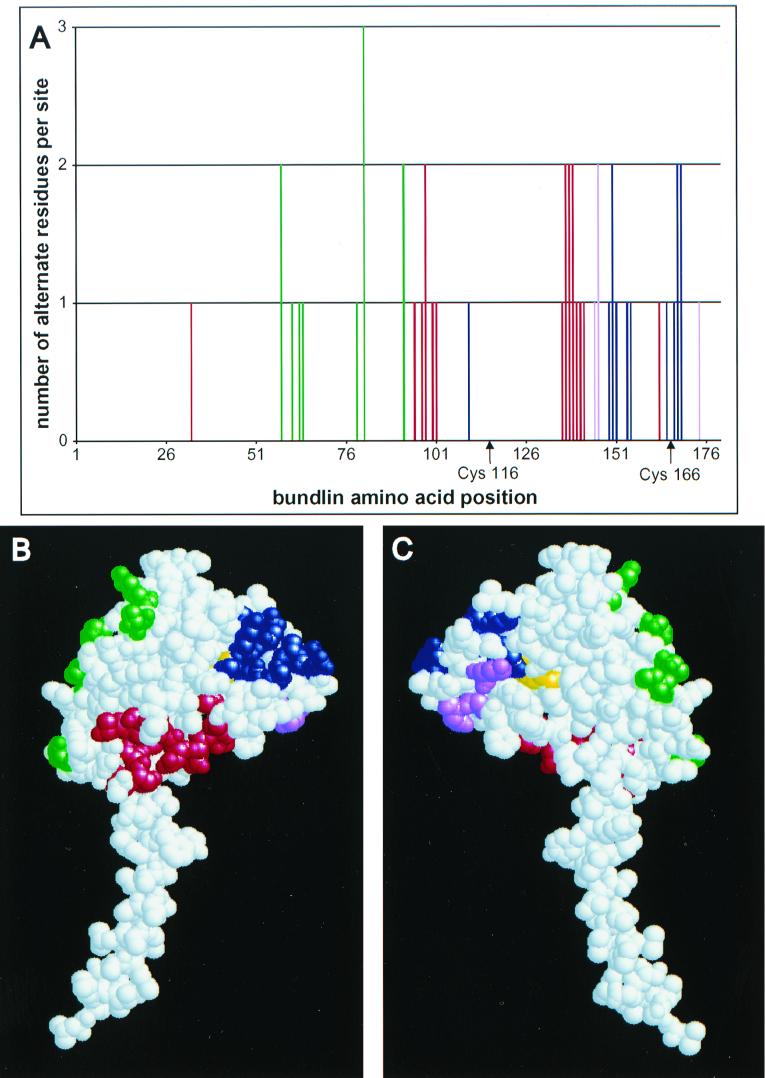
Variable amino acids may be clustered on the surface of bundlin. (A) Graphical analysis of bundlin variation. The bars represent amino acid residues that vary among the eight bundlin types identified in this study. The heights of the bars are proportional to the numbers of alternate residues per site. The positions of conserved cysteine residues are indicated below the x axis. (B and C) Theoretical 3D structure of bundlin (Chattopadhyaya and Ghose, unpublished). Colored amino acid residues are those that vary between bundlin types. These residues have been assigned to four color groups (green, red, blue, and violet) in accordance with their relative locations in the molecule. These colors correspond to those displayed in the graph (A). The disulfide-bonded cysteines are yellow. Panel B shows the convex face of bundlin that is likely to be facing outward on the surface of the BPF filament. Panel C shows the flattened face on the opposite side of the molecule that is likely to be facing toward the center of the filament, based on existing models of gonococcal and V. cholerae pili.

References

    1. Aho E L, Botten J W, Hall R J, Larson M K, Ness J K. Characterization of a class II pilin expression locus from Neisseria meningitidis: evidence for increased diversity among pilin genes in pathogenic Neisseria species. Infect Immun. 1997;65:2613–2620. - PMC - PubMed
    1. Anantha R P, Stone K D, Donnenberg M S. Effects of bfp mutations on biogenesis of functional enteropathogenic Escherichia coli type IV pili. J Bacteriol. 2000;182:2498–2506. - PMC - PubMed
    1. Baldini M M, Kaper J B, Levine M M, Candy D C, Moon H W. Plasmid-mediated adhesion in enteropathogenic Escherichia coli. J Pediatr Gastroenterol Nutr. 1983;2:534–538. - PubMed
    1. Beaudry M, Zhu C, Fairbrother J M, Harel J. Genotypic and phenotypic characterization of Escherichia coli isolates from dogs manifesting attaching and effacing lesions. J Clin Microbiol. 1996;34:144–148. - PMC - PubMed
    1. Bieber D, Ramer S W, Wu C Y, Murray W J, Tobe T, Fernandez R, Schoolnik G K. Type IV pili, transient bacterial aggregates, and virulence of enteropathogenic Escherichia coli. Science. 1998;280:2114–2118. - PubMed

Associated data

LinkOut - more resources