


Extent and distribution of linkage disequilibrium in three genomic regions
- PMID: 11083947
- PMCID: PMC1234912
- DOI: 10.1086/316944
Extent and distribution of linkage disequilibrium in three genomic regions
Abstract
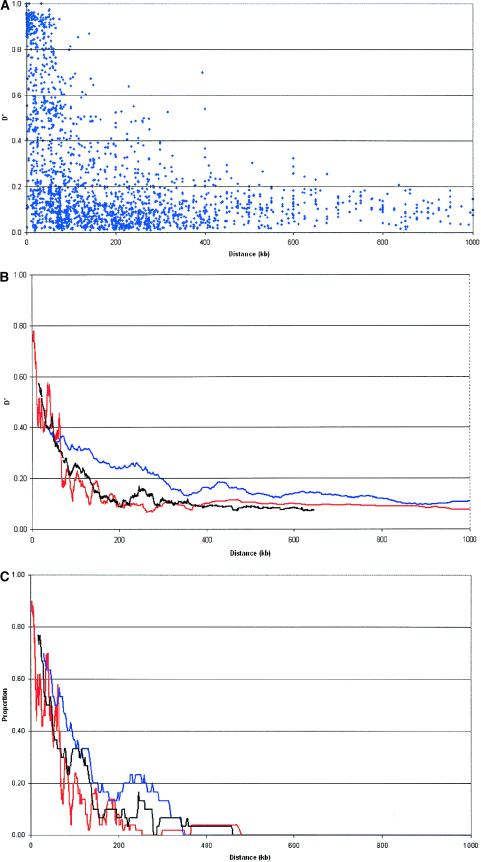
The positional cloning of genes underlying common complex diseases relies on the identification of linkage disequilibrium (LD) between genetic markers and disease. We have examined 127 polymorphisms in three genomic regions in a sample of 575 chromosomes from unrelated individuals of British ancestry. To establish phase, 800 individuals were genotyped in 160 families. The fine structure of LD was found to be highly irregular. Forty-five percent of the variation in disequilibrium measures could be explained by physical distance. Additional factors, such as allele frequency, type of polymorphism, and genomic location, explained <5% of the variation. Nevertheless, disequilibrium was occasionally detectable at 500 kb and was present for over one-half of marker pairs separated by <50 kb. Although these findings are encouraging for the prospects of a genomewide LD map, they suggest caution in interpreting localization due to allelic association.
Figures

References
Electronic-Database Information
-
- Anonymous FTP, ftp://watson.hgen.pitt.edu/pub/simwalk2 (for SIMWALK2)
-
- Asthma Genetics, http://www.well.ox.ac.uk/asthma/ (for a full set of estimated haplotypes)
-
- GOLD, http://www.well.ox.ac.uk/asthma/GOLD (for GOLD software)
References
-
- Abecasis GR, Cookson WO (2000) GOLD—graphical overview of linkage disequilibrium. Bioinformatics 16:182–183 - PubMed
-
- Bhattacharyya S (1998) Dissecting the genetics of asthma. University of Oxford Press, Oxford
Publication types
MeSH terms
LinkOut - more resources
Full Text Sources
Other Literature Sources
Research Materials
