. 2000 Dec 5;97(25):13818-23.
doi: 10.1073/pnas.250379497.

Functional muscle ischemia in neuronal nitric oxide synthase-deficient skeletal muscle of children with Duchenne muscular dystrophy

Affiliations

Functional muscle ischemia in neuronal nitric oxide synthase-deficient skeletal muscle of children with Duchenne muscular dystrophy

M Sander et al. Proc Natl Acad Sci U S A. .

Abstract

Duchenne muscular dystrophy (DMD) is a fatal disease caused by mutation of the gene encoding the cytoskeletal protein dystrophin. Despite a wealth of recent information about the molecular basis of DMD, effective treatment for this disease does not exist because the mechanism by which dystrophin deficiency produces the clinical phenotype is unknown. In both mouse and human skeletal muscle, dystrophin deficiency results in loss of neuronal nitric oxide synthase, which normally is localized to the sarcolemma as part of the dystrophin-glycoprotein complex. Recent studies in mice suggest that skeletal muscle-derived nitric oxide may play a key role in the regulation of blood flow within exercising skeletal muscle by blunting the vasoconstrictor response to alpha-adrenergic receptor activation. Here we report that this protective mechanism is defective in children with DMD, because the vasoconstrictor response (measured as a decrease in muscle oxygenation) to reflex sympathetic activation was not blunted during exercise of the dystrophic muscles. In contrast, this protective mechanism is intact in healthy children and those with polymyositis or limb-girdle muscular dystrophy, muscle diseases that do not result in loss of neuronal nitric oxide synthase. This clinical investigation suggests that unopposed sympathetic vasoconstriction in exercising human skeletal muscle may constitute a heretofore unappreciated vascular mechanism contributing to the pathogenesis of DMD.


Figures
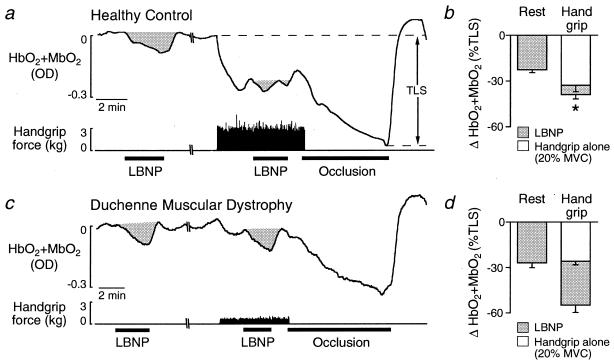
Figure 1
Figure 1
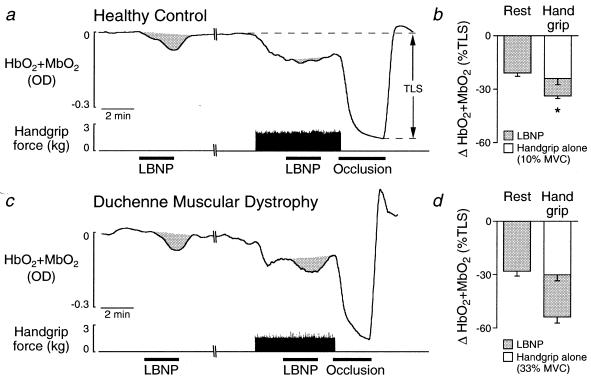
Effect of handgrip at the same relative workload on the decreases in muscle oxygenation (HbO2 + MbO2) elicited by reflex sympathetic activation by using LBNP. (a and c) In the healthy boy, the robust LBNP-induced decrease in muscle oxygenation in resting forearm was greatly diminished during forearm exercise. In contrast, in the boy with DMD, LBNP produced similar decreases in muscle oxygenation in resting and exercising forearm. Complete forearm vascular occlusion was used to maximally decrease tissue oxygenation to determine the total labile signal (TLS). OD, optical density. (b and d) Summary data showing LBNP-induced decreases in muscle oxygenation in resting and exercising forearm in (b) 12 healthy controls and (d) 9 boys with DMD. *, P < 0.05, LBNP at rest vs. handgrip.
Figure 2
Figure 2
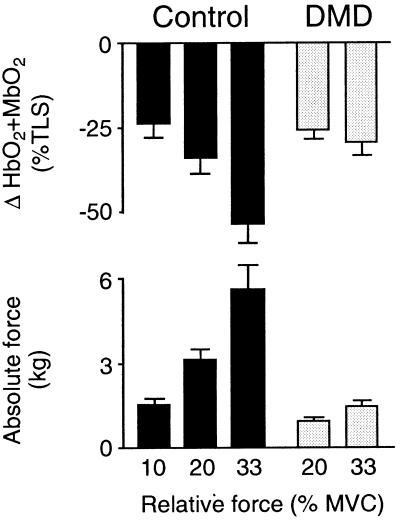
Decreases in forearm muscle oxygenation (HbO2 + MbO2) in response to handgrip alone. In both healthy controls and boys with DMD, handgrip produced intensity-dependent decreases in forearm muscle oxygenation. Because the controls were much stronger than the DMD patients, handgrip at the same relative workload decreased muscle oxygenation to a greater extent in the controls than in patients. However, handgrip at the same absolute workload produced similar decreases in muscle oxygenation in the two groups. Control, n = 12 at 10 and 20% MVC, n = 7 at 33% MVC; DMD, n = 9.
Figure 3
Figure 3
Effect of handgrip at similar absolute workloads on the decreases in muscle oxygenation (HbO2 + MbO2) elicited by reflex sympathetic activation by using LBNP. (a and c) In the healthy boy, the decrease in muscle oxygenation elicited by LBNP in resting forearm was greatly attenuated during forearm exercise at 10% MVC. In the boy with DMD, LBNP elicited similar decreases in muscle oxygenation in the forearm at rest and during exercise at 33% MVC. TLS, total labile signal. (b and d) Summary data showing LBNP-induced decreases in muscle oxygenation in resting and exercising forearm in (b) 12 healthy controls and (d) 9 boys with DMD. *, P < 0.05, LBNP at rest vs. handgrip.
Figure 4
Figure 4
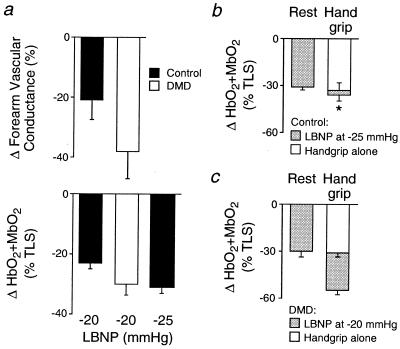
Decreases in forearm vascular conductance and muscle oxygenation (HbO2 + MbO2) elicited by reflex sympathetic activation by using LBNP. (a) The same level of LBNP produced a slightly greater vasoconstrictor response in the DMD patients than in controls. Controls, n = 8; DMD, n = 5. (b and c) In resting forearm, LBNP at −25 mmHg in the controls (b) produced decreases in muscle oxygenation comparable to LBNP at −20 mmHg in the DMD patients (c). In contracting forearm, the LBNP-induced decreases in muscle oxygenation were greatly attenuated in the controls, but not in the DMD patients. Controls, n = 7; DMD, n = 8; *, P < 0.05, LBNP at rest vs. handgrip.
Figure 5
Figure 5
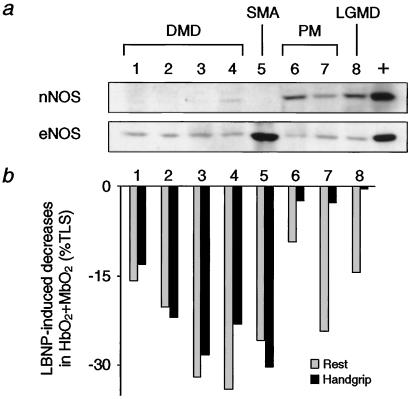
Correspondence between skeletal muscle nNOS and blunted vasoconstriction in exercising forearm. (a) Immunoblots of skeletal muscle biopsy samples from children with DMD, SMA, PM, or LGMD. Blots were probed for nNOS, eNOS, and iNOS (not detected in any sample). +, positive control. (b) Sympathetic vasoconstriction, as assessed by LBNP-induced decreases in muscle oxygenation, in resting and exercising forearm measured in the same children whose biopsies were analyzed in a. Vasoconstrictor responses were not attenuated in exercising forearm in children with DMD or SMA, but were greatly attenuated in those with PM or LGMD.

Comment in

References

    1. Hoffman E P, Brown R H, Jr, Kunkel L M. Cell. 1987;51:919–928. - PubMed
    1. Petrof B J, Shrager J B, Stedman H H, Kelly A M, Sweeney H L. Proc Natl Acad Sci USA. 1993;90:3710–3714. - PMC - PubMed
    1. Rafael J A, Townsend E R, Squire S E, Potter A C, Chamberlain J S, Davies K E. Hum Mol Genet. 2000;9:1357–1367. - PubMed
    1. Hack A A, Cordier L, Shoturma D I, Lam M Y, Sweeney H L, McNally E M. Proc Natl Acad Sci USA. 1999;96:10723–10728. - PMC - PubMed
    1. Grady D, Rubin S M, Petitti D B, Fox C S, Cummings V L. Ann Intern Med. 1992;117:1016–1037. - PubMed

Publication types

Substances

LinkOut - more resources