


Review
doi: 10.1073/pnas.97.24.12933.
Calcium signaling and acute pancreatitis: specific response to a promiscuous messenger
Affiliations
- PMID: 11087843
- PMCID: PMC34065
- DOI: 10.1073/pnas.97.24.12933
Item in Clipboard
Review
Calcium signaling and acute pancreatitis: specific response to a promiscuous messenger
Proc Natl Acad Sci U S A.
.
No abstract available
Figures
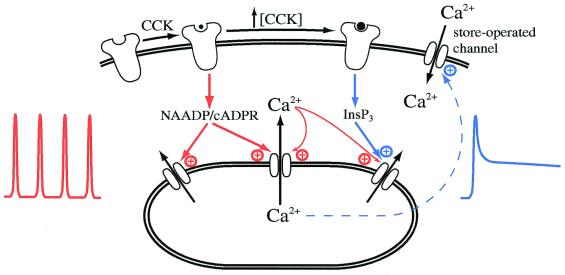
Model for calcium signaling after activation of cholecystokinin
receptors. Low (physiological) levels of cholecystokinin utilize mainly
the NAADP/cADPR pathway. Calcium release by cADPR acting on an open
ryanodine-sensitive receptor exerts positive feedback on the receptor
as well as adjacent ones, resulting in regenerative calcium-induced
calcium release and thus oscillations in intracellular free calcium
concentration. This pathway is shown in red. Calcium release by cADPR
can also interact synergistically with InsP3 to facilitate
further calcium release via open InsP3 receptors. However,
physiological levels of cholecystokinin do not increase the levels of
InsP3. Higher concentrations of cholecystokinin trigger a
robust increase in InsP3, and this results in calcium
mobilization from InsP3-sensitive calcium stores. The fall
in calcium concentration within the stores activates store-operated
calcium entry that underlies the sustained phase of the calcium signal
under these conditions. This pathway is shown in blue. The calcium
entry and not the oscillatory response results in the premature
activation of trypsin within the zymogen granules.
Comment on
-
Calcium-dependent enzyme activation and vacuole formation in the apical granular region of pancreatic acinar cells.Proc Natl Acad Sci U S A. 2000 Nov 21;97(24):13126-31. doi: 10.1073/pnas.97.24.13126. Proc Natl Acad Sci U S A. 2000. PMID: 11087863 Free PMC article.
References
-
- Woods N M, Cuthbertson K S, Cobbold P H. Nature (London) 1986;319:600–602. - PubMed
-
- Jacob R, Merritt J E, Hallam T J, Rink T J. Nature (London) 1988;335:40–45. - PubMed
-
- Tsien R W, Tsien R Y. Annu Rev Cell Biol. 1990;6:715–760. - PubMed
-
- Thomas A P, Bird G S J, Hajnoczky G, Robb-Gaspers L D, Putney J W. FASEB J. 1996;10:1505–1517. - PubMed
Publication types
MeSH terms
Substances
LinkOut - more resources
Full Text Sources
Medical
