


Teaching residents evidence-based medicine skills: a controlled trial of effectiveness and assessment of durability
- PMID: 11089714
- PMCID: PMC1495601
- DOI: 10.1046/j.1525-1497.2000.91026.x
Teaching residents evidence-based medicine skills: a controlled trial of effectiveness and assessment of durability
Abstract
Objectives: To measure the effectiveness of an educational intervention designed to teach residents four essential evidence-based medicine (EBM) skills: question formulation, literature searching, understanding quantitative outcomes, and critical appraisal.
Design: Firm-based, controlled trial.
Setting: Urban public hospital.
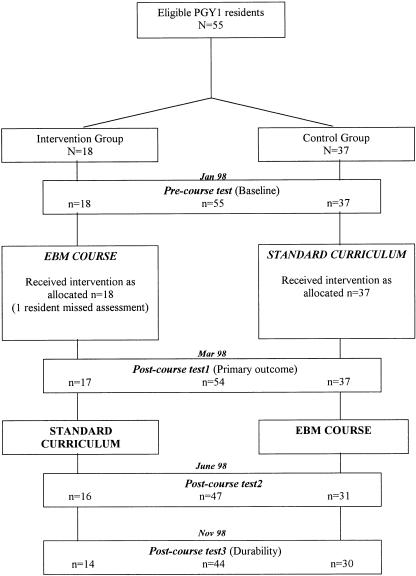
Participants: Fifty-five first-year internal medicine residents: 18 in the experimental group and 37 in the control group.
Intervention: An EBM course, taught 2 hours per week for 7 consecutive weeks by senior faculty and chief residents focusing on the four essential EBM skills.
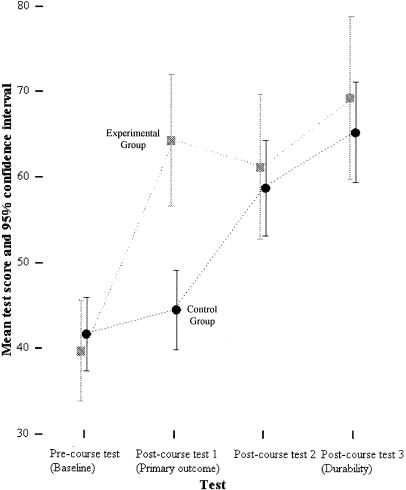
Measurements and main results: The main outcome measure was performance on an EBM skills test that was administered four times over 11 months: at baseline and at three time points postcourse. Postcourse test 1 assessed the effectiveness of the intervention in the experimental group (primary outcome]; postcourse test 2 assessed the control group after it crossed over to receive the intervention; and postcourse test 3 assessed durability. Baseline EBM skills were similar in the two groups. After receiving the EBM course, the experimental group achieved significantly higher postcourse test scores (adjusted mean difference, 21%; 95% confidence interval, 13% to 28%; P < .001). Postcourse improvements were noted in three of the four EBM skill domains (formulating questions, searching, and quantitative understanding [P < .005 for all], but not in critical appraisal skills [P = .4]). After crossing over to receive the educational intervention, the control group achieved similar improvements. Both groups sustained these improvements over 6 to 9 months of follow-up.
Conclusions: A brief structured educational intervention produced substantial and durable improvements in residents' cognitive and technical EBM skills.
Figures
References
-
- Williams BC, Stern DT. Exploratory study of residents' conceptual framework for critical appraisal of the literature. Teaching and Learning in Medicine. 1997;9:270–75. - PubMed
-
- Stern DT, Linzer M, O'sullivan PS, Weld L. Evaluating medical residents' literature appraisal skills. Acad Med. 1995;70:152–4. - PubMed
-
- Kitchens JM, Pfeifer MP. Teaching residents to read the medical literature: a controlled trial of curriculum in critical appraisal/clinical epidemiology. J Gen Intern Med. 1989;4:384–7. - PubMed
Publication types
MeSH terms
LinkOut - more resources
Full Text Sources