


Differential vasoconstrictor activity of human urotensin-II in vascular tissue isolated from the rat, mouse, dog, pig, marmoset and cynomolgus monkey
- PMID: 11090097
- PMCID: PMC1572453
- DOI: 10.1038/sj.bjp.0703690
Differential vasoconstrictor activity of human urotensin-II in vascular tissue isolated from the rat, mouse, dog, pig, marmoset and cynomolgus monkey
Abstract
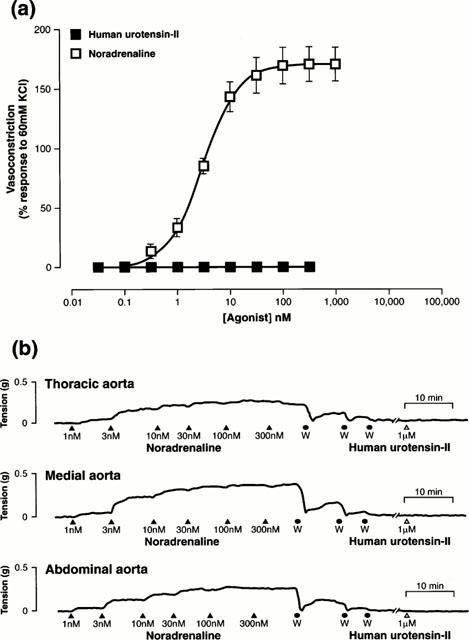
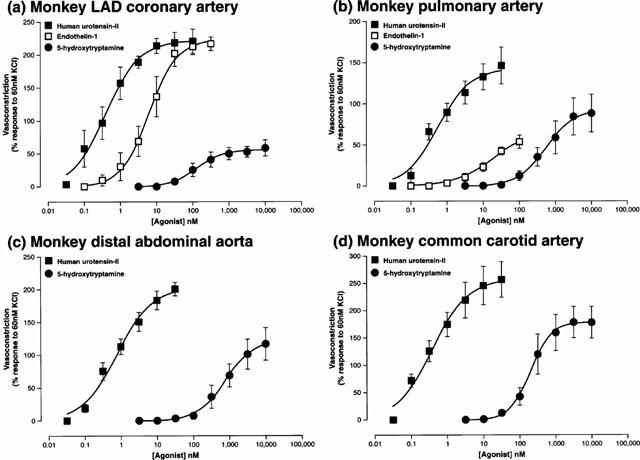
1. Urotensin-II (U-II) and its G-protein-coupled receptor, GPR14, are expressed within mammalian cardiac and peripheral vascular tissue and, as such, may regulate mammalian cardiovascular function. The present study details the vasoconstrictor profile of this cyclic undecapeptide in different vascular tissues isolated from a diverse range of mammalian species (rats, mice, dogs, pigs, marmosets and cynomolgus monkeys). 2. The vasoconstrictor activity of human U-II was dependent upon the anatomical origin of the vessel studied and the species from which it was isolated. In the rat, constrictor responses were most pronounced in thoracic aortae and carotid arteries: -log[EC(50)]s 9.09+/-0.19 and 8.84+/-0.21, R(max)s 143+/-21 and 67+/-26% 60 mM KCl, respectively (compared, for example, to -log[EC(50)] 7.90+/-0.11 and R(max) 142+/-12% 60 mM KCl for endothelin-1 [ET-1] in thoracic aortae). Responses were, however, absent in mice aortae (-log[EC(50)] <6.50). These findings were further contrasted by the observation that U-II was a 'coronary-selective' spasmogen in the dog (-log[EC(50)] 9.46+/-0.11, R(max) 109+/-23% 60 mM KCl in LCX coronary artery), yet exhibited a broad spectrum of vasoconstrictor activity in arterial tissue from Old World monkeys (-log[EC(50)]s range from 8.96+/-0.15 to 9.92+/-0.13, R(max)s from 43+/-16 to 527+/-135% 60 mM KCl). Interestingly, significant differences in reproducibility and vasoconstrictor efficacy were seen in tissue from pigs and New World primates (vessels which responded to noradrenaline, phenylephrine, KCl or ET-1 consistently). 3. Thus, human U-II is a potent, efficacious vasoconstrictor of a variety of mammalian vascular tissues. Although significant species/anatomical variations exist, the data support the hypothesis that U-II influences the physiological regulation of mammalian cardiovascular function.
Figures




References
-
- AMES R.S., SARAU H.M., CHAMBERS J.K., WILLETTE R.N., AIYAR N.V., ROMANIC A.M., LOUDEN C.S., FOLEY J.J., SAUERMELCH C.F., COATNEY R.W., AO Z., DISA J., HOLMES S.D., STADEL J.M., MARTIN J.D., LIU W.-S., GLOVER G.I., WILSON S., MCNULTY D.E., ELLIS C.E., ELSHOURBAGY N.A., SHABON U., TRILL J.J., HAY D.W.P., OHLSTEIN E.H., BERGSMA D.J., DOUGLAS S.A. Human urotensin-II is a potent vasoconstrictor and agonist for the orphan receptor GPR14. Nature. 1999;401:282–286. - PubMed
-
- BERN H.A., LEDERIS K. A reference preparation for the study of active substances in the caudal neurosecretory system of teleosts. J. Endocrinol. 1969;45:11–12. - PubMed
-
- BERN H.A., PEARSON D., LARSON B.A., NISHIOKA R.S. Neurohormones from fish tails: the caudal neurosecretory system. I. “Urophysiology” and the caudal neurosecretory system of fishes. Recent Prog. Horm. Res. 1985;41:533–552. - PubMed
-
- CONLON M.J., TOSTIVINT H., VAUDRY H. Somatostatin- and urotensin II-related peptides: molecular diversity and evolutionary perspectives. Reg. Peptides. 1997;69:95–103. - PubMed
MeSH terms
Substances
LinkOut - more resources
Full Text Sources
Other Literature Sources
Molecular Biology Databases
