. 2000 Nov 15;14(22):2869-80.
doi: 10.1101/gad.849600.

Transgene integration into the same chromosome location can produce alleles that express at a predictable level, or alleles that are differentially silenced

Affiliations

Transgene integration into the same chromosome location can produce alleles that express at a predictable level, or alleles that are differentially silenced

C D Day et al. Genes Dev. .

Abstract

In an effort to control the variability of transgene expression in plants, we used Cre-lox mediated recombination to insert a gus reporter gene precisely and reproducibly into different target loci. Each integrant line chosen for analysis harbors a single copy of the transgene at the designated target site. At any given target site, nearly half of the insertions give a full spatial pattern of transgene expression. The absolute level of expression, however, showed target site dependency that varied up to 10-fold. This substantiates the view that the chromosome position can affect the level of gene expression. An unexpected finding was that nearly half of the insertions at any given target site failed to give a full spatial pattern of transgene expression. These partial patterns of expression appear to be attributable to gene silencing, as low gus expression correlates with DNA methylation and low transcription. The methylation is specific for the newly integrated DNA. Methylation changes are not found outside of the newly inserted DNA. Both the full and the partial expression states are meiotically heritable. The silencing of the introduced transgenes may be a stochastic event that occurs during transformation.


Figures
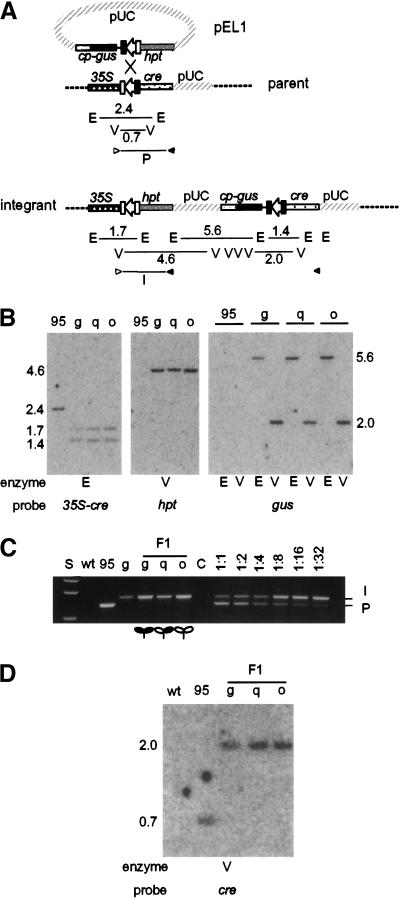
Figure 1
Figure 1
Precise and stable integration of transgene. (A) Schematic map of the genomic target and the structure produced through integration of pEL1. The lox site is depicted by an open arrow with flanking rectangles that represent the 8-bp core and the flanking 13-bp Cre-binding sites, respectively. (Solid rectangle) Mutant sequence; when present on both sides of the core sequence, the site recombines less efficiently (Albert et al. 1995). Not shown are nos3′ terminator sequences of cre, hpt, and gus. Endonuclease sites shown: E, EcoRI; V, EcoRV. Fragment sizes, in kilobases, correspond to those next to the gels in (B,D). (B) Representative Southern blots of parent 95 and integrant T0 plants, 95g, 95q, and 95o, that show single precise copy pEL1 integration. (C) PCR products specific to parental (P) or F1 integrant (I) DNA detected from individual seedlings. Primers corresponding to 35S (open arrowhead) and nos terminator (solid arrowhead) are shown in A. Primer-only control lane is C. Lanes after C are reconstruction experiments of 95 and 95g DNA mixed, respectively, at ratios from 1:1 to 1:32. Expression of gus is depicted pictorially; solid and open leaves represent active and inactive gus expression, respectively. (D) Southern blot showing stable integration of pEL1 in integrant lines.
Figure 2
Figure 2
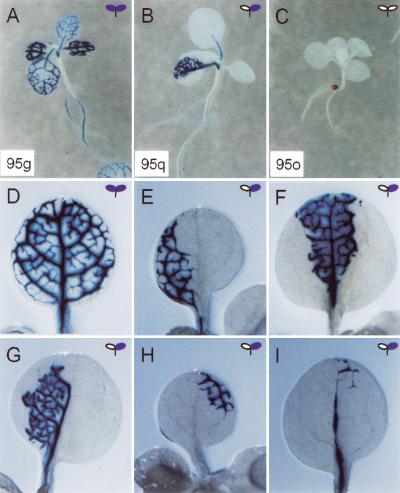
Independent integrants at the same locus show different spatial patterns of gus expression. All seedlings are stained for GUS activity at the two-leaf stage. At the 95 locus, the 95g line has a vascular specific expression characteristic of the Cp promoter (A,D). The 95q line shows sectoring of gus expression (B,E–I), and the 95o line rarely shows gus expression (C).
Figure 3
Figure 3
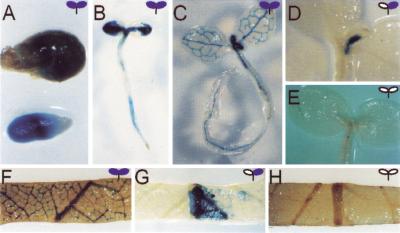
Expression pattern during early stages of seedling development (A–E) and in mature leaves (F–H). Expression in 95g is observed at 3 (A), 7 (B), and 11 (C) days after germination. By day 11, expression is detected in the leaves of 95q (D), but not 95o (E). Expression patterns in mature leaves (adjacent to the inflorescence) of 95g (F), 95q (G), and 95o (H) are consistent with those observed in seedlings.
Figure 4
Figure 4
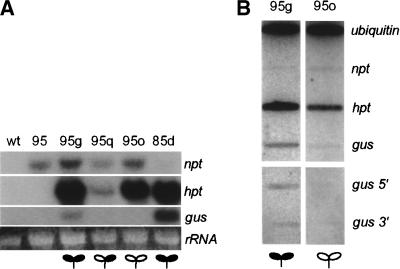
Gene silencing acts at the level of transcription. (A) Steady state mRNA of parental and integrant plants. Probes for nptII, hpt, and gus mRNA were used in Northern blots. Loading control is large ribosomal RNA stained with ethidium bromide. (B) Run-on transcription from leaf nuclei of active and inactive lines. Radioactive transcripts were used to probe target DNA specific for the full-length ubiquitin, nptII, hpt, and gus genes. In an independent experiment, 5′- and 3′-specific regions of the gus gene were used as target DNA (bottom). The run-on transcripts from the 95g and 95o nuclei were hybridized to the target DNA and the signals from each filter were normalized relative to the ubiquitin signal.
Figure 5
Figure 5
Methylation analysis of active and inactive integrant lines at the 95, 93, and 911 target sites. (A) Predicted DNA fragments, in basepairs, of Cp-gus from cleavage with EcoRV and EcoRI and either BglII, Sau3A, or HpaII. Southern blots reveal the fragments hybridizing to a Cp-gus 5′ fragment probe (for BglII and Sau3A panels) or a gus 3′ fragment probe (for HpaII panel). Leftmost control lanes were not cleaved with BglII, Sau3A, or HpaII. Numbers next to autoradiograms correspond to sizes of predicted fragments (bp). Endonuclease sites shown are as follows: B, BglII; E, EcoRI; H, HpaII; S, Sau3A; V, EcoRV. (B) Predicted DNA fragments, in basepairs, of lox-cre after cleavage with EcoRV, EcoRI, and HpaII and detected by hybridization to a cre probe. Outermost control lanes were not cleaved with HpaII.
Figure 6
Figure 6
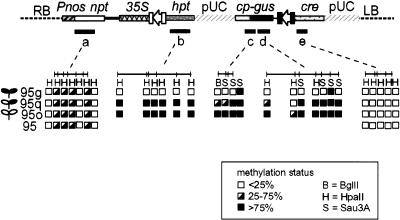
Methylation patterns in parental and integrant lines. Summary of methylation analysis at specific restriction sites in 95 and integrant lines 95g, 95q, and 95o. Specific probes (a, b, c, d, e) represent nptII, hpt, Cp-gus 5′ fragment, gus 3′ fragment and cre, respectively. (RB and LB) the positions of the T-DNA right border and left border, respectively. Endonuclease sites are as follows: S, Sau3A; B, BglII; H, HpaII.
Figure 7
Figure 7
Reactivation of Cp-gus expression in 95o by DNA methylation and acetylation inhibitors. (A) GUS activity from untreated cotyledons from the active line 95g. (B) Na butyrate–treated cotyledons from the inactive line 95o shows slight reactivation of expression. (C–H) Leaves of 95o treated with 5-azacytidine (C–E) or Na butyrate (F–H). Seedlings were grown on agar with 0.6 mM Na butyrate or 19 mg/L 5-azacytidine.

References

    1. Albert H, Dale EC, Lee E, Ow DW. Site-specific integration of DNA into wild-type and mutant lox sites placed in the plant genome. Plant J. 1995;7:649–659. - PubMed
    1. Assaad FF, Tucker KL, Signer ER. Epigenetic repeat-induced gene silencing RIGS in Arabidopsis. Plant Mol Biol. 1993;22:1067–1085. - PubMed
    1. Bestor TH, Tycko B. Creation of genomic methylation patterns. Nat Genet. 1996;12:363–367. - PubMed
    1. Cogoni C, Macino G. Homology-dependent gene silencing in plants and fungi: A number of variations on the same theme. Curr Opin Microbiol. 1999;2:657–662. - PubMed
    1. Cubas P, Vincent C, Coen E. An epigenetic mutation responsible for natural variation in floral symmetry. Nature. 1999;401:157–161. - PubMed

Publication types

LinkOut - more resources