


Vav3 mediates receptor protein tyrosine kinase signaling, regulates GTPase activity, modulates cell morphology, and induces cell transformation
- PMID: 11094073
- PMCID: PMC102179
- DOI: 10.1128/MCB.20.24.9212-9224.2000
Vav3 mediates receptor protein tyrosine kinase signaling, regulates GTPase activity, modulates cell morphology, and induces cell transformation
Abstract
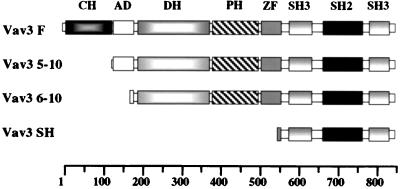
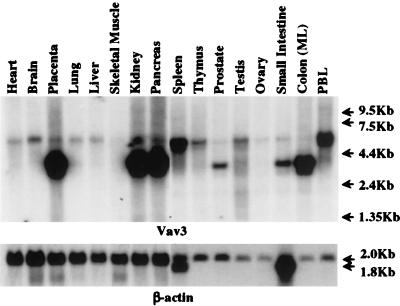
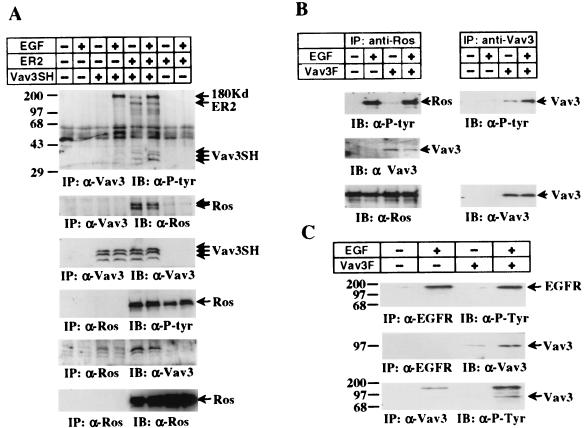
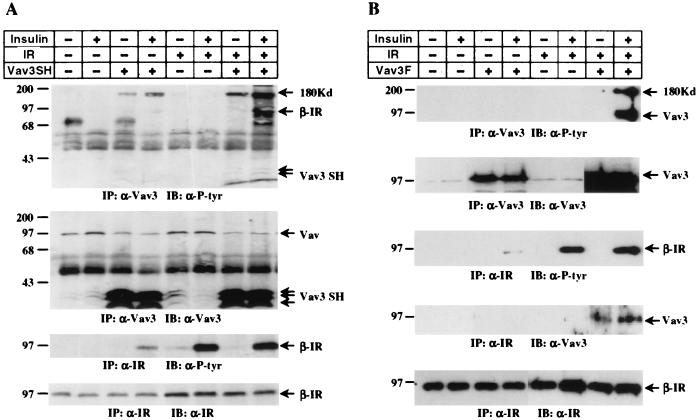
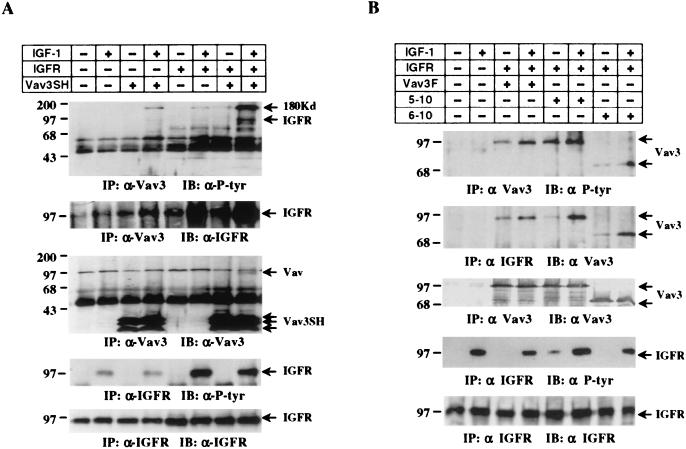
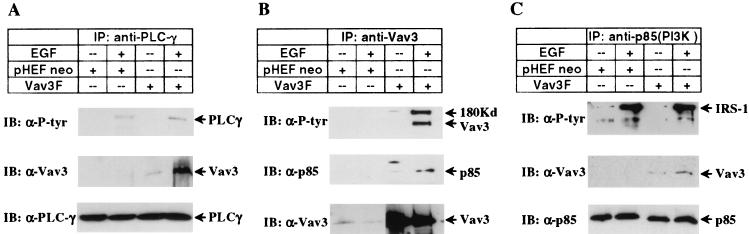
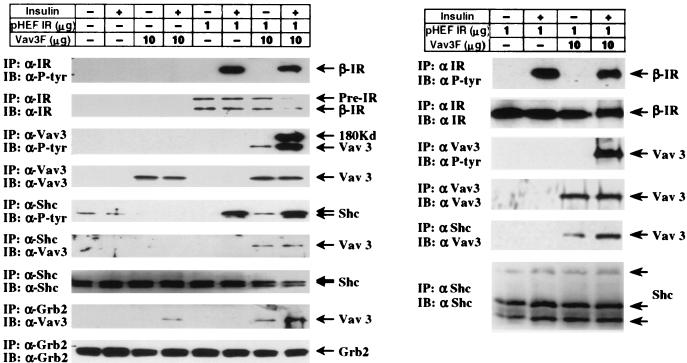
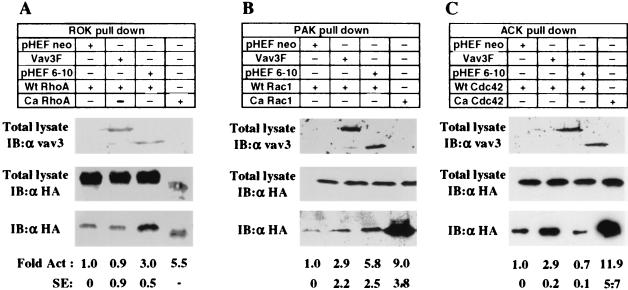
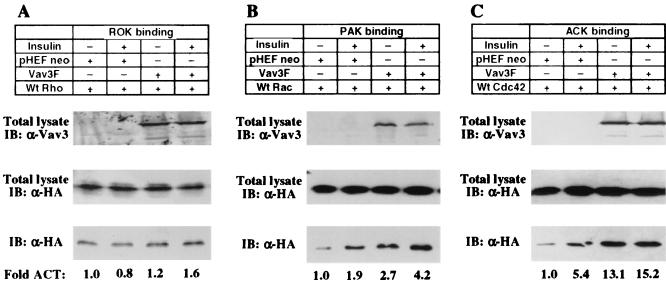
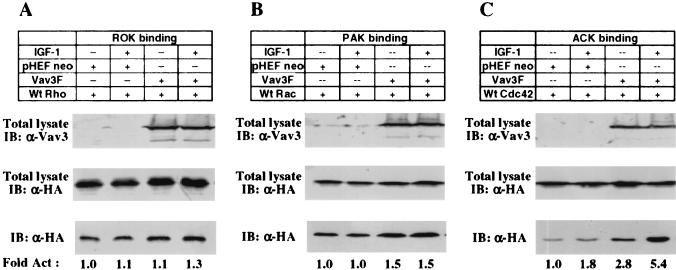
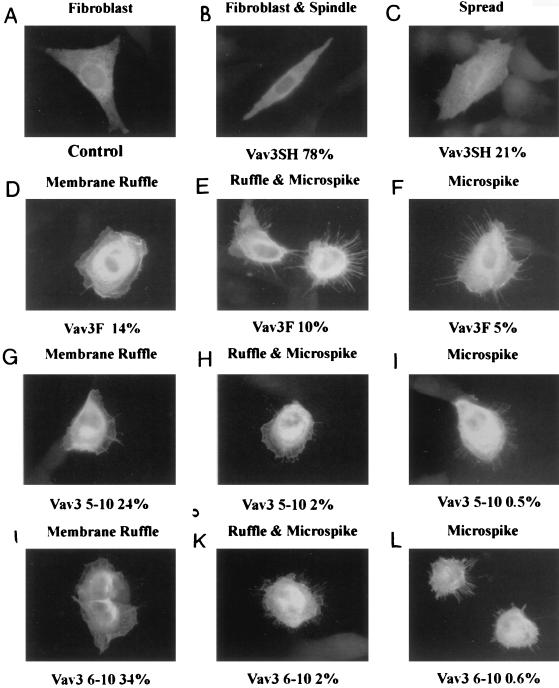
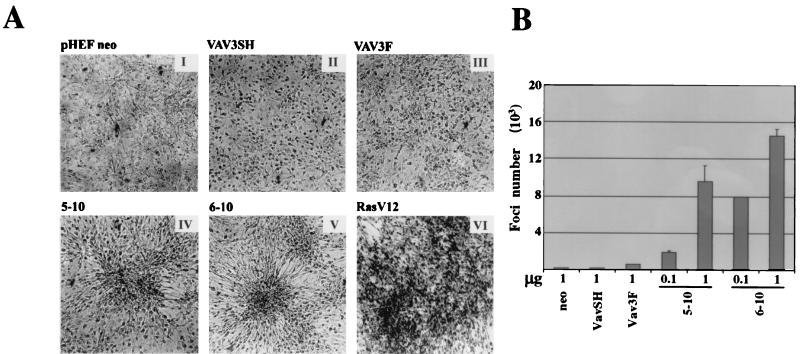
A recently reported new member of the Vav family proteins, Vav3 has been identified as a Ros receptor protein tyrosine kinase (RPTK) interacting protein by yeast two-hybrid screening. Northern analysis shows that Vav3 has a broad tissue expression profile that is distinct from those of Vav and Vav2. Two species of Vav3 transcripts, 3.4 and 5.4 kb, were detected with a differential expression pattern in various tissues. Transient expression of Vav in 293T and NIH 3T3 cells demonstrated that ligand stimulation of several RPTKs (epidermal growth factor receptor [EGFR], Ros, insulin receptor [IR], and insulin-like growth factor I receptor [IGFR]) led to tyrosine phosphorylation of Vav3 and its association with the receptors as well as their downstream signaling molecules, including Shc, Grb2, phospholipase C (PLC-gamma), and phosphatidylinositol 3 kinase. In vitro binding assays using glutathione S-transferase-fusion polypeptides containing the GTPase-binding domains of Rok-alpha, Pak, or Ack revealed that overexpression of Vav3 in NIH 3T3 cells resulted in the activation of Rac-1 and Cdc42 whereas a deletion mutant lacking the N-terminal calponin homology and acidic region domains activated RhoA and Rac-1 but lost the ability to activate Cdc42. Vav3 induced marked membrane ruffles and microspikes in NIH 3T3 cells, while the N-terminal truncation mutants of Vav3 significantly enhanced membrane ruffle formation but had a reduced ability to induce microspikes. Activation of IR further enhanced the ability of Vav3 to induce membrane ruffles, but IGFR activation specifically promoted Vav3-mediated microspike formation. N-terminal truncation of Vav3 activated its transforming potential, as measured by focus-formation assays. We conclude that Vav3 mediates RPTK signaling and regulates GTPase activity, its native and mutant forms are able to modulate cell morphology, and it has the potential to induce cell transformation.
Figures
References
-
- Abe K, Rossman K L, Liu B, Ritola K D, Chiang D, Campbell S L, Burridge K, Der C J. Vav2 is an activator of Cdc42, Rac1, and RhoA. J Biol Chem. 2000;275:10141–10149. - PubMed
-
- Bartel P L, Chien C T, Sternglanz R, Fields S. Using the two-hybrid system to detect protein-protein interactions. In: Hartley D A, editor. Cellular interactions in development: a practical approach. Oxford, United Kingdom: Oxford University Press; 1993. pp. 153–179.
-
- Bertagnolo V, Marchisio M, Volinia S, Caramelli E, Capitani S. Nuclear association of tyrosine-phosphorylated Vav to phospholipase C-γ 1 and phosphoinositide 3-kinase during granulocytic differentiation of HL-60 cells. FEBS Lett. 1998;441:480–484. - PubMed
-
- Bubeck Wardenburg J, Pappu R, Bu J Y, Mayer B, Chernoff J, Straus D, Chan A C. Regulation of PAK activation and the T cell cytoskeleton by the linker protein SLP-76. Immunity. 1998;9:607–616. - PubMed
Publication types
MeSH terms
Substances
Grants and funding
LinkOut - more resources
Full Text Sources
Molecular Biology Databases
Research Materials
Miscellaneous
