Review
. 2000;2(1):16-32.
doi: 10.1186/ar66. Epub 1999 Dec 23.

Janus kinases and signal transducers and activators of transcription: their roles in cytokine signaling, development and immunoregulation

Affiliations
Review

Janus kinases and signal transducers and activators of transcription: their roles in cytokine signaling, development and immunoregulation

R A Ortmann et al. Arthritis Res. 2000.

Abstract

Cytokines play a critical role in the normal development and function of the immune system. On the other hand, many rheumatologic diseases are characterized by poorly controlled responses to or dysregulated production of these mediators. Over the past decade tremendous strides have been made in clarifying how cytokines transmit signals via pathways using the Janus kinase (Jak) protein tyrosine kinases and the Signal transducer and activator of transcription (Stat) proteins. More recently, research has focused on several distinct proteins responsible for inhibiting these pathways. It is hoped that further elucidation of cytokine signaling through these pathways will not only allow for a better comprehension of the etiopathogenesis of rheumatologic illnesses, but may also direct future treatment options.


Figures
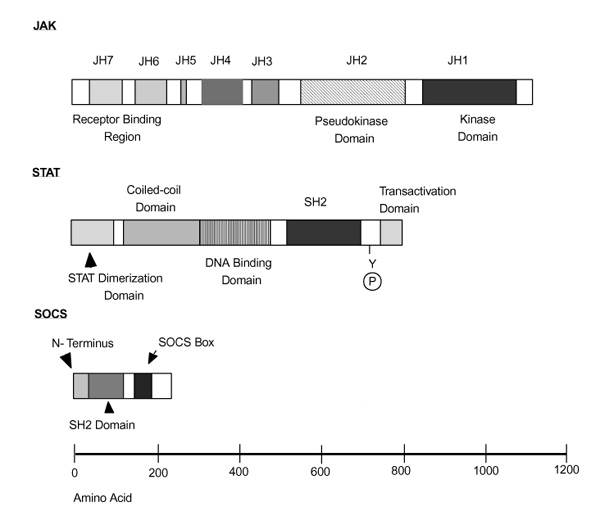
Figure 1
Figure 1
Structure of Janus kinases (Jaks), signal transducers and activators of transcription (Stats), and suppressors of cytokine signaling (SOCS). Regions of homology shared by Jaks have been termed Jak homology (JH) domains. JH1 is a kinase domain and JH2 is a pseudo-kinase domain. The amino-terminus of the Jaks appears to be important for association with cytokine receptors subunits. Stats have a conserved tyrosine residue, phosphorylation of which allows Stat dimerization; a src homology (SH2) domain that mediates the dimerization; and an amino-terminal region that is known to play a role in the dimerization of Stats dimer. The amino-terminal, carboxy-terminal and coiled-coil regions of Stats can interact with other transcription factors. SOCS proteins share a similar strucuture with a central SH2 domain, a region at the amino-terminus that is variable in both length and in amino acid sequence, and a region of homology at the carboxy-terminus termed the 'SOCS box'.
Figure 2
Figure 2
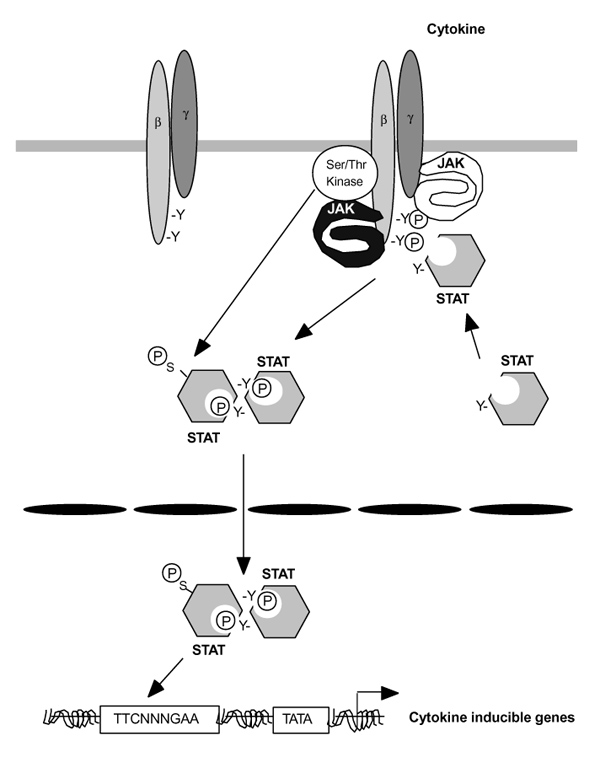
Model for cytokine signal transduction. Cytokines associate with cytokine receptor subunits and activate janus kinases (Jaks). The Jaks in turn phosphorylate tyrosine-based docking sites on the receptor. signal transducers and activators of transcription (Stats) then bind via their src homology (SH)2 domains. The STATs are then phosphorylated by the JAKs, form homo-hetero-dimers and then translocate into the nucleus, where they bind target sequences like γ activated sequence (GAS) motif. Transcriptional activation of genes typically requires the coordinated function of multiple accessory transcription factors. Additionally, serine phosphorylation of some Stats may be important for maximal transcription of target genes.
Figure 3
Figure 3
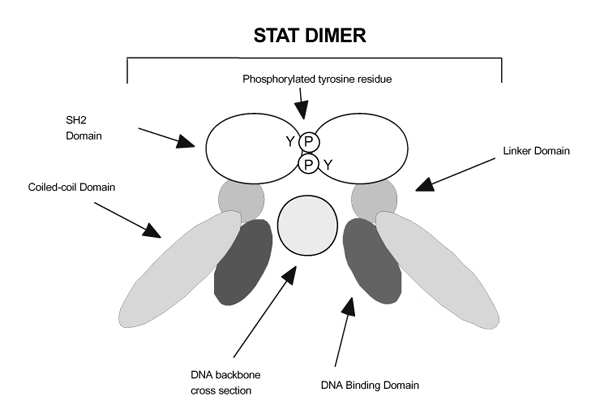
Signal transducer and activator of transcription (Stat) binding to DNA. In this two-dimensional model, the heterodimerized or homodimerized Stat molecule binds to the appropriate DNA sequence via a 'C clamp' structure. Note that in addition to the specificity controlled by the DNA binding domain, other regions of the Stat molecule may also be important in DNA interactions. Tetramerization of the Stats may allow for an even greater degree of stability in DNA binding to adjacent imperfect Stat binding sites; this is mediated by the Stat amino-terminus (not shown). Also not shown in this illustration is the Stat transcriptional activation domain.
Figure 4
Figure 4
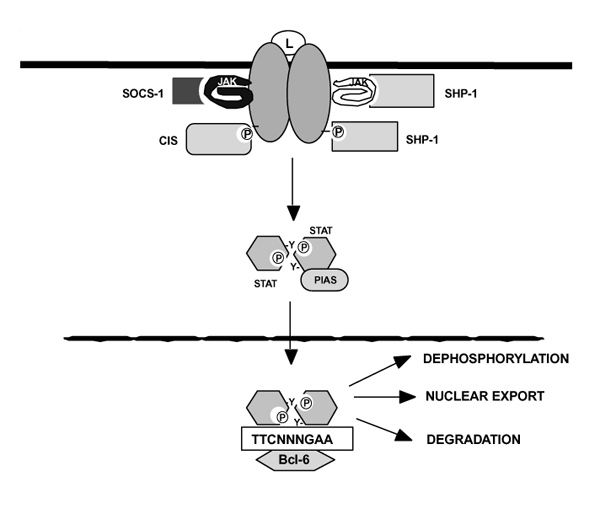
Attenuation of cytokine signaling. Suppressor of cytokine signaling (SOCS) proteins are induced in response to cytokines and suppress signal transduction in two ways. Some SOCS proteins bind directly to janus kinases (Jaks) and inhibit their catalytic activity, whereas others like cytokine inducible src homology-2 protein (CIS) can bind to activated receptors and prevent docking by signaling intermediates such as the Stats. SHP-1 can either dephosphorylate Jaks or activated receptor subunits, depending upon the pathway activated. Protein inhibitors of activated Stats (PIAS) family members inactivate Stat dimers by an as yet unknown mechanism. Stat dimers are also probably downregulated by degradation and dephosphorylated by unknown mechanisms. The accumulation of STATs in the nucleus could be regulated at the level of nuclear import, nuclear export, or a combination of the two; the mechanisms that control these processes are not well characterized. Finally, molecules like Bcl-6 can bind to consensus Stat binding sites and function as repressors.

References

    1. Darnell JEJ, Kerr IM, Stark GR. Jak-STAT pathways and transcriptional activation in response to IFNs and other extracellular signaling proteins. Science. 1994;264:1415–1421. - PubMed
    1. Pellegrini S, Dusanter-Fourt I. The structure, regulation and function of the Janus kinases (JAKs) and the signal transducers and activators of transcription (STATs). Eur J Biochem. 1997;248:615–633. - PubMed
    1. Ihle JN, Thierfelder W, Teglund S, et al. Signaling by the cytokine receptor superfamily. Ann N Y Acad Sci. 1998;865:1–9. - PubMed
    1. O'Shea JJ. Jaks, STATs, cytokine signal transduction, and immunoregulation: are we there yet? Immunity. 1997;7:1–11. - PubMed
    1. Bach EA, Aguet M, Schreiber RD. The IFN-gamma receptor: a paradigm for cytokine receptor signaling. Annu Rev Immunol. 1997;15:563–593. - PubMed

MeSH terms

LinkOut - more resources