


Cell-cell interactions in synovitis. Interactions between T lymphocytes and synovial cells
- PMID: 11094451
- PMCID: PMC130139
- DOI: 10.1186/ar115
Cell-cell interactions in synovitis. Interactions between T lymphocytes and synovial cells
Abstract
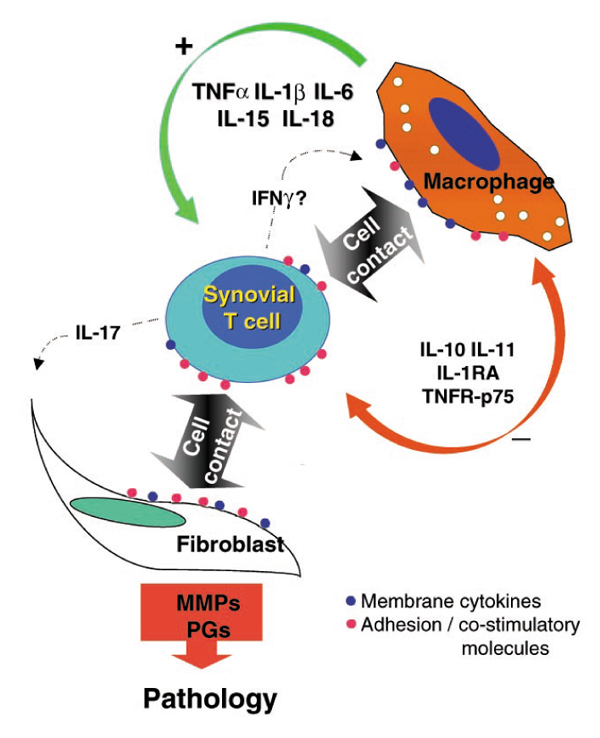
Mechanisms whereby T lymphocytes contribute to synovial inflammation in rheumatoid arthritis are poorly understood. Here we review data that indicate an important role for cell contact between synovial T cells, adjacent macrophages and fibroblast-like synoviocytes (FLS). Thus, T cells activated by cytokines, endothelial transmigration, extracellular matrix or by auto-antigens can promote cytokine, particularly TNF alpha, metalloproteinase production by macrophages and FLS through cell-membrane interactions, mediated at least through beta-integrins and membrane cytokines. Since soluble factors thus induced may in turn contribute directly to T cell activation, positive feedback loops are likely to be created. These novel pathways represent exciting potential therapeutic targets.
Figures
References
-
- Maini RN, Taylor PC. Anti-cytokine therapy for rheumatoid arthritis. Annu Rev Med. 2000;51:207–229. - PubMed
-
- Fox DA. The role of T cells in the immunopathogenesis of rheumatoid arthritis: new perspectives. Arthritis Rheum. 1997;40:598–609. - PubMed
-
- Panayi G. T-cell-dependent pathways in rheumatoid arthritis. . Curr Opin Rheum. 1997;9:236–240. - PubMed
-
- Ronnelid J, Berg L, Rogberg S, Nilsson A, Albertsson K, Klareskog L. Production of T-cell cytokines at the single-cell level in patients with inflammatory arthritides: enhanced activity in synovial fluid compared to blood. Br J Rheumatol. 1998;37:7–14. - PubMed
-
- Dolhain R, Van Der Heiden AN, Ter Haar NT, Breedveld FC, Miltenburg AMM. Shift toward T lymphocytes with a T helper 1 cytokine-secretion profile in the joints of patients with rheumatoid arthritis. . Arthritis Rheum. 1996;39:1961–1969. - PubMed
Publication types
MeSH terms
LinkOut - more resources
Full Text Sources
Other Literature Sources
