


Weaning from mechanical ventilation
- PMID: 11094496
- PMCID: PMC137330
- DOI: 10.1186/cc660
Weaning from mechanical ventilation
Erratum in
- Crit Care. 2006;10(4):414
Abstract
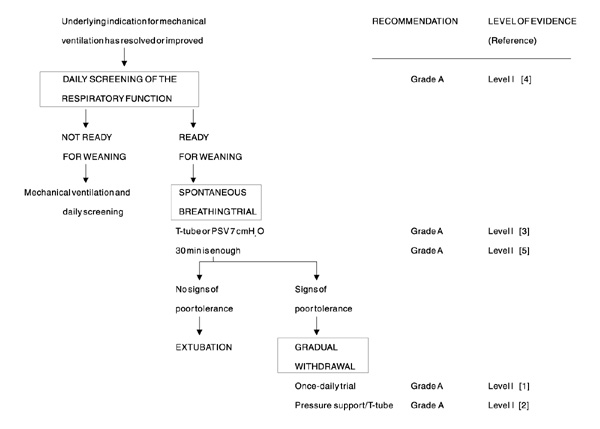
Practice guidelines on weaning should be based on the results of several well-designed randomized studies performed over the last decade. One of those studies demonstrated that immediate extubation after successful trials of spontaneous breathing expedites weaning and reduces the duration of mechanical ventilation as compared with a more gradual discontinuation of ventilatory support. Two other studies showed that the ability to breathe spontaneously can be adequately tested by performing a trial with either T-tube or pressure support of 7 cmH2O lasting either 30 or 120 min. In patients with unsuccessful weaning trials, a gradual withdrawal for mechanical ventilation can be attempted while factors responsible for the ventilatory dependence are corrected. Two randomized studies found that, in difficult-to-wean patients, synchronized intermittent mandatory ventilation (SIMV) is the most ineffective [corrected] method of weaning.
Figures
References
-
- Esteban A, Frutos F, Tobin MJ, et al. A comparison of four methods of weaning patients from mechanical ventilation. N Engl J Med. 1995;332:345–350. - PubMed
-
- Brochard L, Rauss A, Benito S, et al. Comparison of three methods of gradual withdrawal from ventilatory support during weaning from mechanical ventilation. Am J Respir Crit Care Med. 1994;150:896–903. - PubMed
-
- Esteban A, Alía I, Gordo F, et al. Extubation outcome after spontaneous breathing trials with T-tube or pressure support ventilation. Am J Respir Crit Care Med. 1997;156:459–465. - PubMed
-
- Ely EW, Baker AM, Dunagan DP, et al. Effect on the duration of mechanical ventilation of identifying patients capable of breathing spontaneously. N Engl J Med. 1996;335:1864–1869. - PubMed
-
- Esteban A, Alía I, Tobin MJ, et al. Effect of spontaneous breathing trial duration on outcome of attempts to discontinue mechanical ventilation. Am J Respir Crit Care Med. 1999;159:512–518. - PubMed
Publication types
MeSH terms
LinkOut - more resources
Full Text Sources
