


Influence of infected cell growth state on bacteriophage reactivation levels
- PMID: 11097891
- PMCID: PMC92445
- DOI: 10.1128/AEM.66.12.5206-5212.2000
Influence of infected cell growth state on bacteriophage reactivation levels
Abstract
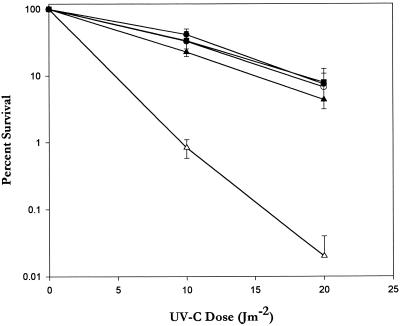
Reactivation of UV-C-inactivated Pseudomonas aeruginosa bacteriophages D3C3, F116, G101, and UNL-1 was quantified in host cells infected during the exponential phase, during the stationary phase, and after starvation (1 day, 1 and 5 weeks) under conditions designed to detect dark repair and photoreactivation. Our experiments revealed that while the photoreactivation capacity of stationary-phase or starved cells remained about the same as that of exponential-phase cells, in some cases their capacity to support dark repair of UV-inactivated bacteriophages increased over 10-fold. This enhanced reactivation capacity was correlated with the ca. 30-fold-greater UV-C resistance of P. aeruginosa host cells that were in the stationary phase or exposed to starvation conditions prior to irradiation. The dark repair capacity of P. aeruginosa cells that were infected while they were starved for prolonged periods depended on the bacteriophage examined. For bacteriophage D3C3 this dark repair capacity declined with prolonged starvation, while for bacteriophage G101 the dark repair capacity continued to increase when cells were starved for 24 h or 1 week prior to infection. For G101, the reactivation potentials were 16-, 18-, 10-, and 3-fold at starvation intervals of 1 day, 1 week, 5 weeks, and 1. 5 years, respectively. Exclusive use of exponential-phase cells to quantify bacteriophage reactivation should detect only a fraction of the true phage reactivation potential.
Figures

References
-
- Adams M H. Bacteriophages. New York, N.Y: Interscience Publishers; 1959.
-
- Arber W, Enquist L, Hohn B, Murray N E, Murray K. Experimental methods for use with lambda. In: Hendrix R W, Roberts J W, Stahl F W, Weisberg R A, editors. Lambda II. Cold Spring Harbor, N.Y: Cold Spring Harbor Laboratory; 1983. pp. 433–466.
-
- Bergh O, Borsheim K, Bratbak G, Heldal M. High abundance of viruses found in aquatic environments. Nature. 1989;340:467–468. - PubMed
-
- Dulbecco R. Reactivation of ultraviolet-inactivated bacteriophage by visible light. Nature. 1949;163:949–950. - PubMed
-
- Eisenstark A, Calcutt M J, Becker-Hapak M, Ivanova A. Role of Escherichia coli rpoS and associated genes in defense against oxidative damage. Free Radic Biol Med. 1996;21:975–993. - PubMed
