


Suitability of PCR fingerprinting, infrequent-restriction-site PCR, and pulsed-field gel electrophoresis, combined with computerized gel analysis, in library typing of Salmonella enterica serovar enteritidis
- PMID: 11097902
- PMCID: PMC92456
- DOI: 10.1128/AEM.66.12.5273-5281.2000
Suitability of PCR fingerprinting, infrequent-restriction-site PCR, and pulsed-field gel electrophoresis, combined with computerized gel analysis, in library typing of Salmonella enterica serovar enteritidis
Abstract
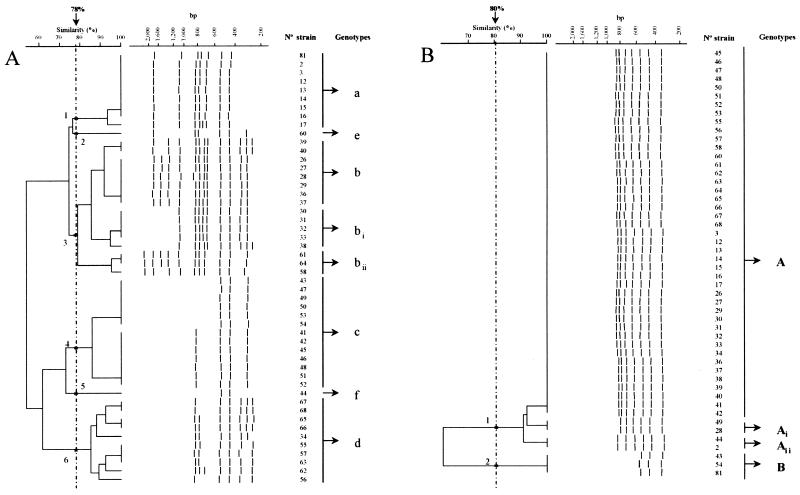
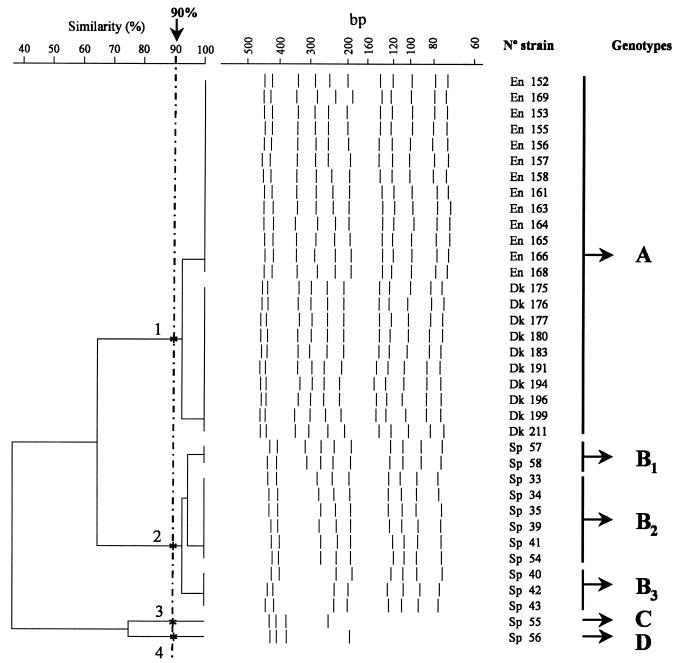
Strains of Salmonella enterica (n = 212) of different serovars and phage types were used to establish a library typing computerized system for serovar Enteritidis on the basis of PCR fingerprinting, infrequent-restriction-site PCR (IRS-PCR), or pulsed-field gel electrophoresis (PFGE). The rate of PCR fingerprinting interassay and intercenter reproducibility was low and was only increased when DNA samples were extracted at the same time and amplified with the same reaction mixtures. Reproducibility of IRS-PCR technique reached 100%, but discrimination was low (D = 0.52). The PFGE procedure showed an intercenter reproducibility value of 93.3%. The high reproducibility of PFGE combined with the previously determined high discrimination directed its use for library typing. The use of PFGE with enzymes XbaI, BlnI, and SpeI for library typing of serovar Enteritidis was assessed with GelCompar 4.0 software. Three computer libraries of PFGE DNA profiles were constructed, and their ability to recognize new DNA profiles was analyzed. The results obtained pointed out that the combination of PFGE with computerized analysis could be suitable in long-term epidemiological comparison and surveillance of Salmonella serovar Enteritidis, specially if the prevalence of genetic events that could be responsible for changes in PFGE profiles in this serovar was low.
Figures


References
-
- Aarts H J M, van Lith L A J T, Keijer J. High-resolution genotyping of Salmonella strains by AFLP-fingerprinting. Lett Appl Microbiol. 1998;26:131–135. - PubMed
-
- Ellsworth D L, Rittenhouse K D, Honeycutt R L. Artifactual variation in randomly amplified polymorphic DNA banding patterns. BioTechniques. 1993;14:214–217. - PubMed
Publication types
MeSH terms
Substances
LinkOut - more resources
Full Text Sources
Molecular Biology Databases
