. 2000 Dec;66(12):5290-300.
doi: 10.1128/AEM.66.12.5290-5300.2000.

Genetic linkage map of the edible basidiomycete Pleurotus ostreatus

Affiliations

Genetic linkage map of the edible basidiomycete Pleurotus ostreatus

L M Larraya et al. Appl Environ Microbiol. 2000 Dec.

Abstract

We have constructed a genetic linkage map of the edible basidiomycete Pleurotus ostreatus (var. Florida). The map is based on the segregation of 178 random amplified polymorphic DNA and 23 restriction fragment length polymorphism markers; four hydrophobin, two laccase, and two manganese peroxidase genes; both mating type loci; one isozyme locus (est1); the rRNA gene sequence; and a repetitive DNA sequence in a population of 80 sibling monokaryons. The map identifies 11 linkage groups corresponding to the chromosomes of P. ostreatus, and it has a total length of 1,000.7 centimorgans (cM) with an average of 35.1 kbp/cM. The map shows a high correlation (0.76) between physical and genetic chromosome sizes. The number of crossovers observed per chromosome per individual cell is 0.89. This map covers nearly the whole genome of P. ostreatus.


Figures
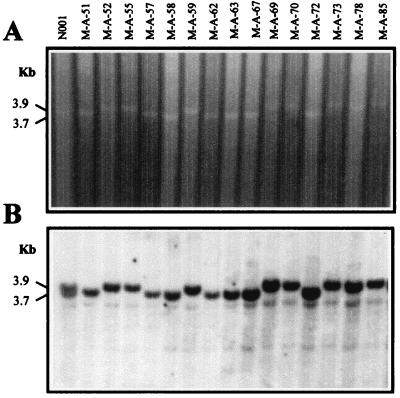
FIG. 1
FIG. 1
(A) XhoI digestion of DNA purified from dikaryotic strain N001 and some monokaryons of the mapping population. Two polymorphic bands (3.7 and 3.9 kbp) of repetitive DNA segregating as alleles can be observed (rXhoI marker). (B) RFLP pattern obtained using a portion of the rDNA of S. carlsbergensis as a probe for Southern hybridization of the digested DNA shown in panel A. Two polymorphic bands segregating as alleles can be observed (Rib marker). These bands are coincident with the two bands of repetitive DNA in panel A.
FIG. 2
FIG. 2
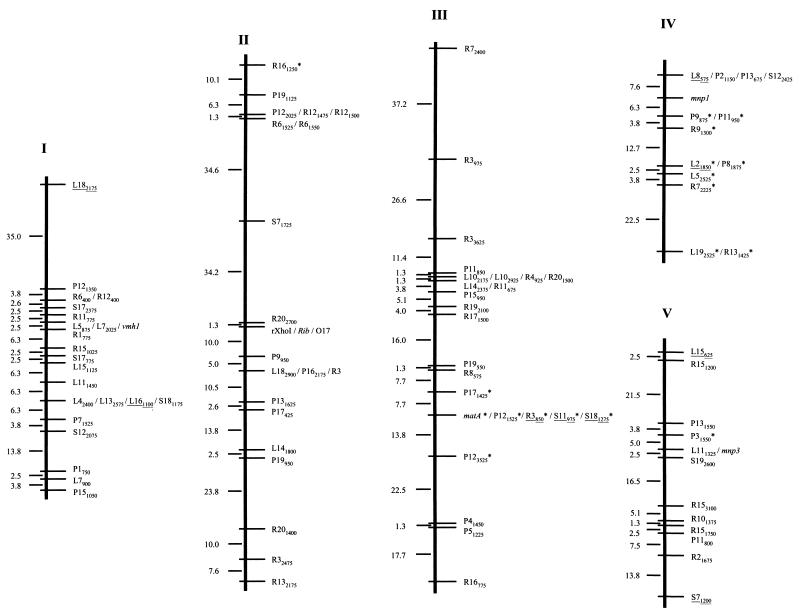
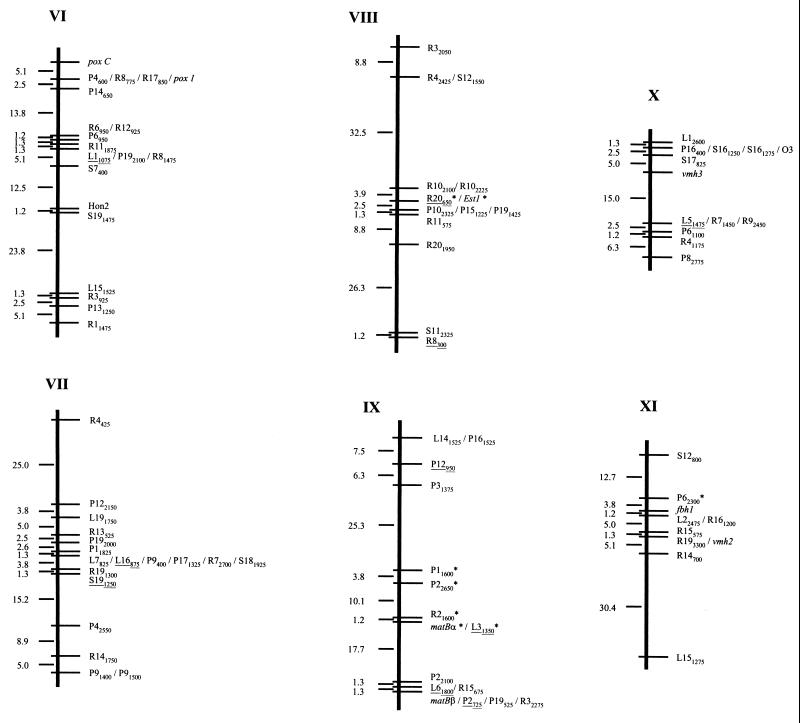
Linkage map of P. ostreatus. Linkage groups are numbered in accordance with the molecular size of the corresponding chromosome (in protoclone PC9) revealed by PFGE (32). Polymorphic RAPD markers were named by the primer designation, followed by the approximate size of the amplified fragment in base pairs. RAPD markers converted into RFLP markers are underlined. Genes are in italics. Markers that deviated from the expected 1:1 segregation (P < 0.05) appear with an asterisk to the right of the marker name. The linkage distances (centimorgans) between consecutive genetic markers are indicated on the left of each linkage group.
FIG. 2
FIG. 2
Linkage map of P. ostreatus. Linkage groups are numbered in accordance with the molecular size of the corresponding chromosome (in protoclone PC9) revealed by PFGE (32). Polymorphic RAPD markers were named by the primer designation, followed by the approximate size of the amplified fragment in base pairs. RAPD markers converted into RFLP markers are underlined. Genes are in italics. Markers that deviated from the expected 1:1 segregation (P < 0.05) appear with an asterisk to the right of the marker name. The linkage distances (centimorgans) between consecutive genetic markers are indicated on the left of each linkage group.

References

    1. Antolin M F, Bosio C F, Cotton J, Sweeney W, Strand M R, Black W C. Intensive linkage mapping in a wasp (Bracon hebetor) and a mosquito (Aedes aegypti) with single-strand conformation polymorphism analysis of random amplified polymorphic DNA markers. Genetics. 1996;143:1727–1738. - PMC - PubMed
    1. Arias A, Ramírez R, Leal H. Cultivation of Pleurotus ostreatus hybrids resistant to 2DG obtained by pairings of neaohaplonts from selected dikaryons. In: van Griensven L J L D, editor. Science and cultivation of edible fungi. Vol. 1. Rotterdam, The Netherlands: A. A. Balkema; 2000. pp. 305–309.
    1. Arnau J, Housego A P, Oliver R P. The use of RAPD markers in the genetic analysis of the plant pathogenic fungus Cladosporium fulvum. Curr Genet. 1994;25:438–444. - PubMed
    1. Asgeirsdóttir S A, de Vries O M H, Wessels J G H. Identification of three differentially expressed hydrophobins in Pleurotus ostreatus (oyster mushroom) Microbiology. 1998;144:2961–2969. - PubMed
    1. Baars J J P, Sonnenberg A S M, Mikosch T S P, Griensven L J L D V. Development of a sporeless strain of oyster mushroom Pleurotus sotreatus. In: van Griensven L J L D, editor. Science and cultivation of edible fungi. Vol. 1. Rotterdam, The Netherlands: A. A. Balkema; 2000. pp. 317–323.

Publication types

LinkOut - more resources