


doi: 10.1128/AEM.66.12.5383-5386.2000.
Construction and characterization of an Escherichia coli strain genetically engineered for Ni(II) bioaccumulation
Affiliations
- PMID: 11097917
- PMCID: PMC92471
- DOI: 10.1128/AEM.66.12.5383-5386.2000
Item in Clipboard
Construction and characterization of an Escherichia coli strain genetically engineered for Ni(II) bioaccumulation
Appl Environ Microbiol.
2000 Dec.
Abstract
An Escherichia coli strain that accumulated Ni(II) was constructed by introducing the nixA gene (coding for a nickel transport system) from Helicobacter pylori into JM109 cells that expressed a glutathione S-transferase-pea metallothionein fusion protein. The resulting strain accumulated 15 micromol of Ni(II) per g (dry weight) from a 10 microM Ni(II) solution, four times the level taken up by JM109 cells. Ni(II) accumulation did not require an energy source, was inhibited by only 50% by 0.1 M NaCl, and occurred over the pH range from 3 to 9.
Figures
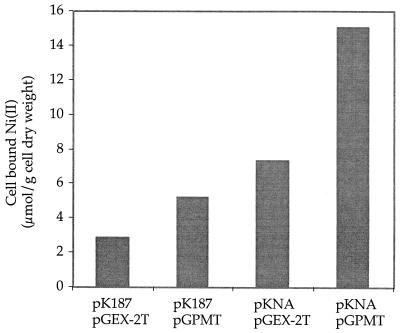
Ni(II) bioaccumulation by E. coli cells carrying different plasmids. Induced JM109 cells containing the indicated plasmids were resuspended in phosphate buffer containing 30 μg of chloramphenicol per ml and 10 μM Ni(II) and shaken at 37°C for 1 h.
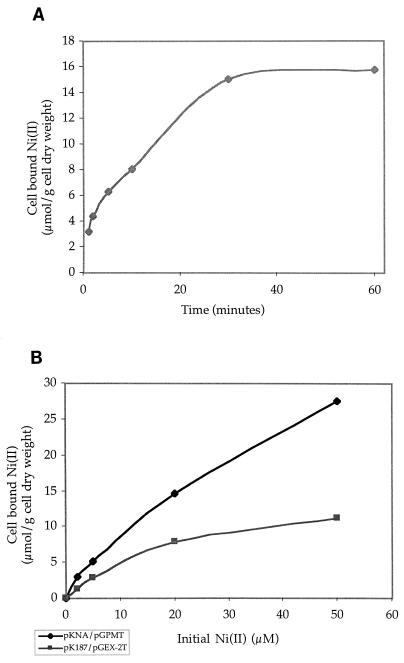
(A) Time course of Ni(II) bioaccumulation. Induced cells containing pKNA and pGPMT were resuspended in phosphate buffer containing 10 μM Ni(II) and were shaken at 37°C for the indicated amounts of time. (B) Ni(II) bioaccumulation isotherms. Induced cells expressing both a nickel transporter and PMT-GST fusion protein (pKNA/pGPMT) and control cells expressing neither (pK187/pGEX-2T) were resuspended in phosphate buffer at various levels of Ni(II). Cells were shaken at 37°C and harvested after 1 h.
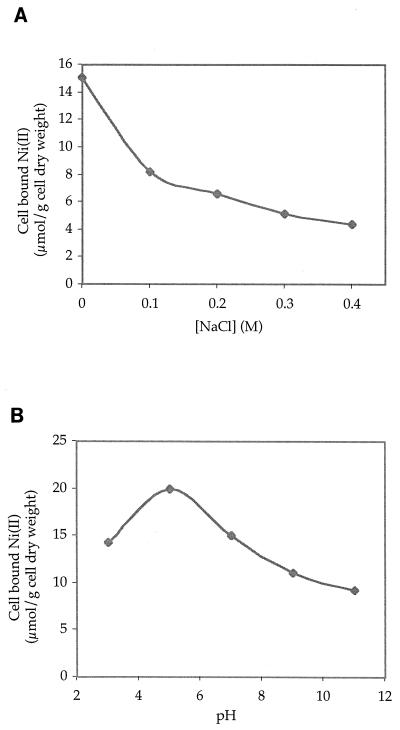
(A) Effect of ionic strength on Ni(II) bioaccumulation. Induced cells containing pKNA and pGPMT were resuspended in phosphate buffer containing 10 μM Ni(II) and the indicated concentrations of NaCl. Cells were shaken at 37°C and harvested after 1 h. (B) Effect of pH on Ni(II) bioaccumulation. Induced cells containing pKNA and pGPMT were resuspended in phosphate buffer adjusted to the indicated pH and containing 10 μM Ni(II). Cells were shaken at 37°C and harvested after 1 h.
References
-
- Baudet C, Sprott G D, Patel G B. Adsorption and nickel uptake in Methanothrix concilii. Arch Microbiol. 1988;150:338–342.
-
- Chang J, Hong J. Biosorption of mercury by the inactivated cells of Pseudomonas aeruginosa PU21 (Rip64) Biotechnol Bioeng. 1994;44:999–1006. - PubMed
-
- Chang J, Hong J, Ogunseitan O A, Olson B H. Interaction of mercuric ions with the bacterial growth medium and its effects on enzymatic reduction of mercury. Biotechnol Prog. 1993;9:526–532.
-
- Chen C Y, Lin T H. Nickel toxicity to human term placenta: in vitro study on lipid peroxidation. J Toxicol Environ Health Part A. 1998;54:37–47. - PubMed
MeSH terms
Substances
LinkOut - more resources
Full Text Sources
