Comparative Study
. 2000 Dec;66(12):5460-8.
doi: 10.1128/AEM.66.12.5460-5468.2000.

Homoduplex and heteroduplex polymorphisms of the amplified ribosomal 16S-23S internal transcribed spacers describe genetic relationships in the "Bacillus cereus group"

Affiliations
Comparative Study

Homoduplex and heteroduplex polymorphisms of the amplified ribosomal 16S-23S internal transcribed spacers describe genetic relationships in the "Bacillus cereus group"

D Daffonchio et al. Appl Environ Microbiol. 2000 Dec.

Abstract

Bacillus anthracis, Bacillus cereus, Bacillus mycoides, Bacillus pseudomycoides, Bacillus thuringiensis, and Bacillus weihenstephanensis are closely related in phenotype and genotype, and their genetic relationship is still open to debate. The present work uses amplified 16S-23S internal transcribed spacers (ITS) to discriminate between the strains and species and to describe the genetic relationships within the "B. cereus group," advantage being taken of homoduplex-heteroduplex polymorphisms (HHP) resolved by polyacrylamide gel electrophoresis and silver staining. One hundred forty-one strains belonging to the six species were investigated, and 73 ITS-HHP pattern types were distinguished by MDE, a polyacrylamide matrix specifically designed to resolve heteroduplex and single-strand conformation polymorphisms. The discriminating bands were confirmed as ITS by Southern hybridization, and the homoduplex or heteroduplex nature was identified by single-stranded DNA mung bean nuclease digestion. Several of the ITS-HHP types corresponded to specific phenotypes such as B. anthracis or serotypes of B. thuringiensis. Unweighted pair group method arithmetic average cluster analysis revealed two main groups. One included B. mycoides, B. weihenstephanensis, and B. pseudomycoides. The second included B. cereus and B. thuringiensis, B. anthracis appeared as a lineage of B. cereus.


Figures
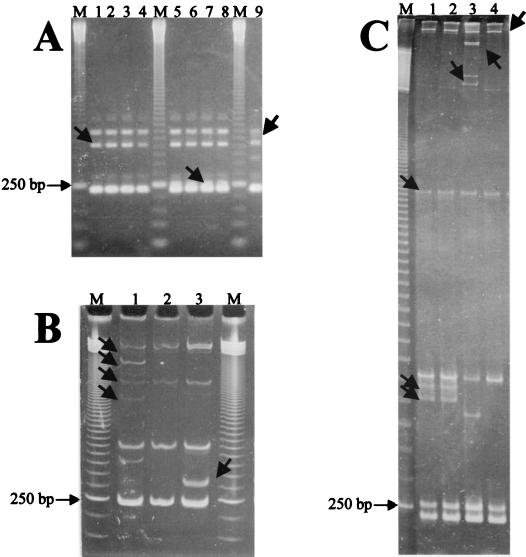
FIG. 1
FIG. 1
Example of ITS-PCR fingerprinting patterns of B. anthracis strains resolved by agarose (A), polyacrylamide (B), and MDE (C) gel electrophoresis, showing the migration shifts of some amplified products. Lanes M, 50-bp ladder. (A) Lanes 1 to 9, B. anthracis strains 256, 282, 582, 846, 7700, 7702, Cepanzo, 4229, and Davis TE702, respectively. (B) Lanes 1 to 3, B. anthracis strains Davis TE702, 282, and Cepanzo, respectively. (C) Lanes 1 to 4, B. anthracis strains 7700, 7702, Davis TE702, and 256, respectively. The 250-bp band of the ladder is indicated. Arrows indicate bands that showed different mobilities among agarose, polyacrylamide, and MDE gel electrophoresis assays.
FIG. 2
FIG. 2
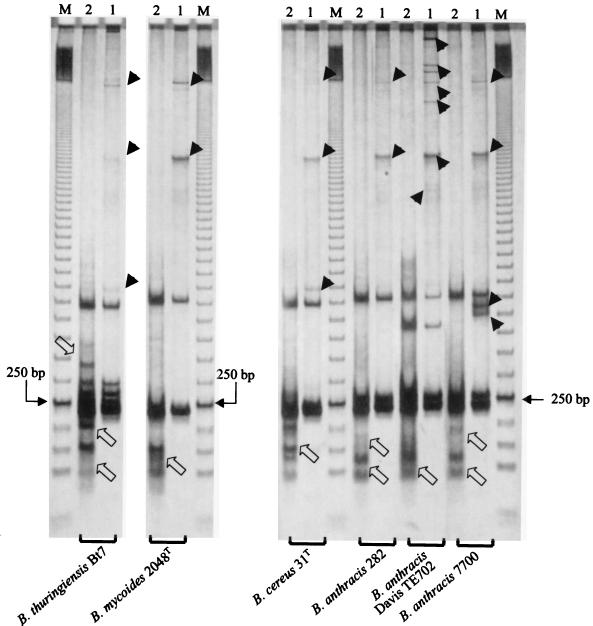
Identification of the heteroduplex bands in the ITS-HHP patterns separated in an MDE gel after mung bean nuclease digestion of the PCR products. The MDE runs for B. anthracis 7700, Davis TE702, and 282; B. cereus 31T; B. mycoides 2048T; and B. thuringiensis Bt7 are shown. Lanes M, 50-bp ladder. Lanes 1, normal ITS-HHP profiles. Lanes 2, the same products of lanes 1 after treatment with mung bean nuclease. The 250-bp band of the ladder is indicated. Arrowheads indicate the heteroduplex products removed by the mung bean nuclease. Open arrows show degradation products of the heteroduplex bands.
FIG. 3
FIG. 3
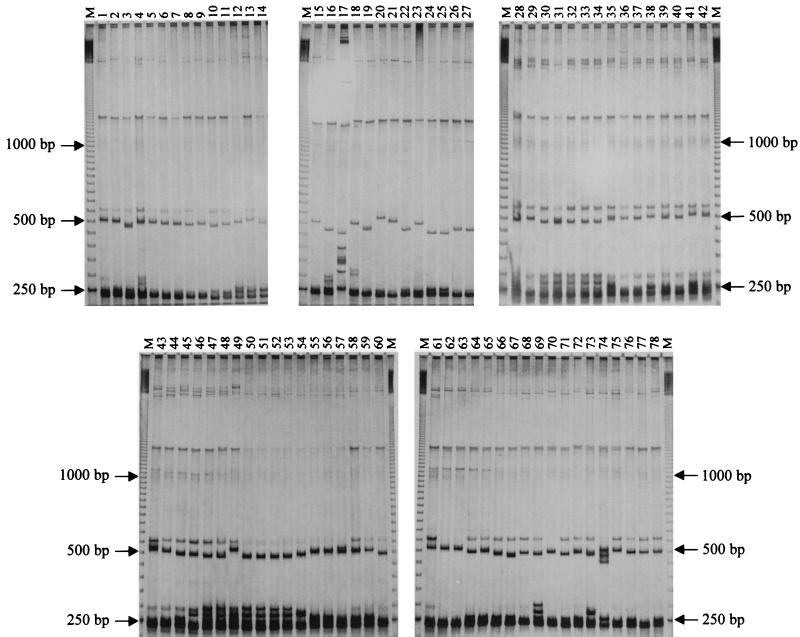
Examples of the ITS-HHP pattern variability observed in the collection examined. For each strain, the ITS-HHP type (H), (Table 1 and Fig. 4) is marked in parentheses below. Lanes M, 50-bp ladder. Lanes 1 to 14, B. cereus 351 (ITS-HHP type H43), myd (H42), co2 (H45), 6127 (H47), 46321 (H37), 2896 (H29), 31T (H40), co1 (H28), cer4 (H41), cer3 (H13), 360 (H25), 487 (H38), cer6 (H27), and bc1 (H39), respectively. Lanes 15 to 18, B. mycoides mych (H46), nov2 (H48), G2 (H3), and NRS273 (H16), respectively. Lane 19, B. pseudomycoides TP1 (H12). Lanes 20 and 21, B. mycoides 309 (H15) and 2048T (H17), respectively. Lane 22, B. pseudomycoides CA (H10). Lane 23, B. mycoides B615 (H18). Lanes 24 to 27, B. pseudomycoides BD14 (H7), BD10 (H7), B617T (H11), and B346 (H9), respectively. Lane 28, B. cereus 5148 (H50). Lanes 29 to 60, B. thuringiensis HD868 (H56), HD2 (H72), HD1 (H73), BTK (H72), PTB (H72), BTX (H72), Ht51 (H67), Ht39 (H61), Hc45 (H68), Hc36 (H69), Hc17 (H63), Hc16 (H64), Hc15 (H62), Hc13 (H65), BMG1.6 (H51), BUMP30 (H54), BUMP33 (H57), BMG1.1 (H74), BX16 (H70), BMG1.7 (H71), BMG1.3 (H66), Bt33 (H73), Bt9 (H73), Bt7 (H73), Bt1 (H73), Bt13 (H75), Bt44 (H60), Bt14 (H60), Bt10 (H53), Bt5 (H59), 5424 (H55), and 2046T (H52), respectively. Lanes 61 to 64, B. weihenstephanensis 10201 (H4), 10202 (H6), 10204T (H6), and 10208 (H5), respectively. Lanes 65 to 73, B. cereus myd (H42), my1 (H44), co2 (H45), co1 (H28), cer5 (H35), cer4 (H41), cer3 (H13), cer1 (H26), and 345 (H34), respectively. Lane 74, B. anthracis 7700 (H32). Lanes 75 to 78, B. cereus 351 (H43), bc2 (H33), 2896 (H29), and 360 (H25), respectively. The 250-, 500-, and 1,000-bp bands of the ladder are indicated.
FIG. 4
FIG. 4
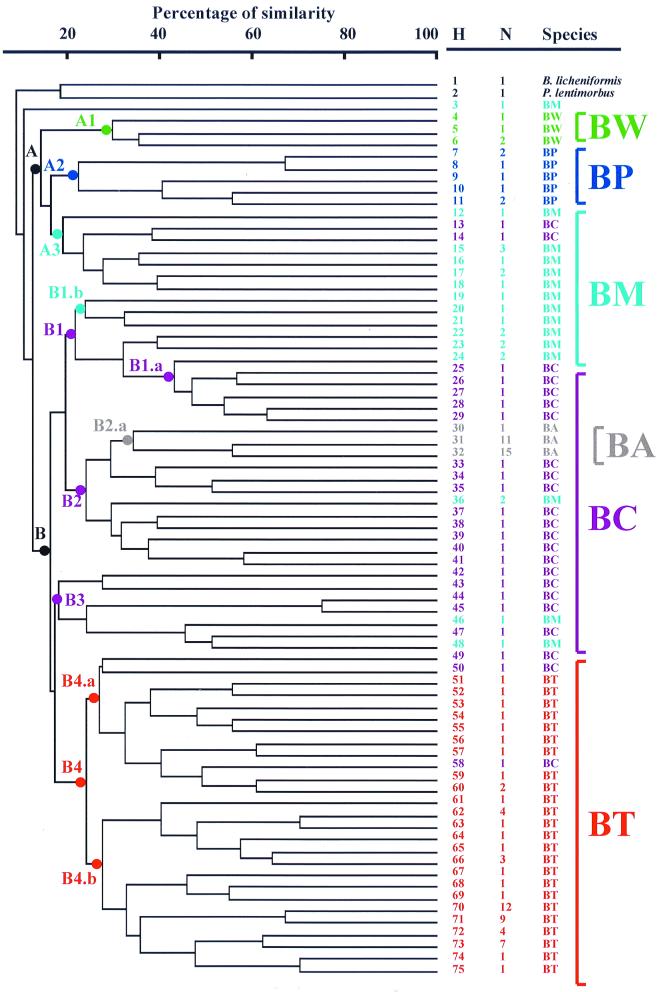
Genetic relationship among B. cereus group strains as described by the UPGMA cluster analysis of the ITS-HHP patterns. The percentages of similarity among the ITS-HPP patterns were calculated using the Jaccard coefficient. H, ITS-HHP type number (Table 1); N, number of isolates for each ITS-HHP type (Table 1). Abbreviations (and colors) used to indicate the B. cereus group species are as follows: BA (grey), B. anthracis; BC (purple), B. cereus; BM (pale blue), B. mycoides; BP (blue), B. pseudomycoides; BT (red), B. thuringiensis; and BW (green), B. weihenstephanensis. The dots indicated with letter-number designations (see text) and marked with the colors identifying the six B. cereus group species were drawn on the dendrogram nodes where separated clusters and subclusters are evident.

References

    1. Amann R I, Ludwig W, Schleifer K-H. Phylogenetic identification and in situ detection of individual microbial cells without cultivation. Microbiol Rev. 1995;59:143–169. - PMC - PubMed
    1. Andreoni V, Moro Luischi M, Cavalca L, Erba D, Ciapellano S. Selenite tolerance and accumulation in the Lactobacillus species. Ann Microbiol. 2000;50:77–88.
    1. Ash C, Collins M D. Comparative analysis of 23S ribosomal RNA gene sequences of Bacillus anthracis and emetic Bacillus cereus determined by PCR-direct sequencing. FEMS Microbiol Lett. 1992;94:75–80. - PubMed
    1. Ash C, Farrow J A E, Dorsch M, Stackebrandt E, Collins M D. Comparative analysis of Bacillus anthracis, Bacillus cereus, and related species on the basis of reverse transcriptase sequencing of 16S rRNA. Int J Syst Bacteriol. 1991;41:343–346. - PubMed
    1. Ash C, Farrow J A E, Wallbanks S, Collins M D. Phylogenetic heterogeneity of the genus Bacillus revealed by comparative analysis of small-subunit-ribosomal RNA sequences. Lett Appl Microbiol. 1991;13:202–206.

Publication types

MeSH terms

LinkOut - more resources