


Osmotic stress-induced genetic rearrangements in Escherichia coli H10407 detected by randomly amplified polymorphic DNA analysis
- PMID: 11097933
- PMCID: PMC92487
- DOI: 10.1128/AEM.66.12.5484-5487.2000
Osmotic stress-induced genetic rearrangements in Escherichia coli H10407 detected by randomly amplified polymorphic DNA analysis
Abstract
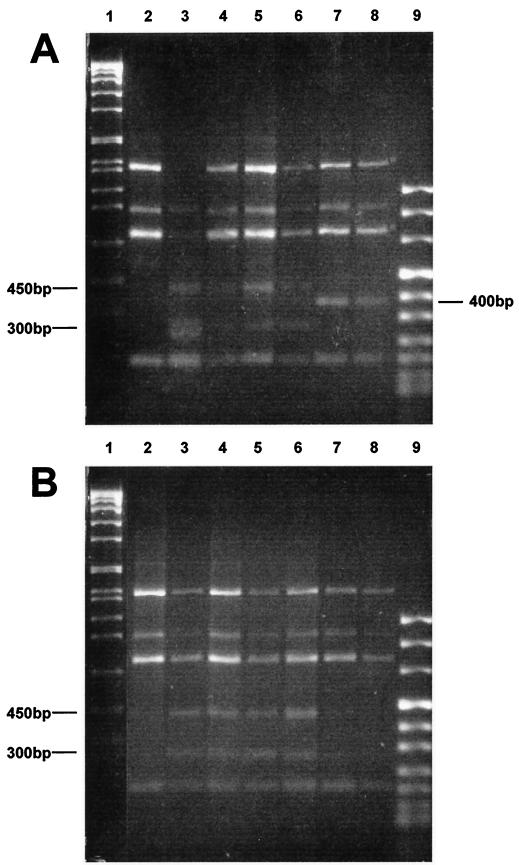
Randomly amplified polymorphic DNA (RAPD) analysis is a DNA polymorphism assay commonly used for fingerprinting genomes. After optimizing the reaction conditions, samples of Escherichia coli H10407 DNA were assayed to determine the influence of osmotic and/or oligotrophic stress on variations in RAPD banding patterns. Genetic rearrangements or DNA topology variations could be detected as changes in agarose gel electrophoresis banding profiles. A new amplicon generated using DNA extracted from bacteria prestarved by an osmotic stress and resuscitated in rich medium was observed. Enrichment improved recovery of mutator cells and allowed them to be detected in samples, suggesting that DNA modifications, such as stress-induced alterations and supercoiling phenomena, should be taken into consideration before beginning RAPD analyses.
Figures
References
-
- Caetano-Anolles G, Bassam B J, Gresshoff P M. DNA amplification fingerprinting using very short arbitrary oligonucleotide primers. Bio/Technology. 1991;9:553–557. - PubMed
-
- Cave H, Bingen E, Elion J, Denamur E. Differentiation of Escherichia coli strains using randomly amplified polymorphic DNA analysis. Res Microbiol. 1994;145:141–150. - PubMed
-
- Csonka L N, Hanson A D. Procaryotic osmoregulation: genetics and physiology. Annu Rev Microbiol. 1991;45:569–606. - PubMed
-
- Drlica K. Control of bacterial DNA supercoiling. Mol Microbiol. 1992;6:425–433. - PubMed
MeSH terms
Substances
LinkOut - more resources
Full Text Sources
