


doi: 10.1128/JCM.38.12.4560-4568.2000.
Genomic and phylogenetic analysis of hepatitis C virus isolates from argentine patients: a six-year retrospective study
Affiliations
- PMID: 11101596
- PMCID: PMC87637
- DOI: 10.1128/JCM.38.12.4560-4568.2000
Item in Clipboard
Genomic and phylogenetic analysis of hepatitis C virus isolates from argentine patients: a six-year retrospective study
J Clin Microbiol.
2000 Dec.
Erratum in
- J Clin Microbiol 2001 Mar;39(3):1208-10
Abstract
Typing of hepatitis C virus (HCV) isolates from Argentine patients was performed by using different methodologies in a population of 243 patients. HCV subtype was assigned based upon restriction fragment length polymorphism (RFLP). HCV RNA genomes obtained from serum samples were classified as belonging to clade 1 (53.5%), 2 (23. 0%), or 3 (8.6%); 14.8% of samples showed HCV mixed infections, more frequently implying different subtypes within the same clade. In addition to RFLP typing, phylogenetic relatedness among sequences from both 5' untranslated region (n = 50) and nonstructural 5B coding region (n = 15) was established.
Figures

5′UTR-core RFLP. Amplicons (647 bp) were digested with AccI and run on a 4% agarose gel which was stained with ethidium bromide. Lane a, mixed HCV infection involving subtypes 1a (predominant) and 1b; lane b, 25-bp ladder; lane c, subtype 1b restriction pattern.
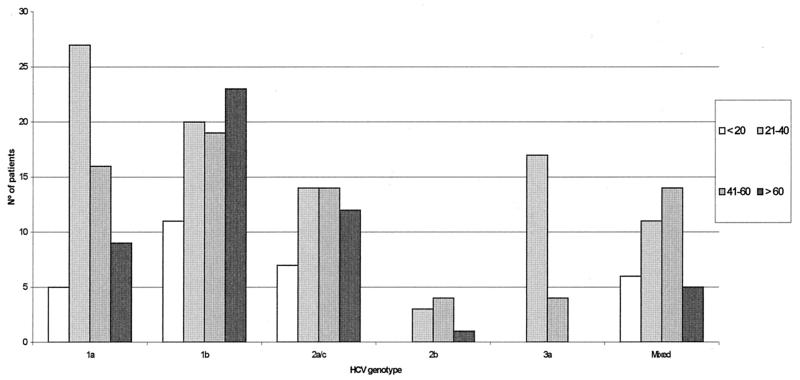
HCV genotype distribution according to age range (years).
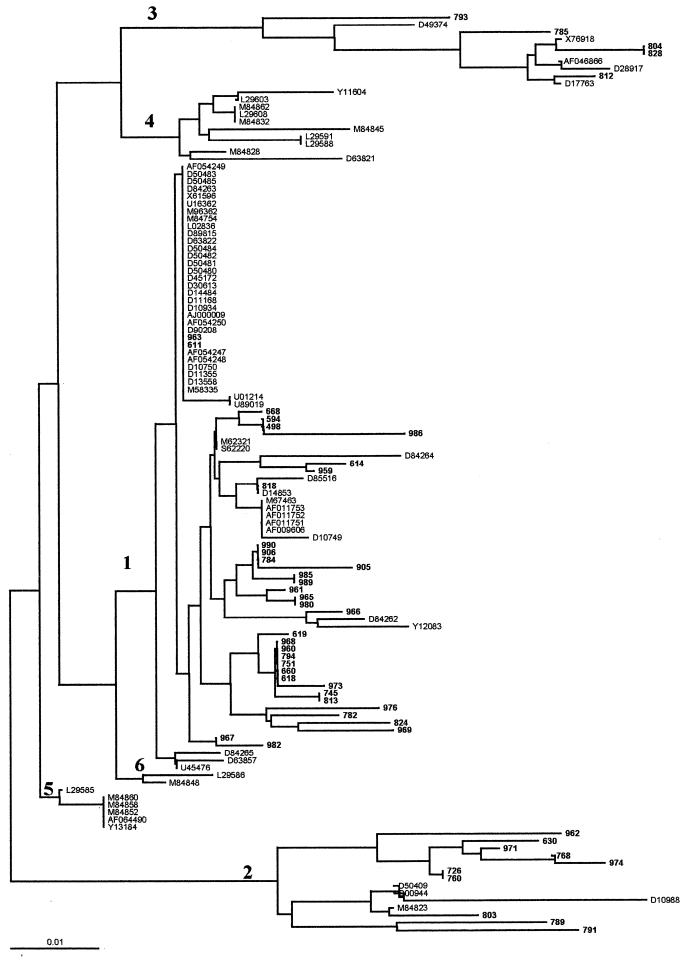
The phylogenetic tree shown is based on 124 sequences derived from the 5′UTR of HCV. Argentine HCV sequences (n = 50) are indicated by their isolate numbers (in boldface type): samples 498, 594, 611, 614, 618, 619, 630, 660, 668, 726, 745, 751, 760, 768, 782, 784, 785, 789, 791, 793, 794, 803, 804, 812, 813, 818, 824, 828, 905, 906, 959, 963, 965, 969, 971, 973, 974, 976, 980, 982, 985, 986, 989, and 990 correspond to accession numbers from GenBank AF041264 to AF041313, respectively. Sequences used as references for the phylogenetic tree (n = 74) are identified by their accession number from GenBank. Note that major HCV clades from 1 to 6 are indicated. The DNA alignments were generated with the Clustal X program. The phylogenetic tree was constructed with the TREEVIEW program. Bootstrap analysis was performed by using the programs SEQBOOT (to generate 1,000 reshuffled sequences), CONSENSE, and RETREE at the midpoint of the longest branch for comparative purposes (PHYLIP package, version 3.5c). Bar, number of nucleotide substitutions per site.

The phylogenetic tree shown is based on sequences derived from the NS5B region of HCV. Argentine HCV sequences (n = 15) are indicated by their isolate number (in boldface type): samples 619, 760, 794, 803, 812, 874, 959, 967, 968, 969, 974, 980, 986, 1274, and 1470 correspond to accession numbers from GenBank AF041314 to AF041328, respectively. Sequences used as references for the phylogenetic tree (n = 99) are identified by their accession number from GenBank. Note that major HCV clades from 1 to 6 are indicated. Shaded boxes indicate bootstrap values. Bar, number of nucleotide substitutions per site.
References
-
- Abrignani S, Rosa D. Perspectives for a hepatitis C virus vaccine. Clin Diagn Virol. 1998;15:181–185. - PubMed
-
- Buoro S, Pizzighella S, Boschetto R, Pellizzari L, Cusan M, Bonaguro R, Mengoli C, Caudai C, Padula M, Valensin P E, Palù G. Typing of hepatitis C virus by a new method based on restriction fragment length polymorphism. Intervirology. 1999;42:1–8. - PubMed
-
- Castillo I, Bartolome J, Quiroga J A, Carreño V. Comparison of several PCR procedures for detection of serum HCV-RNA using different regions of the HCV genome. J Virol Methods. 1992;38:71–79. - PubMed
Publication types
MeSH terms
Substances
LinkOut - more resources
Full Text Sources
Molecular Biology Databases
