


Differential expression of volume-regulated anion channels during cell cycle progression of human cervical cancer cells
- PMID: 11101648
- PMCID: PMC2270206
- DOI: 10.1111/j.1469-7793.2000.00385.x
Differential expression of volume-regulated anion channels during cell cycle progression of human cervical cancer cells
Abstract
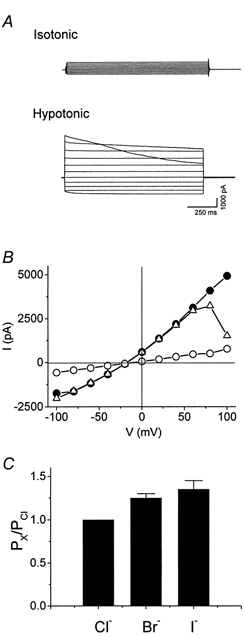
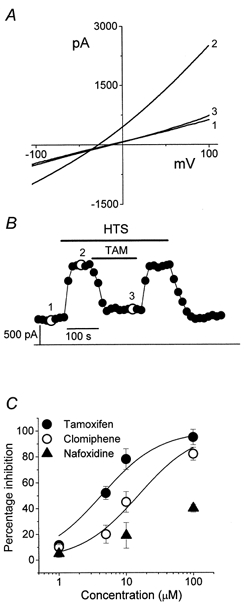
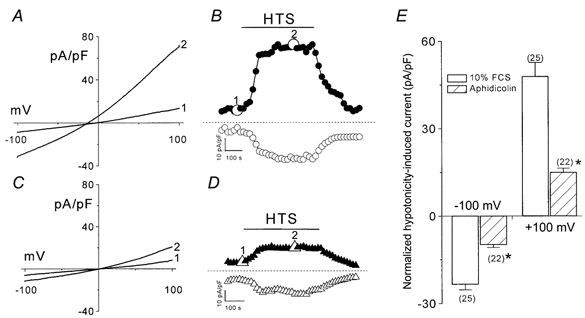
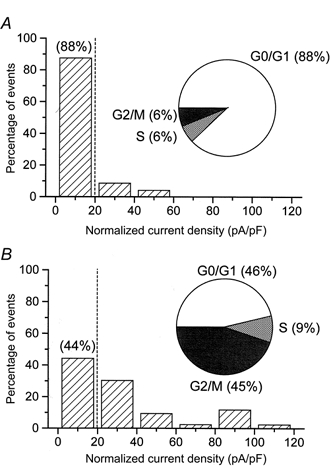
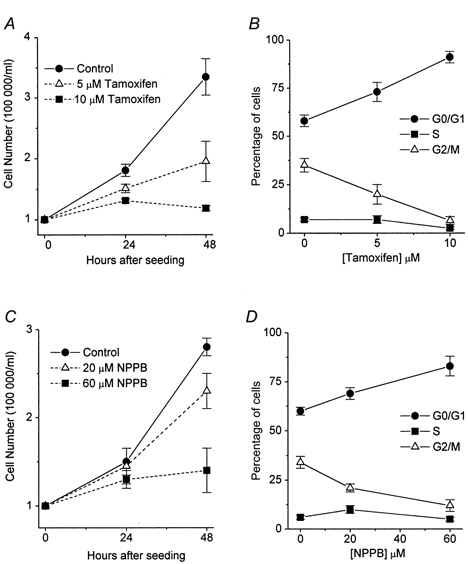
This study investigated the volume-regulated anion channel (VRAC) of human cervical cancer SiHa cells under various culture conditions, testing the hypothesis that the progression of the cell cycle is accompanied by differential expression of VRAC activity. Exponentially growing SiHa cells expressed VRACs, as indicated by the presence of large outwardly rectifying currents activated by hypotonic stress with the anion permeability sequence I- > Br- > Cl-. VRACs were potently inhibited by tamoxifen with an IC50 of 4.6 [mu]M. Fluorescence-activated cell sorting (FACS) experiments showed that 59 +/- 0.5, 5 +/- 0.5 and 36 +/- 1.1% of unsynchronized, exponentially growing cervical cancer SiHa cells were in G0/G1, S and G2/M stage, respectively. Treatment with aphidicolin (5 [mu]M) arrested 88 +/- 1.4% of cells at the G0/G1 stage. Arrest of cell growth in the G0/G1 phase was accompanied by a significant decrease of VRAC activity. The normalized hypotonicity-induced current decreased from 48 +/- 5.2 pA pF-1 at +100 mV in unsynchronized cells to 15 +/- 2.6 pA pF-1 at +100 mV in aphidicolin-treated cells. After removal of aphidicolin, culturing in medium containing 10% fetal calf serum triggered a rapid re-entry into the cell cycle and a concomitant recovery of VRAC density. Pharmacological blockade of VRACs by tamoxifen or NPPB caused proliferating cervical cancer cells to arrest in the G0/G1 stage, suggesting that activity of this channel is critical for G1/S checkpoint progression. This study provides new information on the functional significance of VRACs in the cell cycle clock of human cervical cancer cells.
Figures
References
-
- Bubien JK, Kirk LK, Rado TA, Frizzell RA. Cell cycle dependence of chloride permeability in normal and cystic fibrosis lymphocytes. Science. 1990;248:1416–1419. - PubMed
-
- Chou CY, Shen MR, Chen TM, Huang KE. Volume-activated taurine transport is differentially activated in human cervical cancer HT-3 cells, but not activated in HPV-immortalized Z 183A and normal cervical epithelial cells. Clinical and Experimental Pharmacology and Physiology. 1997;24:935–939. - PubMed
-
- Chou CY, Shen MR, Wu SN. Volume-sensitive chloride channels associated with human cervical carcinogenesis. Cancer Research. 1995;55:6077–6083. - PubMed
-
- DeCoursey TE, Chandy G, Gupta S, Cahalan MD. Voltage-gated K+ channels in human T lymphocytes: a role in mitogenesis? Nature. 1984;307:465–468. - PubMed
Publication types
MeSH terms
Substances
LinkOut - more resources
Full Text Sources
Other Literature Sources
Medical
Research Materials
