. 2000 Dec 19;97(26):14662-7.
doi: 10.1073/pnas.011442598.

Identification of motifs in cholera toxin A1 polypeptide that are required for its interaction with human ADP-ribosylation factor 6 in a bacterial two-hybrid system

Affiliations

Identification of motifs in cholera toxin A1 polypeptide that are required for its interaction with human ADP-ribosylation factor 6 in a bacterial two-hybrid system

M G Jobling et al. Proc Natl Acad Sci U S A. .

Abstract

The latent ADP-ribosyltransferase activity of cholera toxin (CT) that is activated after proteolytic nicking and reduction is associated with the CT A1 subunit (CTA1) polypeptide. This activity is stimulated in vitro by interaction with eukaryotic proteins termed ADP-ribosylation factors (ARFs). We analyzed this interaction in a modified bacterial two-hybrid system in which the T18 and T25 fragments of the catalytic domain of Bordetella pertussis adenylate cyclase were fused to CTA1 and human ARF6 polypeptides, respectively. Direct interaction between the CTA1 and ARF6 domains in these hybrid proteins reconstituted the adenylate cyclase activity and permitted cAMP-dependent signal transduction in an Escherichia coli reporter system. We constructed improved vectors and reporter strains for this system, and we isolated variants of CTA1 that showed greatly decreased ability to interact with ARF6. Amino acid substitutions in these CTA1 variants were widely separated in the primary sequence but were contiguous in the three-dimensional structure of CT. These residues, which begin to define the ARF interaction motif of CTA1, are partially buried in the crystal structure of CT holotoxin, suggesting that a change in the conformation of CTA1 enables it to bind to ARF. Variant CTA polypeptides containing these substitutions assembled into holotoxin as well as wild-type CTA, but the variant holotoxins showed greatly reduced enterotoxicity. These findings suggest functional interaction between CTA1 and ARF is required for maximal toxicity of CT in vivo.


Figures
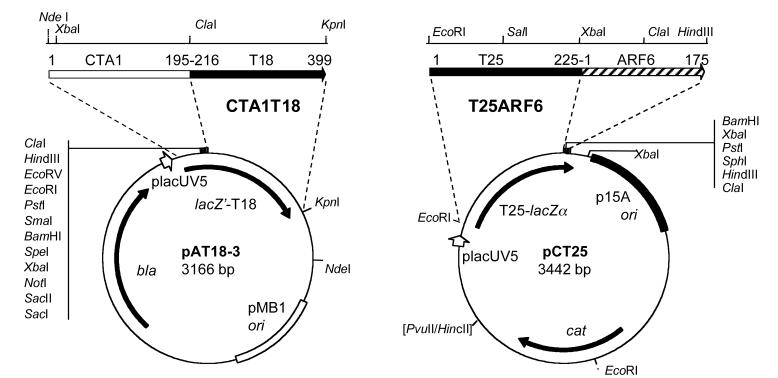
Figure 1
Figure 1
Schematic representations of vectors and two-hybrid fusion constructs. Vectors are shown as circles within which filled arrows represent the β-lactamase (bla) and chloramphenicol acetyl transferase (cat) genes, and the lacZ-T18 and T25-lacZα ORFs. Open and solid boxes represent the pMB1 and p15A origins of replication, respectively. The lacUV5 promoters are shown as open arrowheads that indicate the direction of transcription. Restriction maps for the DNA fragments encoding the CTA1T18 and T25ARF6 hybrid proteins are shown above the vectors. Dashed lines show fragments inserted into vectors to make the clones: CTA1 ORF (open box) linked to the T18 ORF (solid arrow) in pCTA1T18 and derivatives; T25 ORF (solid box) linked to ARF6 ORF (hatched arrow) in pT25ARF6. Numbers above ORFs correspond to the residues of the native proteins included in the fusion polypeptides.
Figure 2
Figure 2
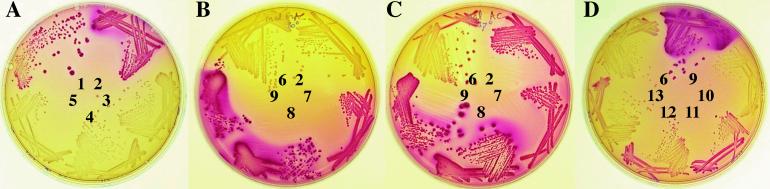
Observed phenotypes in the two-hybrid system of vector controls, wt and variant fusion constructs on maltose–MacConkey plates in E. coli TE1DC. Growth conditions were 40 h at 37°C (A, initial constructs, and C, initial vs. optimized constructs) or 30°C (B, initial vs. optimized constructs) and 28 h at 30°C (D, representative variants). Numbers denote strains carrying the following plasmids (T18 derivatives in strains 1–5 are high copy number): (1) Positive control pT25zip + pT18zip (15); (2) pCTA1T18 + pT25ARF6; (3) pCTA1T18 + pCT25 vector; (4) pAT18 vector + pT25ARF6; (5) pAT18 + pCT25 vectors. Strains 6–13 all contain pT25ARF6 with the following low copy number T18 derivatives: (6) pAT18–3 vector; (7) pCTA1T18–2; (8) pCTA1DDT18–2; (9) pCTA1R7KT18–2. Strains 10–13 carry the following variants of pCTA1R7KT18–2: (10) H171Y; (11) D99N; (12) N40D; (13) H44Y.
Figure 3
Figure 3
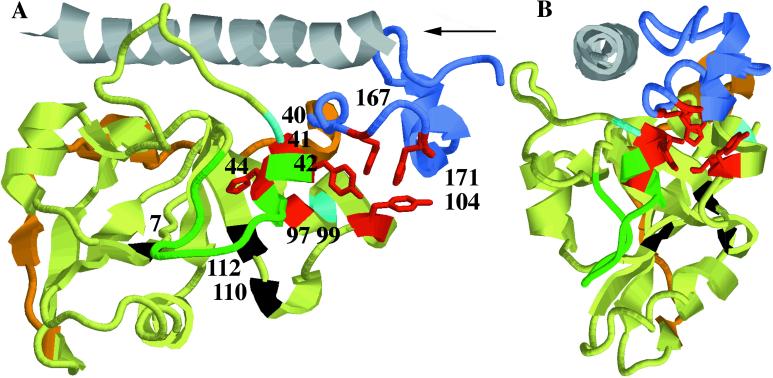
Cartoon diagram of CTA1 and CTA2 showing residues proposed to interact with ARF6. Only residues 196–226 of CTA2 are shown, in gray. Subdomains of CTA1 are colored light green (globular A11, 1–132), orange (extended bridge A12, 133–161), and blue (globular hydrophobic A13, 162–192). The loop (41–56) that partially occludes the active site is shown in green. Individual residues that affected interaction of CTA1 with ARF6 are colored red, and among these the side chains of the aromatic residues are shown in stick format. Residues 40 and 99 that have only partial effects on ARF interaction are colored cyan. Residues where enzyme-inactivating substitutions (R7K, E110D + E112D) were made in parental constructs are shown in black. (A) Individual residues are identified by number. The arrow denotes the point of view for (B), down the axis of the A2 α helix.

References

    1. Kaper J B, Morris J G, Jr, Levine M M. Clin Microbiol Rev. 1995;8:48–86. - PMC - PubMed
    1. Spangler B D. Microbiol Rev. 1992;56:622–647. - PMC - PubMed
    1. Mekalanos J J, Collier R J, Romig W R. J Biol Chem. 1979;254:5855–5861. - PubMed
    1. Galloway T S, van Heyningen S. Biochem J. 1987;244:225–230. - PMC - PubMed
    1. Moss J, Vaughan M. Cell Signalling. 1993;5:367–379. - PubMed

Publication types

MeSH terms

LinkOut - more resources