. 2000 Nov-Dec;21(10):1830-6.

High-b-value diffusion-weighted MR imaging of adult brain: image contrast and apparent diffusion coefficient map features

Affiliations

High-b-value diffusion-weighted MR imaging of adult brain: image contrast and apparent diffusion coefficient map features

M C DeLano et al. AJNR Am J Neuroradiol. 2000 Nov-Dec.

Abstract

Background and purpose: Recent improvements in MR gradient technology allow significant increases in diffusion weighting without prohibitive signal-to-noise degradation. The purpose of our investigation was to establish normative references for the signal intensity characteristics and apparent diffusion coefficient values of the adult brain at high b values.

Methods: Fifty adults underwent diffusion-weighted single-shot spin-echo echo-planar MR imaging. Isotropic diffusion-weighted images were obtained with b values of 0, 1,000, 2,000, 2,500, 3,000, and 3,500 s/mm2. Qualitative assessments were made in multiple regions of interest in gray and white matter. Three apparent diffusion coefficient maps were generated for each of six patients with a 2-point technique at a b value of 0 and at b values of 1,000, 2,000, and 3,000 s/mm2.

Results: Increasing b values result in a progressive decrease in the gray to white matter signal intensity ratio. Isointensity between gray and white matter results at b values between 1,000 and 2,000 s/mm2. At b values greater than 2,000, the gray-white pattern reverses relative to the usual b value of 1,000. Apparent diffusion coefficient values were shown to decrease with increasing b values.

Conclusion: Attention to the reversal of gray-white contrast and the dependence of apparent diffusion coefficient on the b value are important in avoiding erroneous assignment of pathologic abnormalities to normal regions. This study provides the normative data for future diffusion investigations performed at high b values.


Figures
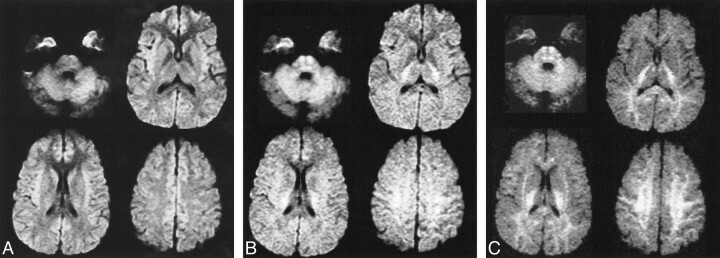
<sc>fig</sc> 1.
fig 1.
Isotropic diffusion-weighted images with varying b values. A, Image obtained with a b value of 1000 and 72/1 (TE/excitations). There is hyperintensity of cortical gray matter, particularly in the insular and medial frontal regions. B, Image obtained with a b value of 2000 and 84/2. Near isointensity of gray and white matter is seen with slight hyperintensity of posterior capsular white matter and pontine regions. C, Image obtained with a b value of 3500 and 96/4. Progressive hyperintensity of white matter is present with diminished gray matter signal intensity.
<sc>fig</sc> 2.
fig 2.
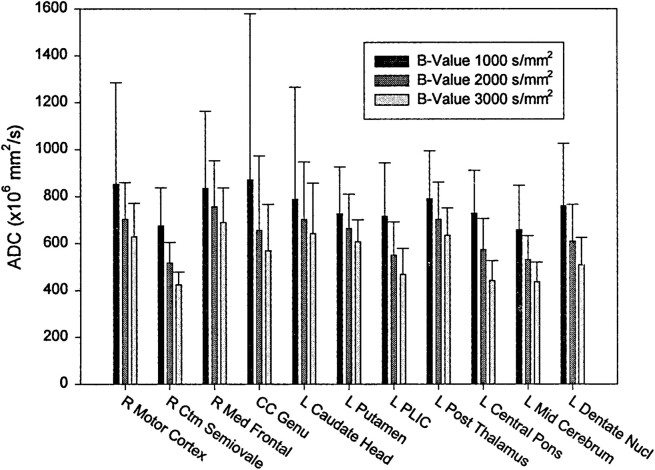
Mean ADC values with SDs for ROI in six participants. Echo time was fixed at 96 ms for all acquisitions. The numbers of excitation were varied to improve signal-to-noise ratios at higher b values: numbers of excitation were one, two, and four for b values of 1000, 2000, and 3000, respectively. ADC values diminish with increasing b values. ADC SDs decrease with multiple numbers of excitaiton
<sc>fig</sc> 3.
fig 3.
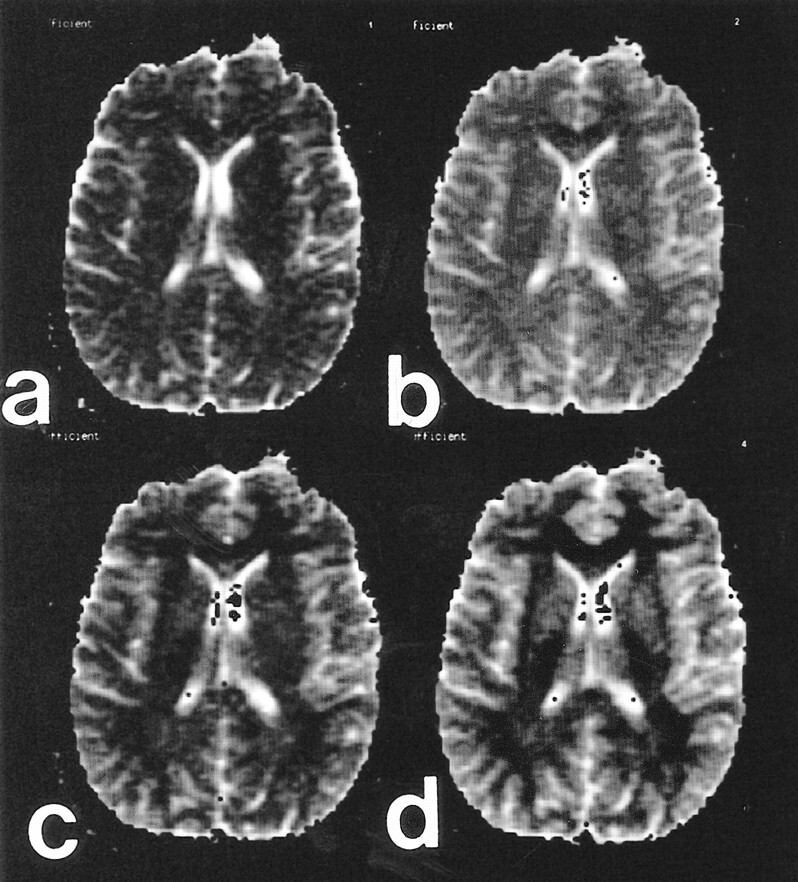
ADC maps at varying b values. Improved gray-white differentiation is noted with increased b value. A, b = 1000; B, b = 2000; C, b = 2500; and D, b = 3500
<sc>fig</sc> 4.
fig 4.
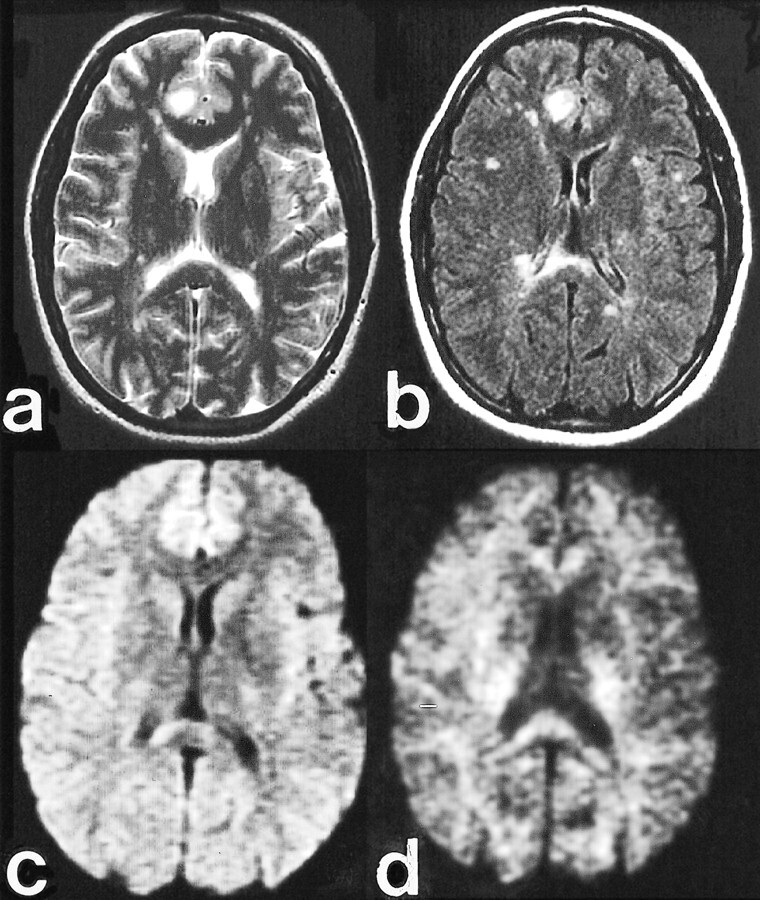
Clinical case of multiple sclerosis. A, Fast spin-echo axial T2-weighted image (4000/102/2 [TR/TE/excitations]) shows a dominant subcortical right cingulate gyrus lesion with marked hyperintensity. B, Fast-FLAIR image (10000/145/2200/1 [TR/TE/excitations]) highlights additional subcortical and periventricular plaques, including a large lesion in the right side of the splenium. C, Diffusion-weighted image (10000/72/1) obtained with b = 1000 s/mm2 reveals slight hyperintensity in the right cingulate lesion, similar to the contralateral mesial frontal region, and hyperintensity in the right splenium lesion. D, Diffusion-weighted image (10000/96/1) obtained with b = 3500 s/mm2 reveals marked hypointensity in the right cingulate lesion, likely reflecting reduced T2 weighting and less T2 shine-through. Persistent hyperintensity in the right splenium lesion is likely due to the normal anisotropy of the splenium and inconspicuity of hypointense lesions adjacent to the CSF spaces. This emphasizes the complementary relationship of the diffusion-weighted acquisitions obtained at standard and high b values.
<sc>fig</sc> 5.
fig 5.
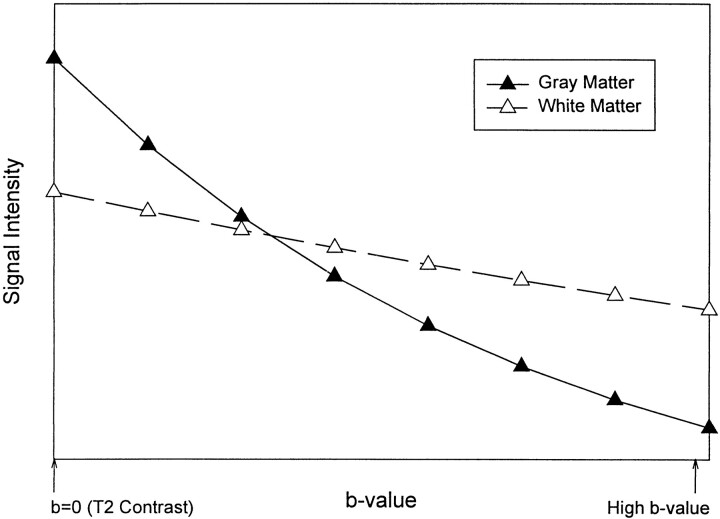
Reversal of gray-white matter contrast with increasing b values. Relative signal intensity values obtained from equation 2 in the text

Comment in

  • Diffusing into the future.
    Sze G, Anderson A. Sze G, et al. AJNR Am J Neuroradiol. 2000 Nov-Dec;21(10):1780-2. AJNR Am J Neuroradiol. 2000. PMID: 11110526 Free PMC article. No abstract available.

References

    1. Le Bihan D, Breton E, Lallemand D, Grenier P, Cabanis E, Laval-Jeantet M. MR imaging of intravoxel incoherent motions: application to diffusion and perfusion in neurologic disorders. Radiology 1986;161:401-407 - PubMed
    1. Warach S, Chien D, Li W, Ronthal M, Edelman RR. Fast magnetic resonance diffusion-weighted imaging of acute human stroke. Neurology 1992;42:1717-1723 - PubMed
    1. Chien D, Kwong KK, Gress DR, Buonanno FS, Buxton RB, Rosen BR. MR diffusion imaging of cerebral infarction in humans. AJNR Am J Neuroradiol 1992;13:1097-1102 - PMC - PubMed
    1. Yuh WT, Crain MR, Loes DJ, Greene GM, Ryals TJ, Sato Y. MR imaging of cerebral ischemia: findings in the first 24 hours. AJNR Am J Neuroradiol 1991;12:621-629 - PMC - PubMed
    1. Lovblad KO, Baird AE, Schlaug G, et al. Ischemic lesion volumes in acute stroke by diffusion-weighted magnetic resonance imaging correlate with clinical outcome. Ann Neurol 1997;42:164-170 - PubMed

Publication types

LinkOut - more resources