. 2000 Dec 1;14(23):3024-36.
doi: 10.1101/gad.852200.

Arabidopsis NAC1 transduces auxin signal downstream of TIR1 to promote lateral root development

Affiliations

Arabidopsis NAC1 transduces auxin signal downstream of TIR1 to promote lateral root development

Q Xie et al. Genes Dev. .

Abstract

Auxin plays a key role in lateral root formation, but the signaling pathway for this process is poorly understood. We show here that NAC1, a new member of the NAC family, is induced by auxin and mediates auxin signaling to promote lateral root development. NAC1 is a transcription activator consisting of an N-terminal conserved NAC-domain that binds to DNA and a C-terminal activation domain. This factor activates the expression of two downstream auxin-responsive genes, DBP and AIR3. Transgenic plants expressing sense or antisense NAC1 cDNA show an increase or reduction of lateral roots, respectively. Finally, TIR1-induced lateral root development is blocked by expression of antisense NAC1 cDNA, and NAC1 overexpression can restore lateral root formation in the auxin-response mutant tir1, indicating that NAC1 acts downstream of TIR1.


Figures
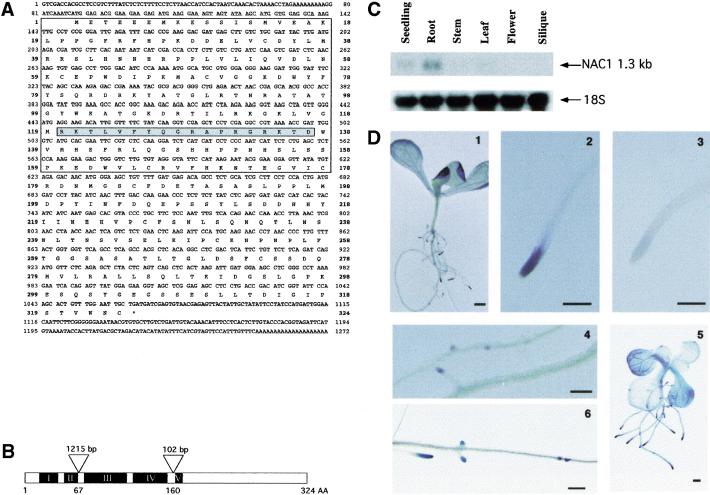
Figure 1
Figure 1
Nucleotide sequence and expression pattern of the NAC1 gene. (A) Nucleotide and amino acid sequences of NAC1 gene. The highly conserved region of NAC family members is boxed, and the putative bipartite nuclear localization signal is shaded (GenBank accession no. AF198054). (B) A schematic diagram showing the genomic structure of the NAC1 gene (GenBank accession no. AC002304). Open triangles represent introns. The first intron is 1215 nucleotides in length, with its 5′ splice junction at position bp 288 of the cDNA, and the second intron is 102 nucleotides, with its 5′ splice junction at position 568. The five conserved regions within NAC family members are indicated by I–V. AA, amino acid. (C) Organ-specific expression of the NAC1 gene. Seedlings were harvested from 2-wk-old plants. Cauline leaves (leaf), main and lateral stems (stem), flower clusters (flower), and siliques at different stages and maturity (silique) were harvested from 35–40-d-old plants grown in a growth chamber. Roots were taken from 2-wk-old seedlings grown vertically on MS medium. The filter was hybridized with a NAC1 cDNA 3′ fragment encoding the C-terminal region (amino acids 200–324) of NAC1. The 18S rRNA was used as a loading control. (D) Tissue-specific expression of NAC1. Whole-mount in situ hybridization was performed with a digoxigenin-labeled (DIG) NAC1 cDNA 3′ fragment encoding the C-terminal region (amino acids 200–324) of NAC1 (1,2,4) and with a DIG-labeled sense probe (3). NAC1–GUS expression in 10-d-old seedlings (5,6). Scale bar, 0.1 mm.
Figure 2
Figure 2
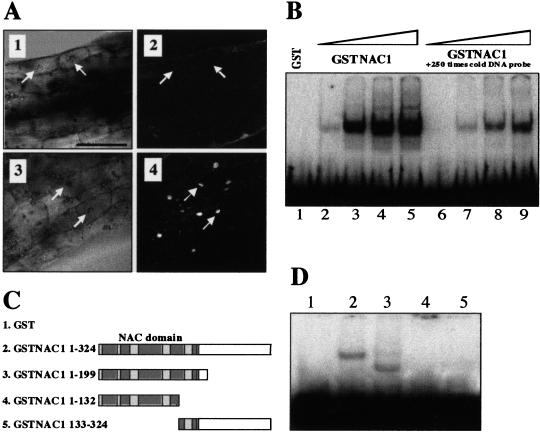
Nuclear localization and DNA binding of NAC1 protein. (A) Nuclear localization of NAC1 protein. Transgenic plants carrying a GFP–NAC1 fusion gene under the control of a dex-inducible promoter (Aoyama and Chua 1997) were germinated on MS medium with 3% sucrose in the absence or presence of dexamethasone in the dark, as described in Materials and Methods. Hypocotyl regions of etiolated seedlings were analyzed by confocal microscopy. (1,2) No dexamethasone; (3,4) with 10 μM dexamethasone; (1,3) transmitted light reference image of hypocotyl cells; (2) no fluorescence was detected; (4) induced fluorescence expression of GFP–NAC1. Arrows indicate the position of nucleus in the cells. (B) Interaction of GST–NAC1 fusion protein with the −90 to +9 fragment of CaMV 35S promoter. Lane 1, 500 ng of GST; lanes 2,6, 10 ng of GST–NAC1; lanes 3,7, 100 ng of GST–NAC1; lanes 4,8, 250 ng of GST–NAC1; lanes 5,9, 500 ng of GST–NAC1. Lanes 6–9 contained 250-fold of unlabeled −90 to +9 fragment of 35S promoter. (C) A schematic diagram showing the different NAC1 protein derivatives used for the DNA gel shift experiment in D. Numbers indicate the amino acid residue at the N and C termini of the various NAC1 derivatives. (D) Interaction of the various NAC1 derivatives with the −90 to +9 fragment of the 35S promoter. (1) GST; (2) GST–NAC1 (1–324); (3) GST–NAC1 (1–199); (4) GST–NAC1 (1–132); (5) GST–NAC1 (133–324). 20 ng of each recombinant protein was used.
Figure 3
Figure 3
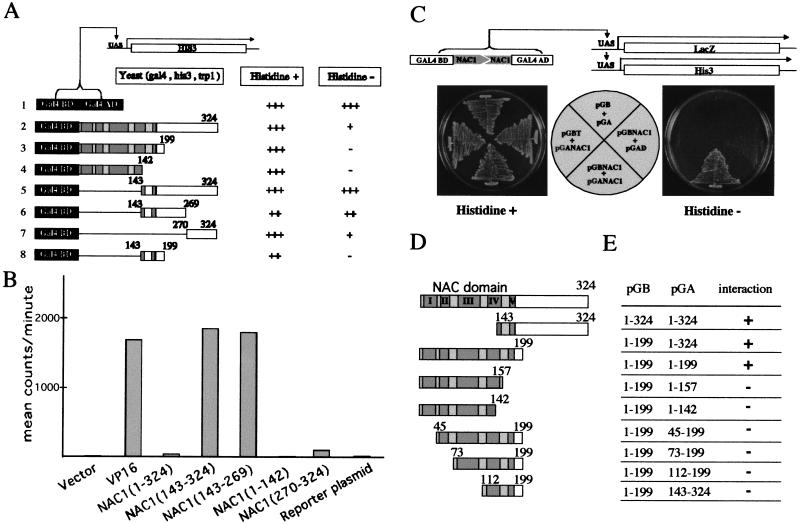
Localization of the transactivation and the dimerization domain of NAC1. (A) Transactivation analysis of NAC1 in yeast. NAC1 cDNA fragments encoding different portions of NAC1 were fused to DNA sequences encoding the Gal4 DNA binding domain in the yeast vector pGBT8 and transformed into yeast strain HF7c. The transformation mixture was plated on MM plates with or without histidine and the necessary amino acids. The plates were incubated for 3 d, and the results were scored. (B) Transactivation domain analysis of NAC1 in vivo. NAC1 cDNA fragments encoding different portions of NAC1 were cloned into the plasmid pGal and cobombarded into onion skin cells with the reporter gene plasmid pTALuc. Luciferase activities were measured by a highly sensitive camera CCS system-ST138S to determine luciferase bioluminscence (Millar et al. 1992). (C) Dimerization of NAC1 analyzed by yeast two-hybrid assay. Yeast HF7c cells were cotransformed with plasmids expressing the GAL4BD alone or GAL4BD–NAC1 fusion and the plasmids expressing the GAL4AD alone or fused to NAC1. Cells were streaked on plates with or without histidine plus 10 mM 3-AT (Sigma) according to the distribution shown in the center of picture. The ability to grow in the absence of histidine depends on the functional reconstitution of a GAL4 activity. The plates were incubated for 3 d, and the results were scored. (D) A schematic diagram showing the different NAC1 protein derivatives used for analysis of the NAC1 dimerization domain in yeast two-hybrid system. (E) Interaction between the different NAC1 derivatives. All conditions used were the same as indicated in C.
Figure 4
Figure 4
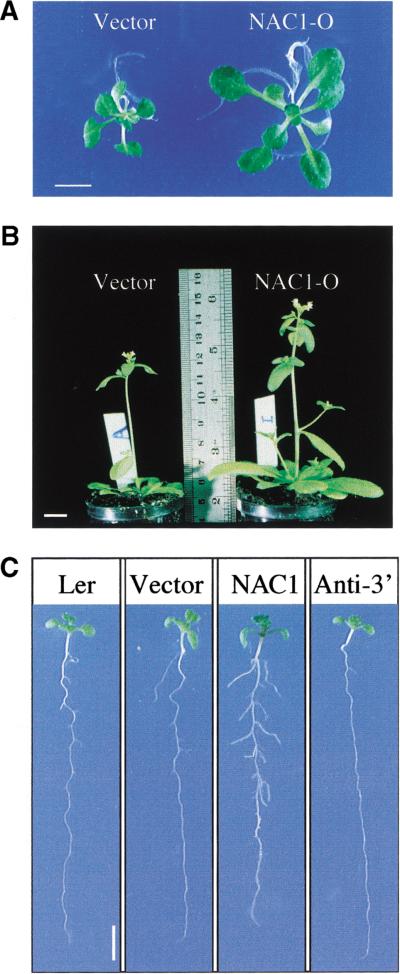
Phenotypes of transgenic plants WT and transgenic plants were either germinated on MS medium with 3% sucrose or transferred to soil and grown in a growth chamber. (A) Constitutive overexpression of the NAC1 gene produces bigger plants. Transgenic plants carrying a 35S::NAC1 transgene (NAC1-O) and transgenic plants carrying an empty vector (Vector) were germinated and grown on MS agar medium with 3% sucrose for 25 d. Scale bar, 0.5 cm. (B) Soil-grown NAC1 transgenic plants also show an overall bigger size. Transgenic plants carrying a 35S::NAC1 transgene (NAC1-O) and vector control (Vector) plants grown in soil for 35 d. Scale bar, 1 cm. (C) Effects of over- and underexpression of NAC1 on lateral root development. Wild-type landsberg ecotype (Ler) and transgenic plants carrying an empty vector (Vector), a 35S::NAC1 transgene (NAC1), and a 35S-antisense 3′ NAC1 (Anti-3′) were grown on MS agar medium with 3% sucrose. Plants were photographed after 14 d. Scale bar, 0.5 cm.
Figure 5
Figure 5
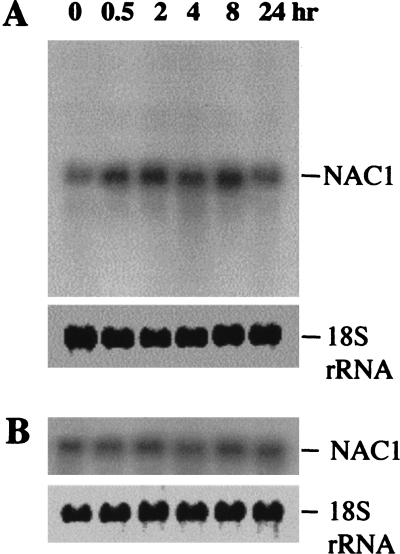
Induction of NAC1 gene expression by auxin. Roots were separated from wild-type seedlings and cultured as described in Materials and Methods. The active form of auxin, 1-NAA 2 μM was added to the culture, and samples were taken at different times for RNA preparation. The filter was hybridized with a NAC1 cDNA fragment encoding the NAC1 C-terminal region (amino acids 200–324). The 18S rRNA was used as a loading control. (A) 1-NAA dissolved in 50% ethanol was added to a final concentration of 2 μM. (B) As a control, the same volume of 50% ethanol was added.
Figure 6
Figure 6
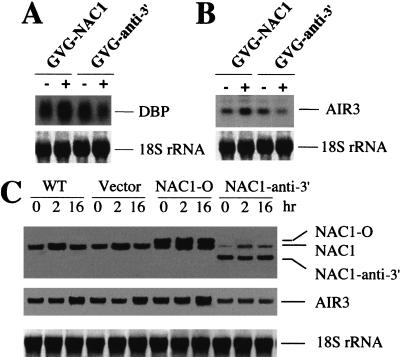
Northern analysis of DBP, AIR3, and NAC1 gene expression in the roots of transgenic plants. (A) Expression of DBP in roots of GVG-transgenic plants. A 300-bp DNA fragment encoding the C terminus of DBP isolated from differential display was used as a probe. GVG–NAC1, transgenic GVG–NAC1 overexpression plants; GVG–anti-3′, transgenic GVG–NAC1 expressing dex-regulated 3′-specific NAC1 antisense. (B) Expression of AIR3 in roots of GVG-transgenic plants. A 280-bp DNA fragment encoding the C terminus of AIR3 isolated from differential display was used as probe. (C) Northern blot analysis of NAC1 and AIR3 gene expression in auxin-treated root sample of transgenic plants. Roots were separated from the appropriate transgenic seedlings and cultured as described in Materials and Methods. 1-NAA was added to the cultures at a final concentration of 2 μM, and samples were taken at different time for RNA preparation. The probe for NAC1 is the same as Figure 1C. The AIR3 probe is the same as used in panel B. WT, untransformed wild-type plant; Vector, transgenic plants carrying the empty vector; NAC1-O, transgenic plants with the 35S::NAC1 transgene; NAC1-anti-3′, transgenic plants carrying 35S::anti-3′ NAC1.
Figure 7
Figure 7
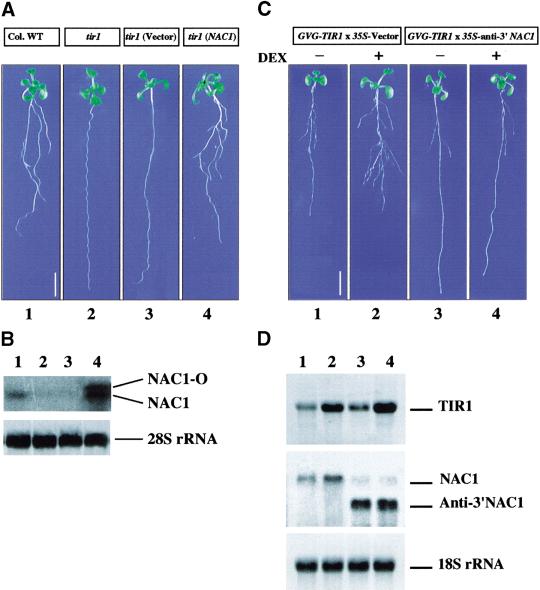
NAC1 acts downstream of TIR1 to promote lateral root development. (A) Wild-type Columbia ecotype (Col) plant (lane 1), tir1 mutant (lane 2), transgenic tir1 plants carrying an empty vector (lane 3), and transgenic tir1 plants carrying a 35S::NAC1 transgene (lane 4) were germinated and grown on MS agar medium with 3% sucrose. Plants were photographed after 12 d. Scale bar, 0.5 cm. (B) Northern blot analysis of NAC1 gene expression. RNA samples were collected from 2-wk-old seedlings. The filter was hybridized with a NAC1 cDNA fragment encoding the C-terminal region (amino acids 200–324) of NAC1. The 28S rRNA was used as a loading control. Lanes 1–4 were samples extracted from plants shown in lanes 1,2,3,4, respectively, in panel A. (C) Promotion of lateral root development by TIR1 is blocked by a NAC1 antisense transgene. A homozygous line carrying a GVG–TIR1 transgene (Gray et al. 1999) was crossed with a homozygous line carrying an empty vector control or a 35S-anti-3′ NAC1 transgene. F1 progeny from the cross was used in the experiments. Seven-day-old seedlings of GVG–TIR1 × 35S-vector and GV–TIR1 × 35S-anti-3′ NAC1 were incubated on MS or MS +30 μM DEX for 2 d and then transferred back to MS medium for an additional day. Plants were photographed (10 d old). Scale bar, 0.5 cm. The average number of lateral roots per seedling for GVG–TIR1 × 35S-vector (−Dex, lane 1) was 5.8; for GVG–TIR1 × 35S-vector (+Dex, lane 2) it was 9.8; for GVG–TIR1 × 35S-anti-3′ NAC1 (−DEX, lane 3) it was 2.2; and for GVG–TIR1 × 35S-anti-3′ NAC1 (+DEX, lane 4) it was 2.4. For each line, lateral roots from 30 seedlings were counted. (D) Northern blot analysis of TIR1 and NAC1 gene expression. RNA samples extracted from plants shown in panel C were used. A 1785-bp fragment covering the coding sequence of TIR1 was amplified by PCR and used as a probe. The probe for NAC1 was the same as that used in panel B. Lanes 1–4 were samples extracted from plants shown in lanes 1, 2, 3, and 4, respectively, in panel C.

References

    1. Aida M, Ishida T, Fukaki H, Fujisawa H, Tasaka M. Genes involved in organ separation in Arabidopsis: An analysis of the cup-shaped cotyledon mutant. Plant Cell. 1997;9:841–857. - PMC - PubMed
    1. Aida M, Ishida T, Tasaka M. Shoot apical meristem and cotyledon formation during Arabidopsis embryogenesis: Interaction among the CUP-SHAPED COTYLEDON and SHOOT MERISTEMLESS genes. Development. 1999;126:1563–1570. - PubMed
    1. Alliotte T, Tire C, Engler G, Peleman J, Caplan A, Van Montagu MM, Inze D. An auxin-regulated gene of Arabidopsis thaliana encodes a DNA-binding protein. Plant Physiol. 1989;89:743–752. - PMC - PubMed
    1. Aoyama T, Chua NH. A glucocorticoid-mediated transcriptional induction system in transgenic plants. Plant J. 1997;11:605–612. - PubMed
    1. Bartel PL, Chien C-T, Sternglanz R, Fields S. Using the two-hybrid system to detect protein–protein interactions. In: In: Hartley DA, editor. Cellular interactions in development: A practical approach. Oxford: Oxford University Press; 1993a. pp. 153–179.

Publication types

MeSH terms

Associated data