


Independent histories of human Y chromosomes from Melanesia and Australia
- PMID: 11115381
- PMCID: PMC1234911
- DOI: 10.1086/316949
Independent histories of human Y chromosomes from Melanesia and Australia
Abstract
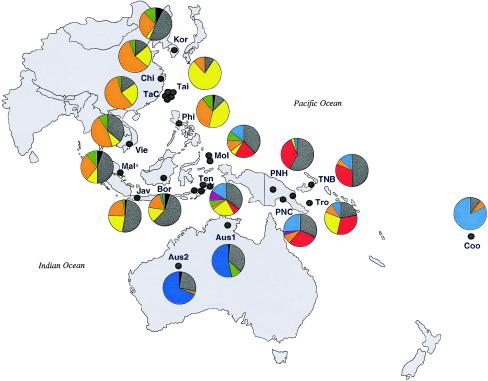
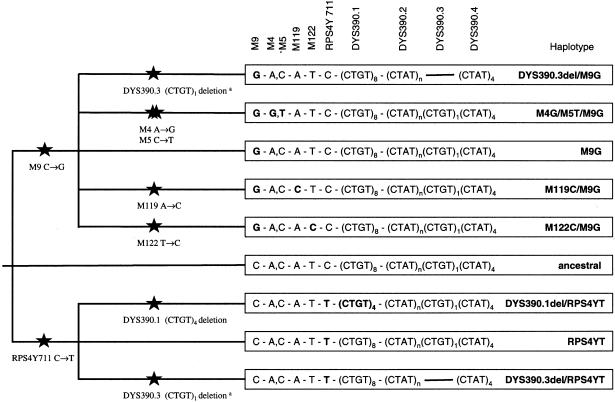
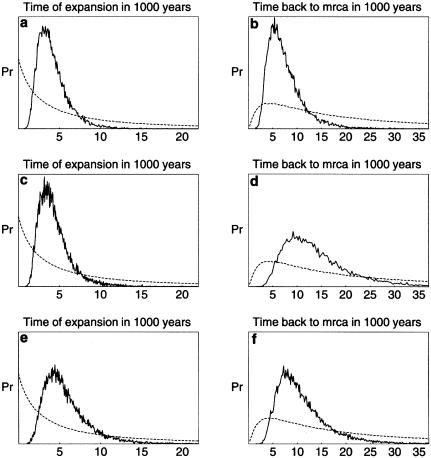
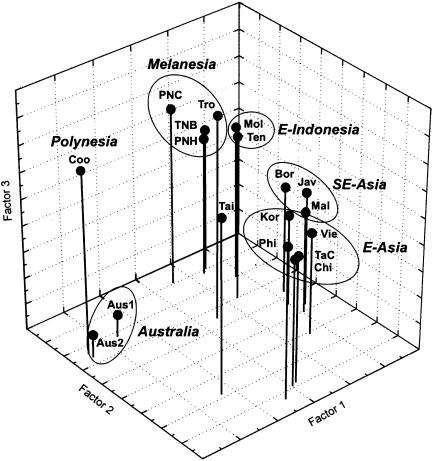
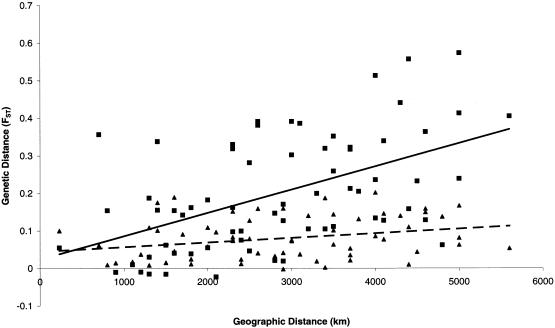
To investigate the origins and relationships of Australian and Melanesian populations, 611 males from 18 populations from Australia, Melanesia, and eastern/southeastern Asia were typed for eight single-nucleotide polymorphism (SNP) loci and seven short tandem-repeat loci on the Y chromosome. A unique haplotype, DYS390.1del/RPS4Y711T, was found at a frequency of 53%-69% in Australian populations, whereas the major haplotypes found in Melanesian populations (M4G/M5T/M9G and DYS390.3del/RPS4Y711T) are absent from the Australian populations. The Y-chromosome data thus indicate independent histories for Australians and Melanesians, a finding that is in agreement with evidence from mtDNA but that contradicts some analyses of autosomal loci, which show a close relationship between Australian and Melanesian (specifically, highland Papua New Guinean) populations. Since the Australian and New Guinean landmasses were connected when first colonized by humans > or =50,000 years ago but separated some 8,000 years ago, a possible way to reconcile all the genetic data is to infer that the Y-chromosome and mtDNA results reflect the past 8,000 years of independent history for Australia and New Guinea, whereas the autosomal loci reflect the long preceding period of common origin and shared history. Two Y-chromosome haplotypes (M119C/M9G and M122C/M9G) that originated in eastern/southeastern Asia are present in coastal and island Melanesia but are rare or absent in both Australia and highland Papua New Guinea. This distribution, along with demographic analyses indicating that population expansions for both haplotypes began approximately 4,000-6,000 years ago, suggests that these haplotypes were brought to Melanesia by the Austronesian expansion. Most of the populations in this study were previously typed for mtDNA SNPs; population differentiation is greater for the Y chromosome than for mtDNA and is significantly correlated with geographic distance, a finding in agreement with results of similar analyses of European populations.
Figures
References
Electronic-Database Information
-
- ARLEQUIN, http://lgb.unige.ch/arlequin/ (for ARLEQUIN version 2.000)
-
- Phylogenetic Network Analysis Shareware Software, http://www.fluxus-engineering.com/sharenet.htm (for Network 2.0b software)
-
- University of Aberdeen Department of Mathematical Sciences, http://www.maths.abdn.ac.uk/ (for BATWING)
References
-
- Allen B (1989) When did humans first colonize Australia? Search 20:149–154
-
- Allen J, Flannery T, Gosden C, Jones R, White JP (1988) Pleistocene dates for the human occupation of New Ireland, Northern Melanesia. Nature 331:707–709 - PubMed
-
- Bandelt H-J, Forster P, Rohl A (1999) Median-joining networks for inferring intraspecific phylogenies. Mol Biol Evol 16:37–48 - PubMed
-
- Bellwood PS (1978) Man's conquest of the Pacific: the prehistory of Southeast Asia and Oceania. Oxford University Press, Oxford
Publication types
MeSH terms
Substances
LinkOut - more resources
Full Text Sources
Miscellaneous
