Comparative Study
. 2000 Dec;124(4):1718-27.
doi: 10.1104/pp.124.4.1718.

Stunted plant 1 mediates effects of cytokinin, but not of auxin, on cell division and expansion in the root of Arabidopsis

Affiliations
Comparative Study

Stunted plant 1 mediates effects of cytokinin, but not of auxin, on cell division and expansion in the root of Arabidopsis

G T Beemster et al. Plant Physiol. 2000 Dec.

Abstract

Plants control organ growth rate by adjusting the rate and duration of cell division and expansion. Surprisingly, there have been few studies where both parameters have been measured in the same material, and thus we have little understanding of how division and expansion are regulated interdependently. We have investigated this regulation in the root meristem of the stunted plant 1 (stp1) mutation of Arabidopsis, the roots of which elongate more slowly than those of the wild type and fail to accelerate. We used a kinematic method to quantify the spatial distribution of the rate and extent of cell division and expansion, and we compared stp1 with wild type and with wild type treated with exogenous cytokinin (1 microM zeatin) or auxin (30 nM 2,4-dichlorophenoxyacetic acid). All treatments reduced average cell division rates, which reduced cell production by the meristem. Auxin lowered root elongation by narrowing the elongation zone and reducing the time spent by a cell in this zone, but did not decrease maximal strain rate. In addition, auxin increased the length of the meristem. In contrast, cytokinin reduced root elongation by lowering maximal strain rate, but did not change the time spent by a cell within the elongation zone; also, cytokinin blocked the increase in length and cell number of the meristem and elongation zone. The cytokinin-treated wild type phenocopied stp1 in nearly every detail, supporting the hypothesis that cytokinin affects root growth via STP1. The opposite effects of auxin and cytokinin suggest that the balance of these hormones may control the size of the meristem.


Figures

Figure 1
Figure 1
Time course of primary root elongation for Arabidopsis wild type, stp1, and wild type treated with 1 μm zeatin or 30 nm 2,4-D. Data are means ± se of 15 replicate plates, with five to eight seedlings per plate. In this and subsequent figures, data for the wild type are replotted from Beemster and Baskin (1998).
Figure 2
Figure 2
Spatial profiles of velocity (A) and strain rate (B) versus distance from the quiescent center on d 8 for Arabidopsis wild type, stp1, and wild type treated with 1.0 μm zeatin or 30 nm 2,4-D. In A, ticks at right give the final velocity measured for unmarked roots on d 8. C enlarges the apical 250 μm of B. Symbols are means ± se of five (2,4-D) or 10 roots, from d 8 (wild type and 2,4-D) or pooled from d 6 and 8 (stp1 and zeatin).
Figure 3
Figure 3
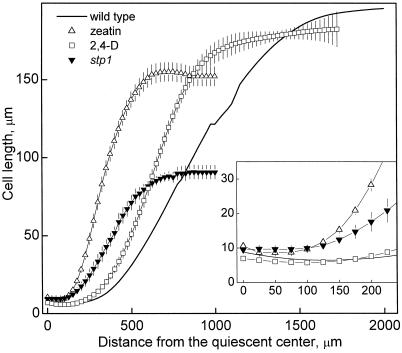
The spatial profile of cortical cell length versus distance from the quiescent center on d 8 for Arabidopsis wild type, stp1, and wild type treated with 1.0 μm zeatin or 30 nm 2,4-D. Cell length was measured in the same roots as used to obtain velocity data, and symbols are means ± se, as given for Figure 2. The wild-type cell length at positions greater than 800 μm from the quiescent center was not measured but was estimated by dividing the local velocity by the flux rate determined at the base of the meristem.
Figure 4
Figure 4
Spatial profile of cortical cell flux versus distance from the quiescent center on d 8 for Arabidopsis wild type, stp1, and wild type treated with 1.0 μm zeatin or 30 nm 2,4-D. A cell flux profile was obtained for each root and averaged; symbols are means ± se, as given for Figure 2.
Figure 5
Figure 5
Spatial profile of cortical cell deposition rate versus distance from the quiescent center on d 8 for Arabidopsis wild type, stp1, and wild type treated with 1.0 μm zeatin or 30 nm 2,4-D. Cell deposition rates were calculated for each root from Equation 1 and averaged. The local time-dependent change in cell density was zero for stp1 and zeatin-treated roots. Symbols are means ± se, as given for Figure 2.

References

    1. Barlow PW. Towards an understanding of the behavior of root meristems. J Theor Biol. 1976;57:433–451. - PubMed
    1. Baskin TI. On the constancy of cell division rate in the root meristem. Plant Mol Biol. 2000;43:545–554. - PubMed
    1. Baskin TI, Cork A, Williamson RE, Gorst JR. STUNTED PLANT 1, A gene required for expansion in rapidly elongating but not in dividing cells and mediating root growth responses to applied cytokinin. Plant Physiol. 1995;107:233–243. - PMC - PubMed
    1. Baskin TI, Wilson JE. Inhibitors of protein kinases and phosphatases alter root morphology and disorganize cortical microtubules. Plant Physiol. 1997;113:493–502. - PMC - PubMed
    1. Beemster GTS, Baskin TI. Analysis of cell division and elongation underlying the developmental acceleration of root growth in Arabidopsis thaliana. Plant Physiol. 1998;116:515–526. - PMC - PubMed

Publication types

LinkOut - more resources