


A recombinant newcastle disease virus with low-level V protein expression is immunogenic and lacks pathogenicity for chicken embryos
- PMID: 11119610
- PMCID: PMC113934
- DOI: 10.1128/JVI.75.1.420-428.2001
A recombinant newcastle disease virus with low-level V protein expression is immunogenic and lacks pathogenicity for chicken embryos
Abstract
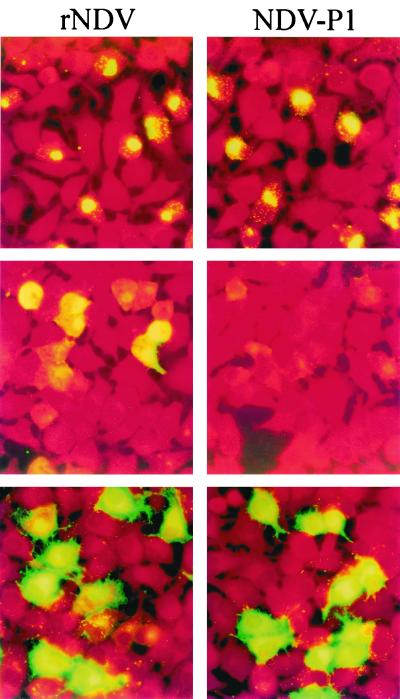
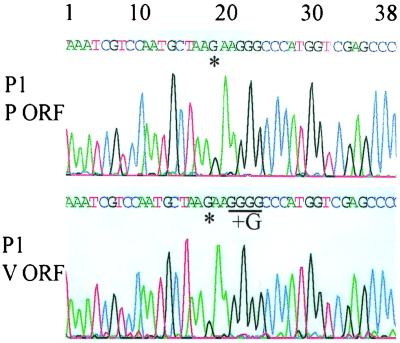
Newcastle disease virus (NDV) edits its P-gene mRNA by inserting a nontemplated G residue(s) at a conserved editing site (3'-UUUUUCCC-template strand). In the wild-type virus, three amino-coterminal P-gene-derived proteins, P, V, and W, are produced at frequencies of approximately 68, 29, and 2%, respectively. By applying the reverse genetics technique, editing-defective mutants were generated in cell culture. Compared to the wild-type virus, mutants lacking either six nucleotides of the conserved editing site or the unique C-terminal part of the V protein produced as much as 5, 000-fold fewer infectious progeny in vitro or 200,000-fold fewer in 6-day-old embryonated chicken eggs. In addition, both mutants were unable to propagate in 9- to 11-day-old embryonated specific-pathogen-free (SPF) chicken eggs. In contrast, a mutant (NDV-P1) with one nucleotide substitution (UUCUUCCC) grew in eggs, albeit with a 100-fold-lower infectious titer than the parent virus. The modification in the first two mutants described above led to complete abolition of V expression, whereas in NDV-P1 the editing frequency was reduced to less than 2%, and as a result, V was expressed at a 20-fold-lower level. NDV-P1 showed markedly attenuated pathogenicity for SPF chicken embryos, unlike currently available ND vaccine strains. These findings indicate that the V protein of NDV has a dual function, playing a direct role in virus replication as well as serving as a virulence factor. Administration of NDV-P1 to 18-day-old embryonated chicken eggs hardly affected hatchability. Hatched chickens developed high levels of NDV-specific antibodies and were fully protected against lethal challenge, demonstrating the potential use of editing-defective recombinant NDV as a safe embryo vaccine.
Figures



References
-
- Ahmad J, Sharma J M. Evaluation of a modified-live virus vaccine administered in ovo to protect chickens against Newcastle disease. Am J Vet Res. 1992;53:1999–2004. - PubMed
-
- Alexander D J. Newcastle disease. In: Purchase H G, Arp L H, Domermuth C H, Pearson J E, editors. A laboratory manual for the isolation and identification of avian pathogens. 3rd ed. Kennett Square, Pa: American Associations of Avian Pathologists, Inc.; 1989. pp. 114–120.
-
- Beard C W, Hanson R P. Newcastle disease. In: Hofstad M S, Barnes H J, Calnek B W, Reid W M, Yoder H W, editors. Diseases of poultry. Ames: Iowa State University Press; 1984. pp. 452–470.
-
- Conzelmann K-K. Nonsegmented negative-strand RNA viruses: genetics and manipulation of viral genomes. Annu Rev Genet. 1998;32:113–162. - PubMed
MeSH terms
Substances
LinkOut - more resources
Full Text Sources
Other Literature Sources
