. 2001 Jan 16;98(2):711-6.
doi: 10.1073/pnas.98.2.711. Epub 2000 Dec 19.

Acid-sensing ion channel 3 matches the acid-gated current in cardiac ischemia-sensing neurons

Affiliations

Acid-sensing ion channel 3 matches the acid-gated current in cardiac ischemia-sensing neurons

S P Sutherland et al. Proc Natl Acad Sci U S A. .

Abstract

Cardiac afferents are sensory neurons that mediate angina, pain that occurs when the heart receives insufficient blood supply for its metabolic demand (ischemia). These neurons display enormous acid-evoked depolarizing currents, and they fire action potentials in response to extracellular acidification that accompanies myocardial ischemia. Here we show that acid-sensing ion channel 3 (ASIC3), but no other known acid-sensing ion channel, reproduces the functional features of the channel that underlies the large acid-evoked current in cardiac afferents. ASIC3 and the native channel are both especially sensitive to pH, interact similarly with Ca(2+), and gate rapidly between closed, open, and desensitized states. Particularly important is the ability of ASIC3 and the native channel to open at pH 7, a value reached in the first few minutes of a heart attack. The steep activation curve suggests that the channel opens when four protons bind. We propose that ASIC3, a member of the degenerin channel (of Caenorhabditis elegans)/epithelial sodium channel family of ion channels, is the sensor of myocardial acidity that triggers cardiac pain, and that it might be a useful pharmaceutical target for treating angina.


Figures
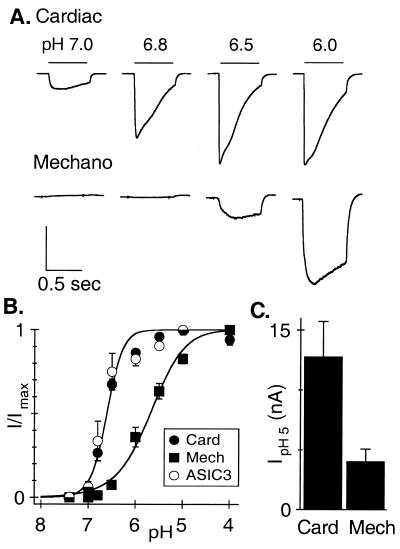
Figure 1
Figure 1
Cardiac afferents have larger and more sensitive acid-evoked currents than do nonnociceptive mechanosensors. (A) Currents evoked from a cardiac afferent and a mechano-sensing afferent by pulses to the indicated pH from pH 8. Vertical scales: 8 nA (Upper), 1 nA (Lower). Horizontal scale: 500 ms. (B) Average (± SEM) fractional current vs. pH. Solid lines are fits of the Hill equation for cardiac afferents (filled circles, n = 14, normalized to current evoked by pH 5) and mechanosensors (squares, n = 7, normalized to current evoked by pH 4). COS-7 cells expressing ASIC3 show an identical dose-response curve to that of cardiac afferents (open circles, pH0.5 = 6.6, n = 11, normalized to current evoked by pH 5, curve fit not shown). (C) Average amplitude of currents evoked by pH 5 in cardiac afferents (12.8 nA) is over 3 times larger than in mechanosensors (4.04 nA). Data are from the same cells used in B.
Figure 2
Figure 2
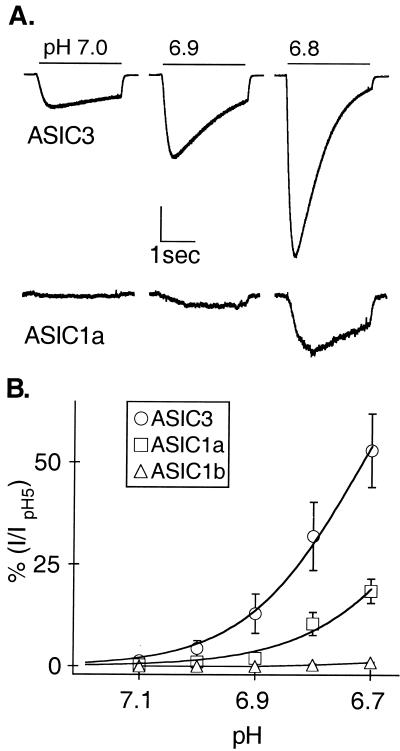
ASIC3 responds to protons in the neutral range. (A) Currents evoked from COS-7 cells expressing either ASIC3 or ASIC1a by steps to pH 7, 6.9, and 6.8. Vertical scale bar represents 10% of current evoked by pH 5 (2 nA ASIC3; 46 pA ASIC1a). Horizontal scale bar: 1 s. (B) Average currents of the indicated clones normalized to the value at pH 5.0 and fit with the Hill equation. Hill coefficients are 4.3 (ASIC3, pH0.5 6.7) and 3.9 (ASIC1a, pH0.5 6.4).
Figure 3
Figure 3
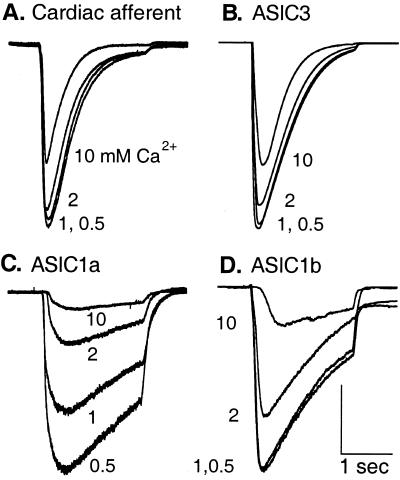
Only ASIC3 mimics kinetics and Ca2+ inhibition of cardiac afferents. Representative currents were evoked from a cardiac afferent (A) or from COS-7 cells expressing ASIC3 (B), ASIC1a (C), or ASIC1b (D) by steps of pH from 8.0 to 6.0 in the indicated extracellular Ca2+ concentrations (mM). Cardiac and ASIC3 channels parallel each other in activation kinetics, desensitization kinetics, and Ca2+ inhibition. Vertical scales: 1.1 nA (A), 14 nA (B), 1.5 nA (C), and 2 nA (D). Horizontal scales: 1 s for all traces.
Figure 4
Figure 4
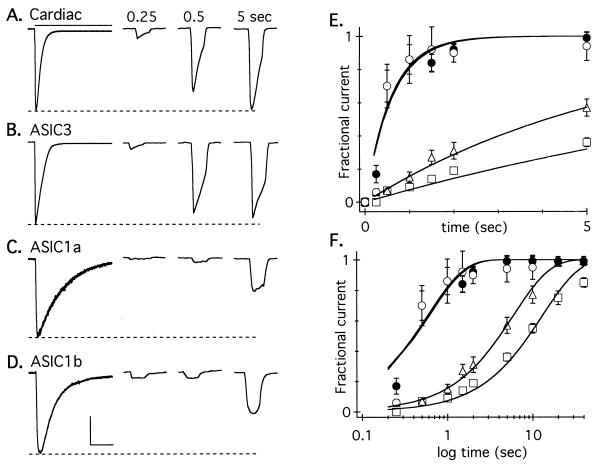
Only ASIC3 mimics recovery kinetics of cardiac afferents. Current was completely desensitized by a prolonged pulse to pH 6.0 (bar), and then the cell was returned to pH 7.4. Recovery from desensitization was tested by a 600-ms pH pulse triggered at the indicated times. (Only one pulse was given after each desensitizing prepulse, thereby avoiding accumulating desensitization; peak current occurs early in the 600-ms pulse, and this time to peak was not added to the recovery time.) Currents in a cardiac afferent (A) and ASIC3 (B) recovered rapidly; currents in ASIC1a (C) and 1b (D) recovered slowly. Horizontal scales: 2 s for desensitizing currents (leftmost), 1 s for test currents. Vertical scales: 1 nA (A), 1.25 nA (B), 0.45 nA (C), and 0.5 nA (D). The recovery of average (± SEM) currents, normalized to initial amplitude, for the first 5 s (E) (linear) and 40 s (F) (log scale) is given. Solid lines are fits of single exponentials. ●, cardiac afferents (τ = 0.61 s, n ≥ 4 for each data point); ○, ASIC3 (τ = 0.58 s, n ≥ 5); □, ASIC1a (τ = 12.99 s, n ≥ 4); ▵, ASIC1b (τ = 5.88 sec, n ≥ 3).
Figure 5
Figure 5
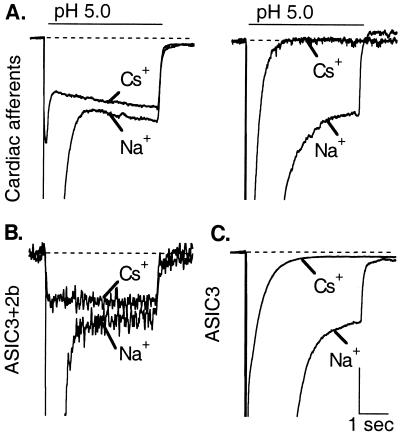
Variable expression of a sustained, nonselective current in cardiac afferents is consistent with variable expression of ASIC2b. Peak currents are off-scale to emphasize the smaller sustained component. (A) Currents, evoked by steps to pH 5 for 4 s, from two cardiac afferents that display sustained components that differ in selectivity. (Left) The sustained component is nonselective (passes Cs+ and Na+ equally). (Right) The sustained component is Na+ selective. (B) Coexpression of ASIC3 and 2b yields a nonselective sustained component. (C) The ASIC3 homomer yields a Na+-selective sustained component. Vertical scales: 600 pA (A Left), 150 pA (A Right), 35 pA (B), 500 pA (C). Horizontal scale: 1 s.

Comment in

  • Lactic acid: New roles in a new millennium.
    Gladden LB. Gladden LB. Proc Natl Acad Sci U S A. 2001 Jan 16;98(2):395-7. doi: 10.1073/pnas.98.2.395. Proc Natl Acad Sci U S A. 2001. PMID: 11209043 Free PMC article. No abstract available.

References

    1. Lewis T. Arch Intern Med (Moscow) 1932;49:713–727.
    1. Armour J A. Cardiovasc Res. 1999;41:41–54. - PubMed
    1. Pan H L, Longhurst J C, Eisenach J C, Chen S R. J Physiol (London) 1999;518:857–866. - PMC - PubMed
    1. Uchida Y, Murao S. Am J Physiol. 1975;228:27–33. - PubMed
    1. Cobbe S M, Poole-Wilson P A. J Mol Cell Cardiol. 1980;12:745–760. - PubMed

MeSH terms