


Use of preclinical data for selection of a phase II/III dose for evernimicin and identification of a preclinical MIC breakpoint
- PMID: 11120938
- PMCID: PMC90233
- DOI: 10.1128/AAC.45.1.13-22.2001
Use of preclinical data for selection of a phase II/III dose for evernimicin and identification of a preclinical MIC breakpoint
Abstract
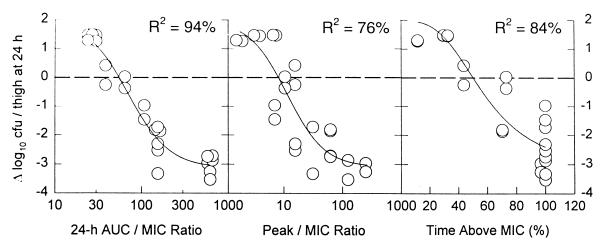
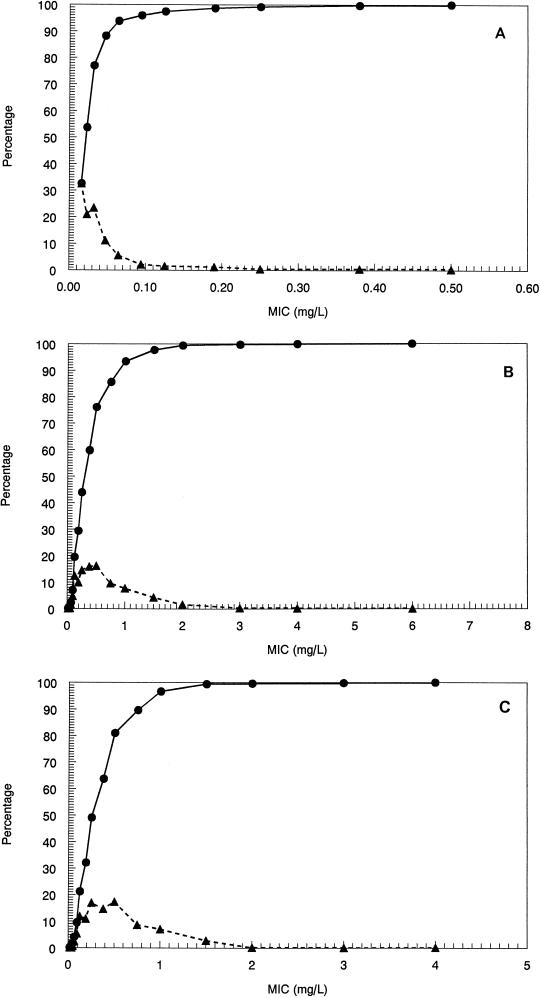
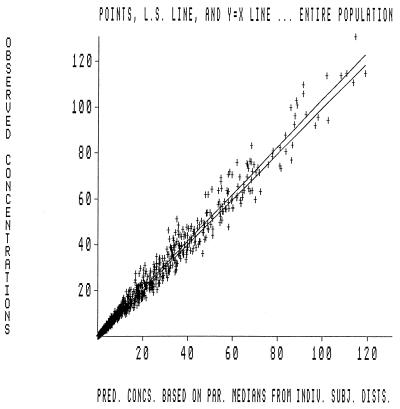
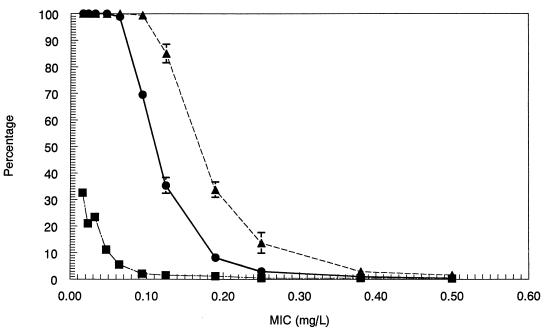
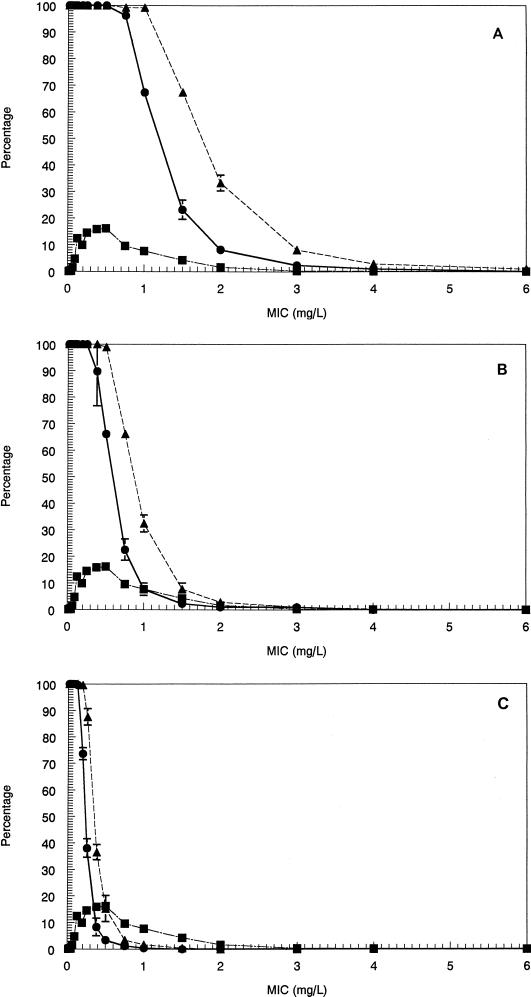
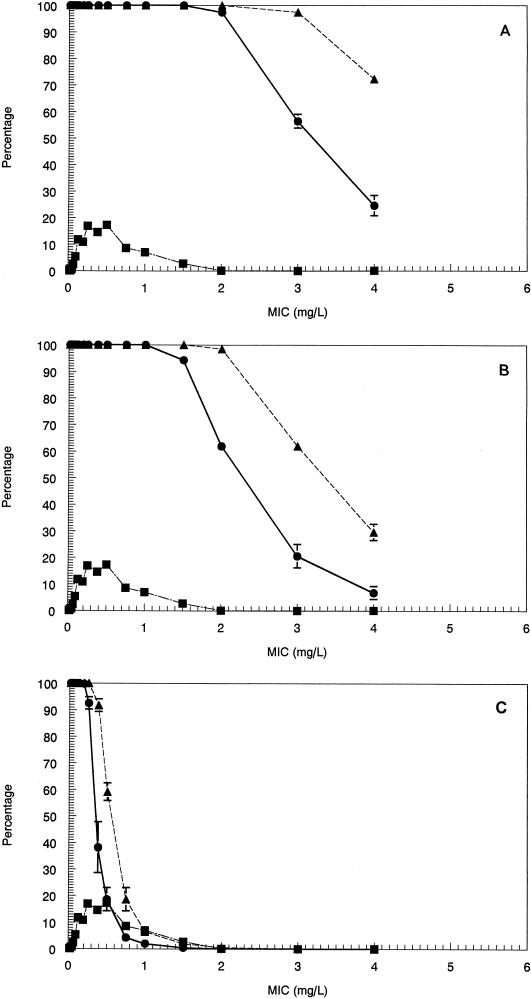
One of the most challenging issues in the design of phase II/III clinical trials of antimicrobial agents is dose selection. The choice is often based on preclinical data from pharmacokinetic (PK) studies with animals and healthy volunteers but is rarely linked directly to the target organisms except by the MIC, an in vitro measure of antimicrobial activity with many limitations. It is the thesis of this paper that rational dose-selection decisions can be made on the basis of the pharmacodynamics (PDs) of the test agent predicted by a mathematical model which uses four data sets: (i) the distribution of MICs for clinical isolates, (ii) the distribution of the values of the PK parameters for the test drug in the population, (iii) the PD target(s) developed from animal models of infection, and (iv) the protein binding characteristics of the test drug. In performing this study with the new anti-infective agent evernimicin, we collected a large number (n = 4,543) of recent clinical isolates of gram-positive pathogens (Streptococcus pneumoniae, Enterococcus faecalis and Enterococcus faecium, and Staphylococcus aureus) and determined the MICs using E-test methods (AB Biodisk, Stockholm, Sweden) for susceptibility to evernimicin. Population PK data were collected from healthy volunteers (n = 40) and patients with hypoalbuminemia (n = 12), and the data were analyzed by using NPEM III. PD targets were developed with a neutropenic murine thigh infection model with three target pathogens: S. pneumoniae (n = 5), E. faecalis (n = 2), and S. aureus (n = 4). Drug exposure or the ratio of the area under the concentration-time curve/MIC (AUC/MIC) was found to be the best predictor of microbiological efficacy. There were three possible microbiological results: stasis of the initial inoculum at 24 h (10(7) CFU), log killing (pathogen dependent, ranging from 1 to 3 log(10)), or 90% maximal killing effect (90% E(max)). The levels of protein binding in humans and mice were similar. The PK and PD of 6 and 9 mg of evernimicin per kg of body weight were compared; the population values for the model parameters and population covariance matrix were used to generate five Monte Carlo simulations with 200 subjects each. The fractional probability of attaining the three PD targets was calculated for each dose and for each of the three pathogens. All differences in the fractional probability of attaining the target AUC/MIC in this PD model were significant. For S. pneumoniae, the probability of attaining all three PD targets was high for both doses. For S. aureus and enterococci, there were increasing differences between the 6- and 9-mg/kg evernimicin doses for reaching the 2 log killing (S. aureus), 1 log killing (enterococci), or 90% E(max) AUC/MIC targets. This same approach may also be used to set preliminary in vitro MIC breakpoints.
Figures
References
-
- Blaser J, Stone B B, Groner M C, Zinner S H. Comparative study with enoxacin and netilmicin in a pharmacodynamic model to determine importance of ratio of antibiotic peak concentration to MIC for bactericidal activity and emergence of resistance. Antimicrob Agents Chemother. 1987;31:1054–1060. - PMC - PubMed
-
- Craig W A. Pharmacokinetic/pharmacodynamic parameters: rationale for antibacterial dosing of mice and men. Clin Infect Dis. 1998;26:1–10. - PubMed
-
- D'Argenio D Z, Schumitzky A. ADAPT II user's guide. Los Angeles: University of Southern California; 1995.
-
- Drusano G L, Aweeka F, Gambertoglio J, Jacobson M, Polis M, Lane H C, Eaton C, Martin-Munley S. Relationship between foscarnet exposure, baseline cytomegalovirus blood culture and the time to progression of cytomegalovirus retinitis in HIV-positive patients. AIDS. 1996;10:1113–1119. - PubMed
-
- Drusano G L, Bilello J A, Stein D S, Nessly M, Meibohm A, Emini E A, Deutsch P, Condra J, Chodakewitz J, Holder D J. Factors influencing the emergence of resistance to indinavir: role of virologic, immunologic, and pharmacologic variables. J Infect Dis. 1998;178:360–367. - PubMed
MeSH terms
Substances
LinkOut - more resources
Full Text Sources
Medical
Miscellaneous
