Pharmacological basis for concentration-controlled therapy with zidovudine, lamivudine, and indinavir
- PMID: 11120972
- PMCID: PMC90267
- DOI: 10.1128/AAC.45.1.236-242.2001
Pharmacological basis for concentration-controlled therapy with zidovudine, lamivudine, and indinavir
Abstract
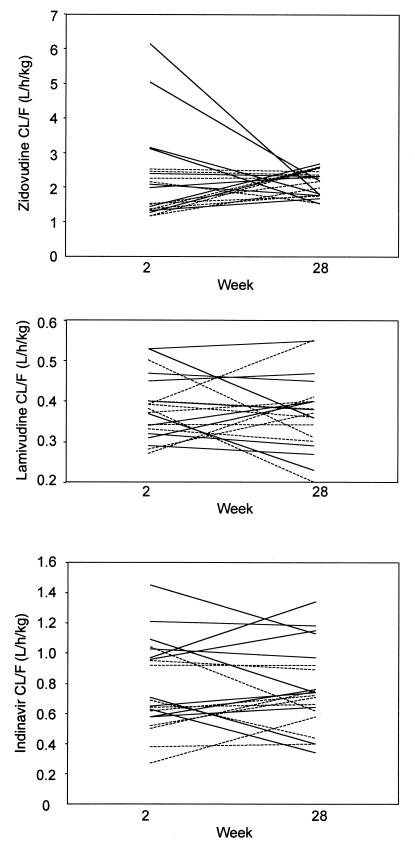
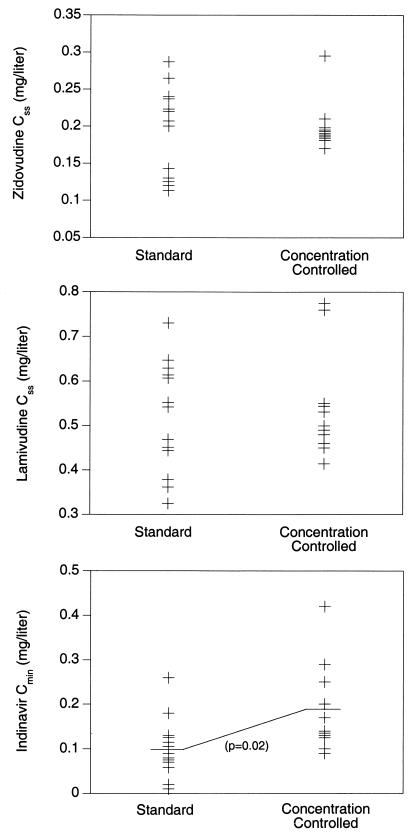
Conventional antiretroviral therapy involves administration of standard fixed doses to adults and adolescents. This approach ignores interindividual variability in pharmacokinetics and results in substantial differences in systemic concentrations among patients. Thus, variability in systemic concentrations contributes to variability in response to therapy. This study was designed to evaluate the feasibility and safety of a regimen of zidovudine, lamivudine, and indinavir designed to achieve select target concentrations versus standard dose therapy. Twenty-four antiretroviral-naïve subjects completed the 24-week study; 13 received standard therapy, and 11 received concentration-controlled therapy. There were no differences in baseline characteristics. Oral clearance for all three drugs was not different between weeks 2 and 28; average ratios of week 2 oral clearance to week 28 oral clearance were 0.95, 1.09, and 1.06 for zidovudine, lamivudine, and indinavir, respectively, with 95% confidence intervals including 1. The selected target concentrations were average steady-state concentrations of 0.19 mg/liter for zidovudine and 0.44 mg/liter for lamivudine and a trough concentration of 0.15 mg/liter for indinavir; mean concentrations achieved at week 28 in the concentration-controlled arm were 0.20, 0.54, and 0.19 mg/liter, respectively. Concentration-controlled therapy significantly reduced interpatient variability in zidovudine concentrations and significantly increased indinavir concentrations. There was no difference in adverse drug effects or adherence. This investigation has provided a pharmacologic basis for concentration-controlled therapy by demonstrating that it is feasible and has a safety profile no different from that of standard therapy. Additional studies to evaluate the virologic effect of the concentration-controlled approach to antiretroviral therapy are warranted.
Figures
References
-
- Acosta E P, Henry K, Baken L, Page L M, Fletcher C V. Indinavir concentrations and antiviral effect. Pharmacotherapy. 1999;19:708–712. - PubMed
-
- Acosta E P, Henry K, Page L M, Erice A, Balfour H H, Fletcher C V. Pharmacokinetics and safety of concentration-controlled oral zidovudine therapy. Pharmacotherapy. 1997;17:424–430. - PubMed
-
- Angel J, Hussey E, Hall S, Donn K, Morris D, McCormack J, Montaner J, Ruedy J. Pharmacokinetics of 3TC (GR109714X) administered with and without food to HIV-infected patients. Drug Investig. 1993;6:70–74.
-
- Beltangady M, Knupp C, Gustafson N, Barbhaiya R, Dolin R, Seidlin M, Cooley T, Rozencweig M. Relation between plasma concentrations of didanosine and markers of antiviral efficacy in adults with AIDS or AIDS-related complex. Clin Infect Dis. 1993;16:26–31. - PubMed
-
- Burger D M, Hoetelmans R M, Hugen P W, Mulder J W, Meenhorst P L, Koopmans P P, Brinkman K, Keuter M, Dolmans W, Hekster Y A. Low plasma concentrations of indinavir are related to virological treatment failure in HIV-1 infected patients on indinavir-containing triple therapy. Antivir Ther. 1998;3:215–220. - PubMed
Publication types
MeSH terms
Substances
Grants and funding
LinkOut - more resources
Full Text Sources
Medical