


The EMBL nucleotide sequence database
- PMID: 11125039
- PMCID: PMC29766
- DOI: 10.1093/nar/29.1.17
The EMBL nucleotide sequence database
Abstract
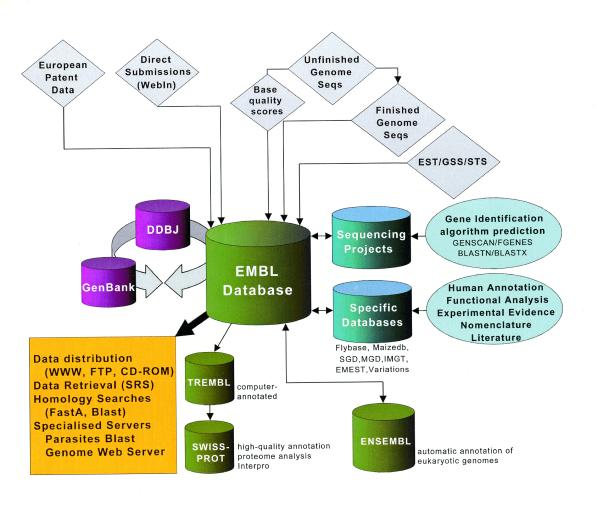
The EMBL Nucleotide Sequence Database (http://www.ebi.ac.uk/embl/) is maintained at the European Bioinformatics Institute (EBI) in an international collaboration with the DNA Data Bank of Japan (DDBJ) and GenBank at the NCBI (USA). Data is exchanged amongst the collaborating databases on a daily basis. The major contributors to the EMBL database are individual authors and genome project groups. Webin is the preferred web-based submission system for individual submitters, whilst automatic procedures allow incorporation of sequence data from large-scale genome sequencing centres and from the European Patent Office (EPO). Database releases are produced quarterly. Network services allow free access to the most up-to-date data collection via ftp, email and World Wide Web interfaces. EBI's Sequence Retrieval System (SRS), a network browser for databanks in molecular biology, integrates and links the main nucleotide and protein databases plus many specialized databases. For sequence similarity searching a variety of tools (e.g. Blitz, Fasta, BLAST) are available which allow external users to compare their own sequences against the latest data in the EMBL Nucleotide Sequence Database and SWISS-PROT.
Figures
References
-
- Wingender E., Chen,X., Hehl,R., Karas,H., Liebich,I., Matys,V., Meinhardt,T., Prüß,M., Reuter,I. and Schacherer,F. (2000) TRANSFAC: an integrated system for gene expression regulation. Nucleic Acids Res., 28, 316–319. Updated article in this issue: Nucleic Acids Res. (2001), 29, 281–283. - PMC - PubMed
MeSH terms
Substances
LinkOut - more resources
Full Text Sources
Other Literature Sources
Research Materials
