


The Medicago Genome Initiative: a model legume database
- PMID: 11125064
- PMCID: PMC29836
- DOI: 10.1093/nar/29.1.114
The Medicago Genome Initiative: a model legume database
Abstract
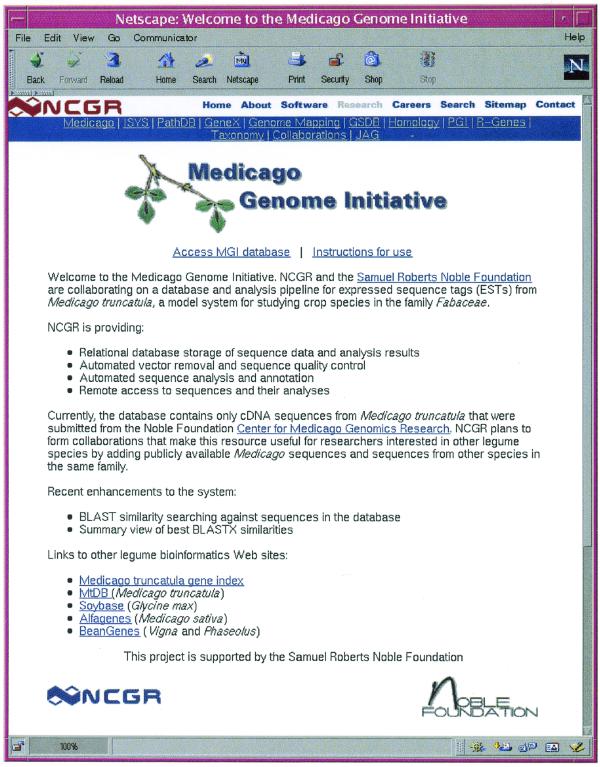
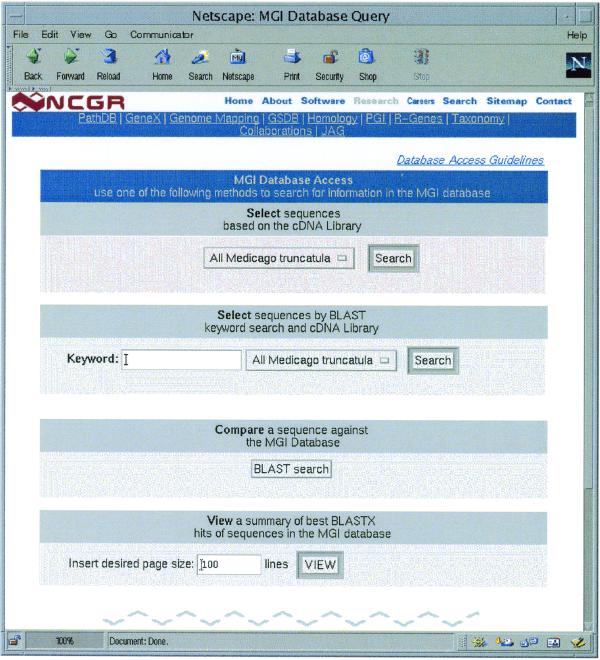
The Medicago Genome Initiative (MGI) is a database of EST sequences of the model legume MEDICAGO: truncatula. The database is available to the public and has resulted from a collaborative research effort between the Samuel Roberts Noble Foundation and the National Center for Genome Resources to investigate the genome of M.truncatula. MGI is part of the greater integrated MEDICAGO: functional genomics program at the Noble Foundation (http://www.noble.org ), which is taking a global approach in studying the genetic and biochemical events associated with the growth, development and environmental interactions of this model legume. Our approach will include: large-scale EST sequencing, gene expression profiling, the generation of M.truncatula activation-tagged and promoter trap insertion mutants, high-throughput metabolic profiling, and proteome studies. These multidisciplinary information pools will be interfaced with one another to provide scientists with an integrated, holistic set of tools to address fundamental questions pertaining to legume biology. The public interface to the MGI database can be accessed at http://www.ncgr.org/research/mgi.
Figures
References
-
- Barker D.G., Bianchi,S., Blondon,F., Dattée,Y., Duc,G., Essad,S., Flament,P., Gallusci,P., Génier,G., Guy,P., Muel,X., Tourneur,J., Dénarié,J. and Huguet,T. (1990) Medicago truncatula, a model plant for studying the molecular genetics of the Rhizobium-legume symbiosis. Plant Mol. Biol. Reporter, 8, 40–49.
-
- Cook D.R. (1999) Medicago truncatula – a model in the making! Curr. Opin. Plant Biol., 2, 301–304. - PubMed
-
- Trieu A.T., Burleigh,S.H., Kardailsky,I.V., Maldonado-Mendoza,I.E., Versaw,W.K., Blaylock,L.A., Shin,H., Chiou,T.-J., Katagi,H., Dewbre,G.R., Weigel,D. and Harrison,M.J. (2000) Transformation of Medicago truncatula via infiltration of seedlings or flowering plants with Agrobacterium. Plant J., 22, 531–542. - PubMed
-
- Harrison M.J. and Dixon,R.A. (1993) Isoflavonoid accumulation and expression of defense gene transcripts during the establishment of vesicular arbuscular mycorrhizal associations in roots of Medicago truncatula. Mol. Plant Microbe Interact., 6, 643–654.
-
- Dixon R.A. (1999) Isoflavonoids: Biochemistry, Molecular Biology, and Biological Functions. In Sankawa,U. (ed.), Comprehensive Natural Products Chemistry. Elsevier, Oxford, UK, Vol. 1, pp. 773–823.
Publication types
MeSH terms
LinkOut - more resources
Full Text Sources
Other Literature Sources
Research Materials
