


HUNT: launch of a full-length cDNA database from the Helix Research Institute
- PMID: 11125086
- PMCID: PMC29790
- DOI: 10.1093/nar/29.1.185
HUNT: launch of a full-length cDNA database from the Helix Research Institute
Abstract
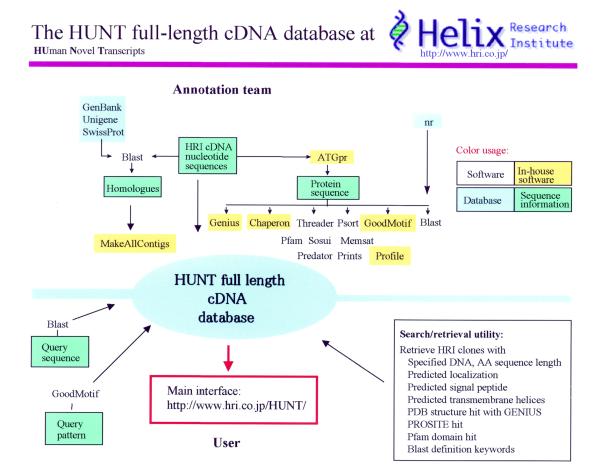
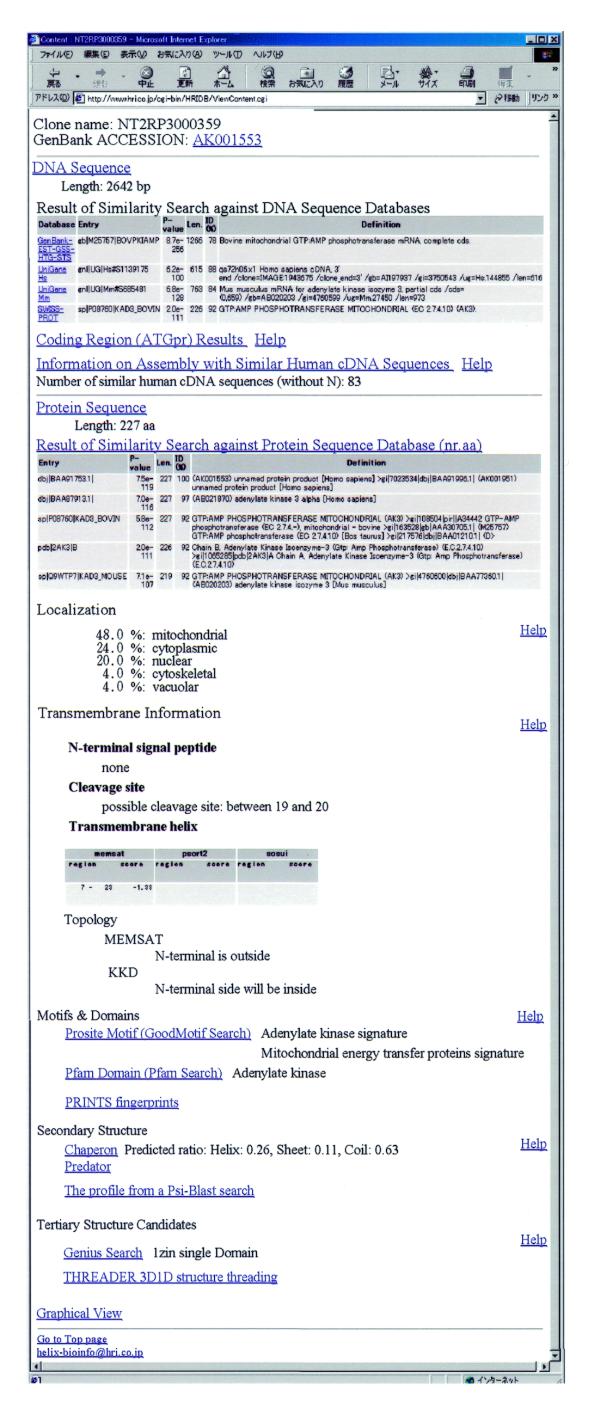
The Helix Research Institute (HRI) in Japan is releasing 4356 HUman Novel Transcripts and related information in the newly established HUNT database. The institute is a joint research project principally funded by the Japanese Ministry of International Trade and Industry, and the clones were sequenced in the governmental New Energy and Industrial Technology Development Organization (NEDO) Human cDNA Sequencing Project. The HUNT database contains an extensive amount of annotation from advanced analysis and represents an essential bioinformatics contribution towards understanding of the gene function. The HRI human cDNA clones were obtained from full-length enriched cDNA libraries constructed with the oligo-capping method and have resulted in novel full-length cDNA sequences. A large fraction has little similarity to any proteins of known function and to obtain clues about possible function we have developed original analysis procedures. Any putative function deduced here can be validated or refuted by complementary analysis results. The user can also extract information from specific categories like PROSITE patterns, PFAM domains, PSORT localization, transmembrane helices and clones with GENIUS structure assignments. The HUNT database can be accessed at http://www.hri.co.jp/HUNT.
Figures
References
-
- Ota T., Nishikawa,T., Suzuki,Y., Maruyama,K., Sugano,S. and Isogai,T. (1997) Full-length cDNA project toward a high throughput functional analysis. Microb. Comp. Genomics, 2, 204.
-
- Maruyama K. and Sugano,S. (1994) Oligo-capping: a simple method to replace the cap structure of eukaryotic mRNAs with Oligoribonucleotides. Gene, 138, 171–174. - PubMed
-
- Salamov A.A., Nishikawa,T. and Swindells,M.B. (1998) Assessing protein coding region integrity in cDNA sequencing projects. Bioinformatics, 14, 384–390. - PubMed
-
- Irie R., Masuho,Y. and Nagai,K. (2000) An Approach to Alternative Gene Transcripts Discovery through Assembly of Fragmental cDNA Sequences. In Miyano,S., Shamir,R. and Takagi,T. (eds), Currents in Computational Molecular Biology, Frontiers Science Series. Universal Academic Press, Inc., Tokyo, Vol. 30, pp. 109–110.
-
- Nakai K. and Horton,P. (1999) PSORT: a program for detecting sorting signals in proteins and predicting their subcellular localization. Trends Biochem. Sci., 24, 34–36. - PubMed
Publication types
MeSH terms
Substances
LinkOut - more resources
Full Text Sources
Other Literature Sources
