


After BRCA1 and BRCA2-what next? Multifactorial segregation analyses of three-generation, population-based Australian families affected by female breast cancer
- PMID: 11133358
- PMCID: PMC1235275
- DOI: 10.1086/318187
After BRCA1 and BRCA2-what next? Multifactorial segregation analyses of three-generation, population-based Australian families affected by female breast cancer
Abstract
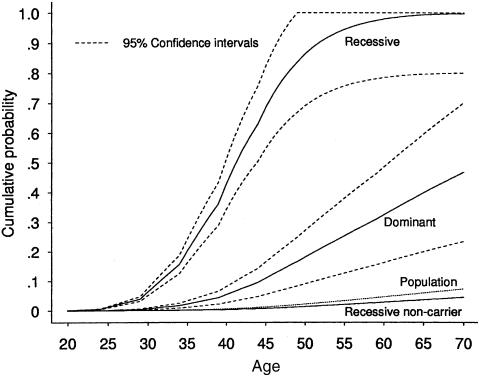
Mutations in BRCA1 and BRCA2 that cause a dominantly inherited high risk of female breast cancer seem to explain only a small proportion of the aggregation of the disease. To study the possible additional genetic components, we conducted single-locus and two-locus segregation analyses, with and without a polygenic background, using three-generation families ascertained through 858 women with breast cancer diagnosed at age <40 years, ascertained through population cancer registries in Melbourne and Sydney, Australia. Extensive testing for deleterious mutations in BRCA1 and BRCA2, to date, has identified 34 carriers. Our analysis suggested that, after other possible unmeasured familial factors are adjusted for and the known BRCA1 and BRCA2 mutation carriers are excluded, there appears to be a residual dominantly inherited risk of female breast cancer in addition to that derived from mutations in BRCA1 and BRCA2. This study also suggests that there is a substantial recessively inherited risk of early-onset breast cancer. According to the best-fitting model, after excluding known carriers of mutations in BRCA1 and BRCA2, about 1/250 (95% confidence interval [CI] 1/500 to 1/125) women have a recessive risk of 86% (95% CI 69%-100%) by age 50 years and of almost 100% by age 60 years. Possible reasons that our study has implicated a novel strong recessive effect include our inclusion of data on lineal aunts and grandmothers, study of families ascertained through women with early-onset breast cancer, allowance for multiple familial factors in the analysis, and removal of families for whom the cause (i.e., BRCA1 or BRCA2) is known. Our findings may have implications for attempts to identify new breast cancer-susceptibility genes.
Figures
References
Electronic-Database Information
-
- Online Mendelian Inheritance in Man (OMIM), http://www.ncbi.nlm.nih.gov/Omim (for breast cancer type 1, BRCA1 [MIM 113705] and breast cancer type 2, early-onset, BRCA2 [MIM 600185])
References
-
- Akaike H (1974) A new look at the statistical model identification. IEEE Trans Automatic Control AU 19:716–722
-
- Antoniou AC, Pharoah PDP, McMullan G, Day NE, Ponder BAJ, Easton DF. Evidence for further breast cancer susceptibility genes in addition to BRCA1 and BRCA2 in a population-based study. Genet Epidemiol (in press) - PubMed
-
- Australian Institute of Health and Welfare (1999) Breast cancer in Australian women 1982–1996. Australian Institute of Health and Welfare, Canberra
-
- Baffoe-Bonnie AB, Beaty TH, Bailey-Wilson JE, Kiemeney LA, Sigvaldason H, Olafsdottir G, Tryggvadottir L, Tulinius H (2000) Genetic epidemiology of breast cancer: segregation analysis of 389 Icelandic pedigrees. Genet Epidemiol 18:81–94 - PubMed
-
- Benichou J (1997) Absolute risk. In: Armitage P, Colton T (eds) Encyclopedia of biostatistics. John Wiley & Sons, Chichester, pp 11–27
Publication types
MeSH terms
Substances
Associated data
- Actions
- Actions
Grants and funding
LinkOut - more resources
Full Text Sources
Other Literature Sources
Medical
Molecular Biology Databases
Miscellaneous
