. 2001 Jan;67(1):22-32.
doi: 10.1128/AEM.67.1.22-32.2001.

Molecular ecology of tetracycline resistance: development and validation of primers for detection of tetracycline resistance genes encoding ribosomal protection proteins

Affiliations

Molecular ecology of tetracycline resistance: development and validation of primers for detection of tetracycline resistance genes encoding ribosomal protection proteins

R I Aminov et al. Appl Environ Microbiol. 2001 Jan.

Abstract

Phylogenetic analysis of tetracycline resistance genes encoding the ribosomal protection proteins (RPPs) revealed the monophyletic origin of these genes. The most deeply branching class, exemplified by tet and otrA, consisted of genes from the antibiotic-producing organisms Streptomyces rimosus and Streptomyces lividans. With a high degree of confidence, the corresponding genes of the other seven classes (Tet M, Tet S, Tet O, Tet W, Tet Q, Tet T, and TetB P) formed phylogenetically distinct separate clusters. Based on this phylogenetic analysis, a set of PCR primers for detection, retrieval, and sequence analysis of the corresponding gene fragments from a variety of bacterial and environmental sources was developed and characterized. A pair of degenerate primers targeted all tetracycline resistance genes encoding RPPs except otrA and tet, and seven other primer pairs were designed to target the specific classes. The primers were used to detect the circulation of these genes in the rumina of cows, in swine feed and feces, and in swine fecal streptococci. Classes Tet O and Tet W were found in the intestinal contents of both animals, while Tet M was confined to pigs and Tet Q was confined to the rumen. The tet(O) and tet(W) genes circulating in the microbiota of the rumen and the gastrointestinal tract of pigs were identical despite the differences in animal hosts and antibiotic use regimens. Swine fecal streptococci uniformly possessed the tet(O) gene, and 22% of them also carried tet(M). This population could be considered one of the main reservoirs of these two resistance genes in the pig gastrointestinal tract. All classes of RPPs except Tet T and TetB P were found in the commercial components of swine feed. This is the first demonstration of the applicability of molecular ecology techniques to estimation of the gene pool and the flux of antibiotic resistance genes in production animals.


Figures
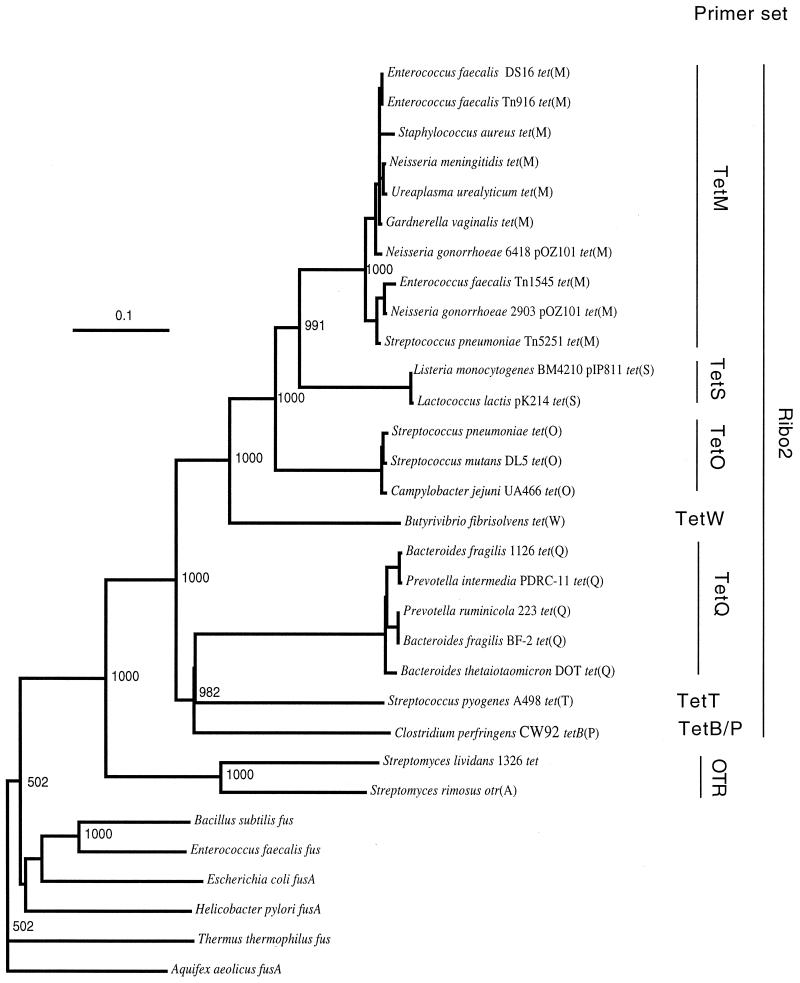
FIG. 1
FIG. 1
Phylogenetic placement of tetracycline resistance genes encoding RPPs. The sequence of the A. aeolicus fusA gene for translation elongation factor EF-G was used as the outgroup to root the tree. The number at each node is the number of times that that tree configuration occurred in 1,000 bootstrap trials. The scale bar indicates 0.1 fixed nucleotide substitution per sequence position. The sets of PCR primers (Table 1) targeting various classes of RPP genes are shown on the right.
FIG. 2
FIG. 2
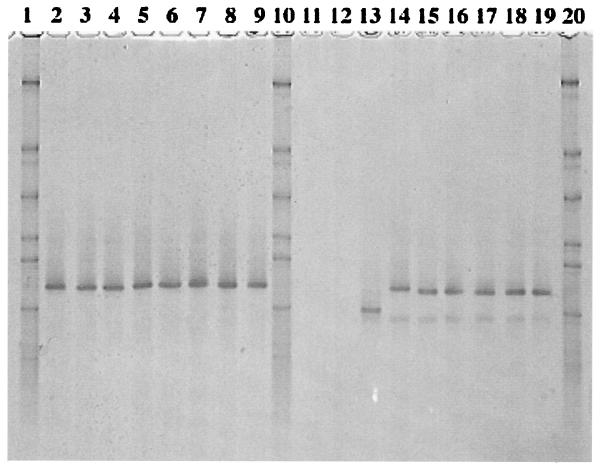
DGGE analysis of tet(W) amplicons from steer rumen and pig fecal samples. Lanes 1, 10, and 20, synthetic marker composed of known 16S rDNA sequences with various G+C contents; lanes 2 through 9, rumen samples from steers 277, 279, 280, 281, J277, J279, J280, and J281, respectively; lanes 11 and 12, negative controls pBT-1 [tet(Q)] and pJIR667 [ΔtetB(P)], respectively; lane 13, positive control pGEM-tetW [tet(W)]; lanes 14 through 19, fecal samples from pigs 1 through 6, respectively.
FIG. 3
FIG. 3
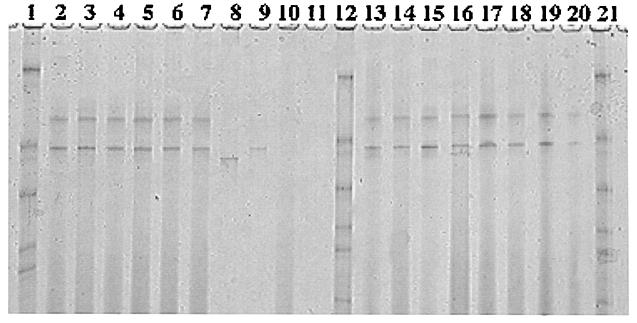
DGGE analysis of tet(O) amplicons from pig fecal and steer rumen samples. Lanes 1, 12, and 21, synthetic marker composed of known 16S rDNA sequences with various G+C contents; lanes 2 through 7, fecal samples from pigs 1 through 6, respectively; lanes 8 and 9, S. alactolyticus O19 and O31, respectively; lanes 10 and 11, negative controls pBT-1 [tet(Q)] and pJIR667 [ΔtetB(P)], respectively; lanes 13 through 20, rumen samples from steers 277, 279, 280, 281, J277, J279, J280, and J281, respectively.
FIG. 4
FIG. 4
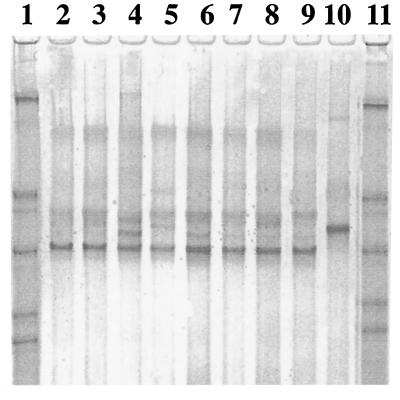
DGGE analysis of tet(Q) amplicons from steer rumen samples. Lanes 1 and 11, synthetic marker composed of known 16S rDNA sequences with various G+C contents; lanes 2 through 9, rumen samples from steers 277, 279, 280, 281, J277, J279, J280, and J281, respectively; lane 10, positive control pBT-1 [tet(Q)].
FIG. 5
FIG. 5
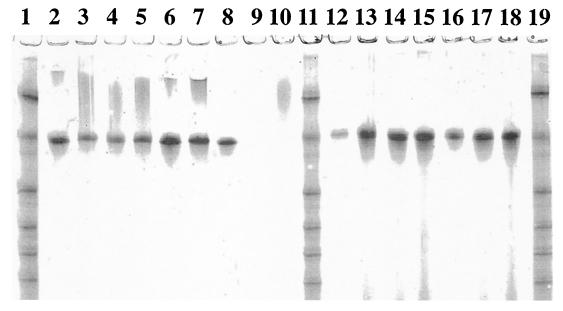
DGGE analysis of tet(M) amplicons from pig fecal samples and streptococcal isolates. Lanes 1, 11, and 19, synthetic marker composed of known 16S rDNA sequences with various G+C contents; lanes 2 through 7, fecal samples from pigs 1 through 6, respectively; lane 8, positive control pFD310 [tet(M)]; lanes 9 and 10, negative controls pBT-1 [tet (Q)] and PCR mixture without a template, respectively; lanes 12 through 18, S. alactolyticus M15, M113, M118, M33, M35, M30, and M32, respectively.
FIG. 6
FIG. 6
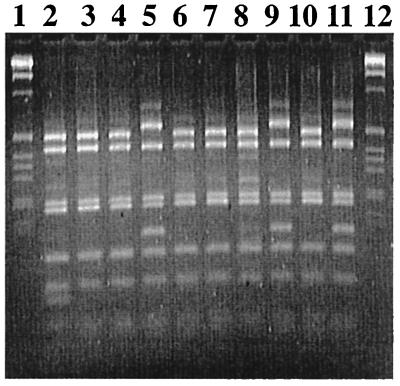
RFLP analysis of swine S. alactolyticus isolates. Lanes 1 and 12, 1-kb ladder (Gibco BRL); lanes 2 through 11, isolates M15, M19, M113, M118, M33, M35, M310, M312, M321, and O31, respectively. The first group includes only M15; the second group includes M19, M113, M33, M35, M310, and M321; and the third group consists of M118, M312, and O31.

References

    1. Amann R I, Ludwig W, Schleifer K H. Phylogenetic identification and in situ detection of individual microbial cells without cultivation. Microbiol Rev. 1995;59:143–169. - PMC - PubMed
    1. Barbosa T M, Scott K P, Flint H J. Evidence for recent intergenic transfer of a new tetracycline resistance gene, tet(W), isolated from Butyrivibrio fibrisolvens, and the occurrence of tet(O), in ruminal bacteria. Environ Microbiol. 1999;1:53–64. - PubMed
    1. Benson D A, Boguski M S, Lipman D J, Ostell J, Ouellette B F, Rapp B A, Wheeler D L. GenBank. Nucleic Acids Res. 1999;27:12–17. - PMC - PubMed
    1. Bergeron M G, Quellette M. Diagnosing bacterial infectious diseases in one hour: an essential upcoming revolution. Infection. 1995;23:69–72. - PubMed
    1. Burdett V. Streptococcal tetracycline resistance mediated at the level of protein synthesis. J Bacteriol. 1986;165:564–569. - PMC - PubMed

MeSH terms

LinkOut - more resources