. 2001 Jan;67(1):42-50.
doi: 10.1128/AEM.67.1.42-50.2001.

Occurrence of Tn4371-related mobile elements and sequences in (chloro)biphenyl-degrading bacteria

Affiliations

Occurrence of Tn4371-related mobile elements and sequences in (chloro)biphenyl-degrading bacteria

D Springael et al. Appl Environ Microbiol. 2001 Jan.

Abstract

Tn4371, a 55-kb transposable element involved in the degradation and biphenyl or 4-chlorobiphenyl identified in Ralstonia eutropha A5, displays a modular structure including a phage-like integrase gene (int), a Pseudomonas-like (chloro)biphenyl catabolic gene cluster (bph), and RP4- and Ti-plasmid-like transfer genes (trb) (C. Merlin, D. Springael, and A. Toussaint, Plasmid 41:40-54, 1999). Southern blot hybridization was used to examine the presence of different regions of Tn4371 in a collection of (chloro)biphenyl-degrading bacteria originating from different habitats and belonging to different bacterial genera. Tn4371-related sequences were never detected on endogenous plasmids. Although the gene probes containing only bph sequences hybridized to genomic DNA from most strains tested, a limited selection of strains, all beta-proteobacteria, displayed hybridization patterns similar to the Tn4371 bph cluster. Homology between Tn4371 and DNA of two of those strains, originating from the same area as strain A5, extended outside the catabolic genes and covered the putative transfer region of Tn4371. On the other hand, none of the (chloro)biphenyl degraders hybridized with the outer left part of Tn4371 containing the int gene. The bph catabolic determinant of the two strains displaying homology to the Tn4371 transfer genes and a third strain isolated from the A5 area could be mobilized to a R. eutropha recipient, after insertion into an endogenous or introduced IncP1 plasmid. The mobilized DNA of those strains included all Tn4371 homologous sequences previously identified in their genome. Our observations show that the bph genes present on Tn4371 are highly conserved between different (chloro)biphenyl-degrading hosts, isolated globally but belonging mainly to the beta-proteobacteria. On the other hand, Tn4371-related mobile elements carrying bph genes are apparently only found in isolates from the environment that provided the Tn4371-bearing isolate A5.


Figures
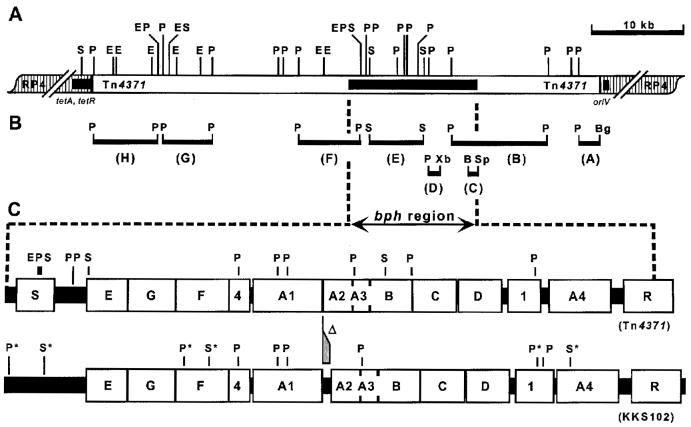
FIG. 1
FIG. 1
Location and specification of fragments of Tn4371 used as gene probes in this study. (A) Restriction map for the enzymes PstI (P), EcoRI (E), and SalI (S) of Tn4371 in RP4::Tn4371 and location of the bph region. (B) Location of the used gene probes on Tn4371 with the indicated cloning sites (P, PstI; S, SalI; B, BamHI; Bg, BglII; Xb, XbaI; Sp, SphI). (C) Enlarged map of the bph regions of Tn4371 and A. georgiopolitanum KKS102 indicating restriction sites PstI (P), SalI (S), EcoRI (E), KpnI (K), XhoI (X), and SmaI (Sm). Restriction sites with an asterisks indicate sites in the KKS102 bph region which are not present in the Tn4371 bph region. The restriction map of the KKS102 bph operon was deduced from its published nucleotide sequence and restriction map (26, 27, 30).
FIG. 2
FIG. 2
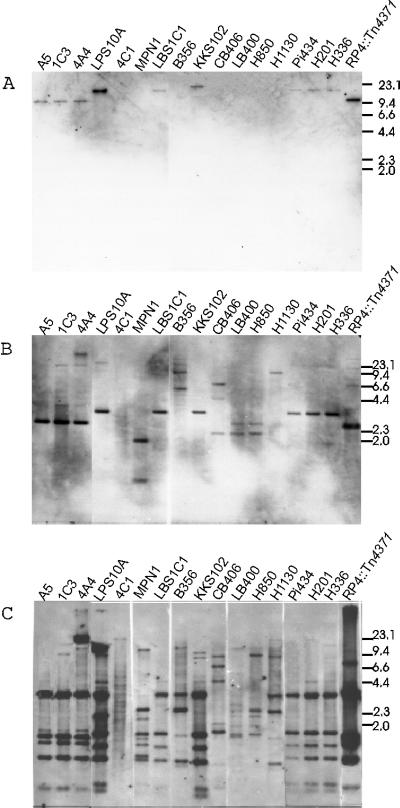
DNA-DNA hybridization analysis of PstI-digested genomic DNAs of relevant chlorobiphenyl-degrading isolates using Tn4371 fragments containing only catabolic sequences, i.e., probe C (bphR) (A), probe D (bphCD) (B), or probe E (bphEGForf4bphA1A2A3B) (C) as gene probes.
FIG. 3
FIG. 3
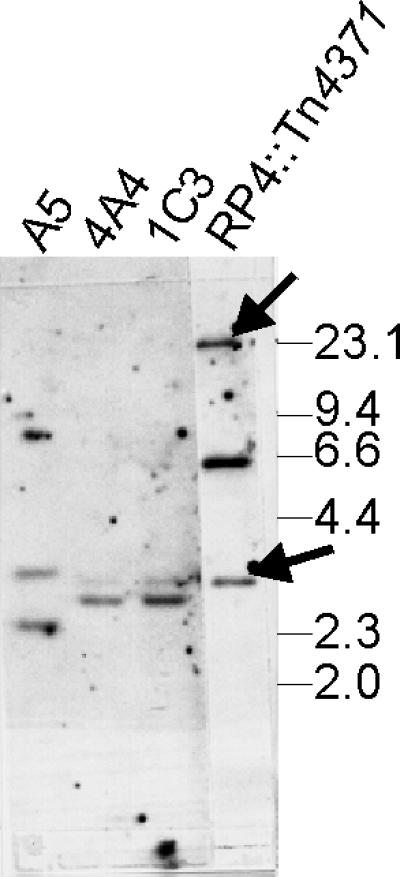
DNA-DNA hybridization analysis of PstI-digested genomic DNAs of relevant chlorobiphenyl-degrading isolates using Tn4371 gene probe A. For probe A, complete plasmid recombinant DNA probe was used as a probe, leading to hybridization with RP4 DNA due to the presence of the bla (Apr) gene, present on both RP4 and pBluescript SKII(+) (the arrows indicate the fragments of RP4::Tn4371 hybridizing with vector DNA).
FIG. 4
FIG. 4
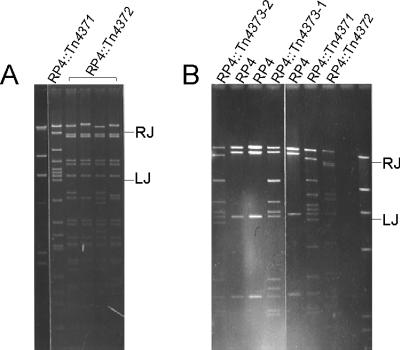
Comparison of PstI restriction patterns of RP4, RP4::Tn4371, and RP4 plasmids containing Tn4372 (A) and Tn4373 (B) of strains LBS1C1 and 4A4, respectively. RJ and LJ indicate the RP4::Tn4371 fragments containing the right and left junctions, respectively, of Tn4371 with RP4.
FIG. 5
FIG. 5
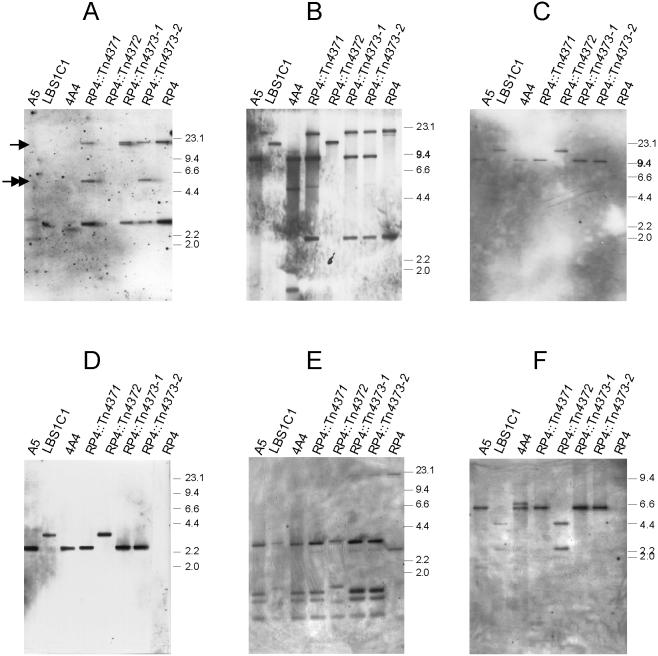
DNA-DNA hybridization analysis of PstI-digested genomic DNAs of chlorobiphenyl-degrading isolates A5, LBS1C1, and 4A4 and PstI-digested enlarged RP4 plasmids carrying bph using Tn4371 gene probes A, B, C, D, E, and F. For probe A, the single and double arrow(s) indicate the different fragments of RP4::Tn4373-1 and RP4::Tn4373-2 hybridizing with probe A. The double arrow additionally indicates the common-sized fragment of RP4::Tn4371 and RP4::Tn4373-2 hybridizing with probe A. For probes A, B, and E, complete plasmid recombinant DNA was used, leading to hybridization with RP4 DNA due to the presence of the bla (Apr) gene, which is present on both RP4 and pBluescript SKII(+).

References

    1. Ahmad D, Massé R, Sylvestre M. Cloning and expression of genes involved in 4-chlorobiphenyl transformation by Pseudomonas testosteroni: homology to polychlorobiphenyl-degrading genes in other bacteria. Gene. 1990;86:53–61. - PubMed
    1. Asturias J A, Timmis K N. Three different 2,3-dihydroxybiphenyl-1,2-dioxygenase genes in the gram-positive polychlorobiphenyl-degrading bacterium Rhodococcus globerulus P6. J Bacteriol. 1993;175:4631–4640. - PMC - PubMed
    1. Asturias J A, Diaz E, Timmis K N. The evolutionary relationship of biphenyl dioxygenase from gram-positive Rhodococcus globerulus P6 to multicomponent dioxygenases from gram-negative bacteria. Gene. 1995;156:11–18. - PubMed
    1. Bedard D L, Wagner R E, Brennan M J, Haberl M L, Brown J F., Jr Extensive degradation of Arochlors and environmentally transformed polychlorinated biphenyls by Alcaligenes eutrophus H850. Appl Environ Microbiol. 1987;53:1094–1102. - PMC - PubMed
    1. Blasco R, Mallavarapu M, Wittich R M, Timmis K N, Pieper D H. Evidence that formation of protoanemonin from metabolites of 4-chlorobiphenyl degradation negatively affects the survival of 4-chlorobiphenyl cometabolizing microorganisms. Appl Environ Microbiol. 1997;63:427–434. - PMC - PubMed

Publication types

LinkOut - more resources