. 2001 Jan;21(2):548-61.
doi: 10.1128/MCB.21.2.548-561.2001.

The RNase P associated with HeLa cell mitochondria contains an essential RNA component identical in sequence to that of the nuclear RNase P

Affiliations

The RNase P associated with HeLa cell mitochondria contains an essential RNA component identical in sequence to that of the nuclear RNase P

R S Puranam et al. Mol Cell Biol. 2001 Jan.

Abstract

The mitochondrion-associated RNase P activity (mtRNase P) was extensively purified from HeLa cells and shown to reside in particles with a sedimentation constant ( approximately 17S) very similar to that of the nuclear enzyme (nuRNase P). Furthermore, mtRNase P, like nuRNase P, was found to process a mitochondrial tRNA(Ser(UCN)) precursor [ptRNA(Ser(UCN))] at the correct site. Treatment with micrococcal nuclease of highly purified mtRNase P confirmed earlier observations indicating the presence of an essential RNA component. Furthermore, electrophoretic analysis of 3'-end-labeled nucleic acids extracted from the peak of glycerol gradient-fractionated mtRNase P revealed the presence of a 340-nucleotide RNA component, and the full-length cDNA of this RNA was found to be identical in sequence to the H1 RNA of nuRNase P. The proportions of the cellular H1 RNA recovered in the mitochondrial fractions from HeLa cells purified by different treatments were quantified by Northern blots, corrected on the basis of the yield in the same fractions of four mitochondrial nucleic acid markers, and shown to be 2 orders of magnitude higher than the proportions of contaminating nuclear U2 and U3 RNAs. In particular, these experiments revealed that a small fraction of the cell H1 RNA (of the order of 0.1 to 0.5%), calculated to correspond to approximately 33 to approximately 175 intact molecules per cell, is intrinsically associated with mitochondria and can be removed only by treatments which destroy the integrity of the organelles. In the same experiments, the use of a probe specific for the RNA component of RNase MRP showed the presence in mitochondria of 6 to 15 molecules of this RNA per cell. The available evidence indicates that the levels of mtRNase P detected in HeLa cells should be fully adequate to satisfy the mitochondrial tRNA synthesis requirements of these cells.


Figures

FIG. 1
FIG. 1
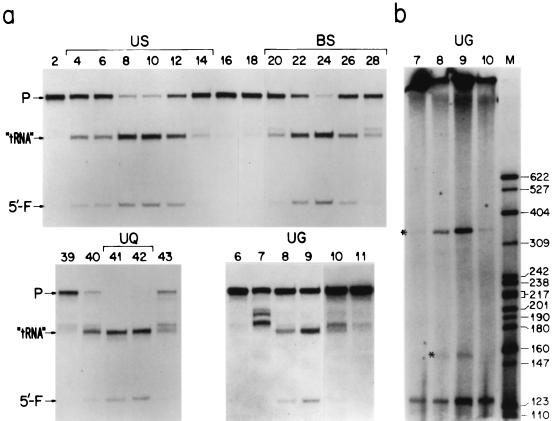
Purification of mtRNase P from HeLa cell mitoplasts. (a) Fractionation scheme. (b) 5′-End processing of in vitro-synthesized tRNATyr uniformly labeled with [α-32P]CTP by 50-μl samples of fractions from Mono-S and Mono-Q chromatography and glycerol gradient centrifugations. The D-treated mitochondrial fraction from 70 ml of packed HeLa cells was lysed with 2% NP-40, and the S100 supernatant of the lysate was run through a DEAE-cellulose column. The eluted RNase P activity was concentrated on a DEAE-Sepharose column, and the active fractions from this fraction were loaded on a Mono-S FPLC column. After collection of the flowthrough and the buffer wash, a 0.1 to 0.6 M KCl gradient was applied. Fractions 2 to 14, containing unbound activity (US), and fractions 20 to 24, containing bound activity eluted between 0.14 and 0.19 M KCl (BS), were pooled separately and each loaded onto a Mono-Q FPLC column at 0.1 M KCl. In both cases, activity was eluted as a fairly sharp peak between 0.35 and 0.4 M Cl (UQ and BQ) and fractionated through a 15 to 35% linear glycerol gradient (UG and BG). See Materials and Methods for details. S, substrate; P, precursor; tRNA,” 5′-end-cleaved tRNATyr precursor; 5′-F, 5′ fragment of precursor cleaved off by RNase P.
FIG. 2
FIG. 2
RNA associated with purified mtRNase P. The mitochondrial fraction was isolated from 64 ml of packed HeLa cells, D treated, and then MN treated, and the mtRNase P was purified from this preparation following the scheme of Fig 1a. (a) Enzyme activity distribution after glycerol gradient centrifugation of the BQ fraction. (b) RNA species isolated by proteinase K digestion, phenol extraction, and ethanol precipitation from the individual glycerol gradient fractions corresponding to the peak of enzyme activity and side fractions, 3′-end labeled with [32P]pCp and RNA ligase, and run on a 5% polyacrylamide–7 M urea gel. M, MspI-digested and 3′-end-labeled pBR322 DNA marker; other symbols as in Fig. 1. The asterisks indicate the 340-and ∼155-nt RNA species.
FIG. 3
FIG. 3
Sedimentation properties of mtRNase P. Two equal samples (1 ml) of the UQ fraction from D-treated mitochondria (■) and two equal samples (1 ml) of the UQ fraction from D-plus-MN-treated mitochondria (□) were run in parallel with two samples of bovine liver catalase (1 ml of a 1-mg/ml solution) through 15 to 35% glycerol gradients. After the enzyme activity in the individual fractions of the mtRNase P gradients and the absorbance at 405 nm (Abs405) of the fractions of the catalase gradients were determined, the combined values of the activities of the two mtRNase P samples derived from D-treated mitochondria and of the two samples derived from D-plus-MN-treated mitochondria and the values of absorbance of the two catalase samples were plotted against migration.
FIG. 4
FIG. 4
Purification of the nuRNase P and analysis of the RNA associated with it. (a) The postmitochondrial S20 fraction (pmS20) from 30 ml of packed HeLa cells was processed for RNase P purification as previously described (15) and chromatographed sequentially through DEAE-cellulose, DEAE-Sepharose, and Mono-S FPLC columns, as described in Materials and Methods. The Mono-S fractions containing unbound RNase P activity were pooled and run through a Mono-Q FPLC column, and the activity eluted between 0.35 and 0.41 M KCl (UQ) was fractionated through a 15 to 30% glycerol gradient (UG). (b) RNA was extracted from individual glycerol gradient fractions exhibiting RNase P activity, 3′-end labeled with [32P]pCp and RNA ligase, and run through a 5% polyacrylamide–7 M urea gel. M, MspI-digested and 3′-end-labeled pBR322 DNA marker; other symbols as in Fig. 1. The asterisks indicate the 340- and ∼ 160-nt species.
FIG. 5
FIG. 5
Processing of ptRNASer(UCN) with an added 3′-terminal -CCA by mtRNase P and nuRNase P. (a) Processing activity on [32P]CTP-labeled E. coli ptRNATyr and HeLa mt-ptRNASer(UCN) of samples of the UQ fraction of mtRNase P from D-plus-MN-treated mitochondria and of a sample of glycerol gradient-fractionated nuRNase P. (b) The products of similar processing reactions carried out on [35S]CTP-labeled ptRNASer(UCN) were subjected to primer extension using reverse transcriptase and Ser-oligo 1 and Ser-oligo 2 as primers and [α-32P]dCTP as the labeled nucleotide. Therefore, the primer extension products are 32P labeled and the 5′ fragments (5′-F) are 35S labeled. Sequencing reactions to generate the tRNASer(UCN) sequence were carried out with the Sequenase kit, using the ptRNASer(UCN)-carrying pGEM.4Z plasmid as a template and the two oligodeoxynucleotides mentioned above as primers. S, substrate; P, products.
FIG. 6
FIG. 6
Quantification, by transfer hybridization analysis, of H1 RNA, MRP RNA, U2 RNA, U3 RNA, mitochondrial DNA, 12S rRNA, ND1 mRNA, and COII mRNA in whole HeLa cells and variously treated mitochondrial fractions. A mitochondrial fraction was prepared from 44 ml of packed HeLa cells and subjected to various treatments, as described in Materials and Methods. (a and b) The indicated amounts of nucleic acids from total HeLa cells and from washed (C) or MN-, D-, or D-plus-MN-treated mitochondrial (Mit.) fractions and 1 or 5 ng of H1 cDNA (NuH1) digested with EcoRI and BamHI were run on a 5% polyacrylamide–7 M urea gel, electrotransferred to a nylon membrane, and hybridized simultaneously with γ-32P-labeled oligodeoxynucleotide probes specific for H1 RNA and MRP RNA (a). After appropriate exposure and quantification of the bands by PhosphorImager analysis, the blot was stripped and rehybridized sequentially with γ-32P-labeled oligodeoxynucleotides specific for U3 and U2 RNA (b). In other experiments, the hybridization with the U3 and U2 RNA probes was carried out on independent blots, with similar results. (c) The indicated amounts of nucleic acids from total-cell (T) or from washed (C) or MN-, D-, or D-plus-MN-treated mitochondrial fractions (Mit. fr.) were digested with RNase A and with EcoRV, fractionated on a 1% agarose gel, transferred to a nylon membrane, and hybridized with HeLa cell mitochondrial DNA 32P labeled by random priming. (d to f) The indicated amounts of total nucleic acids from total cells or variously treated mitochondrial fractions (Mit. fr.) were fractionated on formaldehyde–1.2% agarose gels, transferred to nylon membranes, and hybridized with 32P-labeled probes specific for COII (HCOII-pGEM1-α) (d), 12S rRNA (p12ssf) (e), or ND1 mRNA (pKS2ND1) (f). M, HinfI-digested and 3′-end-labeled pBR322 marker; RNA 19, processing intermediate of heavy-strand transcripts containing sequences of 16S rRNA, tRNALeu(UUR), and ND1 mRNA (58).

Comment in

References

    1. Adhya S, Ghosh T, Das A, Bera S K, Mahaptra S. Role of an RNA-binding protein in import of tRNA into Leishmania mitochondria. J Biol Chem. 1997;272:21396–21402. - PubMed
    1. Aloni Y, Attardi G. Symmetrical in vivo transcription of mitochondrial DNA in HeLa cells. Proc Natl Acad Sci USA. 1971;68:1757–1761. - PMC - PubMed
    1. Altman S, Smith J D. Tyrosine tRNA precursor molecule polynucleotide sequence. Nat New Biol. 1971;233:35–39. - PubMed
    1. Altman S, Baer M, Guerrier-Takada C, Vioque A. Enzymatic cleavage of RNA by RNA. Trends Biochem Sci. 1986;11:515–518.
    1. Anderson S, Bankier A T, Barrell B G, de Bruijn M H L, Coulson A R, Drouin J, Eperon E I, Nierlich D P, Roe B A, Sanger F, Schreier P H, Smith A J H, Staden R, Young I G. Sequence and organization of the human mitochondrial genome. Nature. 1981;290:457–465. - PubMed

Publication types

MeSH terms

LinkOut - more resources