


Comparison of fluorescent in situ hybridization and conventional culturing for detection of Helicobacter pylori in gastric biopsy specimens
- PMID: 11136788
- PMCID: PMC87719
- DOI: 10.1128/JCM.39.1.304-308.2001
Comparison of fluorescent in situ hybridization and conventional culturing for detection of Helicobacter pylori in gastric biopsy specimens
Abstract
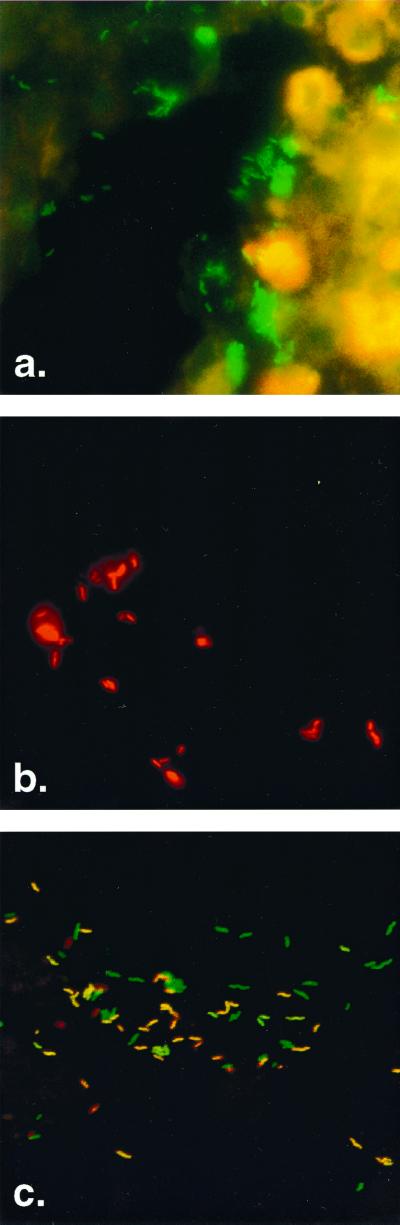
In this study, we have investigated 201 gastric biopsy specimens obtained from dyspeptic patients for the presence of Helicobacter pylori. By means of fluorescent in situ hybridization (FISH) with rRNA-targeted fluorescence-labeled oligonucleotide probes specific for H. pylori, this pathogen was detected in 63 biopsy specimens. By using conventional culturing, H. pylori was isolated from 49 of these 63 gastric biopsy specimens. In contrast, FISH failed to identify H. pylori in four samples from which the pathogen was cultured. The lowest sensitivity was obtained by using the urease test. H. pylori was detected indirectly by this method in 43 of 67 biopsy specimens, which were positive for the pathogen as determined by FISH and/or culturing. All 49 H. pylori isolates that were detected by FISH and culturing underwent antimicrobial susceptibility testing for clarithromycin, a macrolide drug that is a key component in the therapy of peptic ulcer disease caused by this pathogen. Clarithromycin susceptibility testing of cultured isolates was carried out by the E-test, whereas FISH was used on biopsy specimens to detect clarithromycin-resistant mutant strains. No discrepancies were found between these two methods. Thirty-seven strains were clarithromycin sensitive, and eight H. pylori isolates were resistant to the macrolide. From another four biopsy specimens, a mixture of clarithromycin-sensitive and -resistant strains was identified by both methods. Thus, FISH is a reliable technique for determining the clarithromycin susceptibility of this pathogen. Taken together, FISH is a more sensitive and rapid technique than culturing for detection of H. pylori in gastric biopsy specimens. However, in the microbiology routine diagnostic laboratory, the combination of both FISH and conventional culturing significantly increases the sensitivity in detection of H. pylori.
Figures
References
Publication types
MeSH terms
Substances
LinkOut - more resources
Full Text Sources
Medical
