. 2001 Jan 1;288(1):62-75.
doi: 10.1006/abio.2000.4860.

On the possibility of long-wavelength long-lifetime high-quantum-yield luminophores

Affiliations

On the possibility of long-wavelength long-lifetime high-quantum-yield luminophores

J R Lakowicz et al. Anal Biochem. .

Abstract

We describe an approach to creating a new class of luminophores which display both long wavelength emissions exceeding 600 nm and long lifetimes. These luminophores are based on resonance energy transfer (RET) from a long lifetime donor to a short lifetime but long wavelength acceptor. We demonstrated the possibility of obtaining these desirable spectral properties using donors and acceptors noncovalently bound to DNA. The donor was a ruthenium (Ru) metal-ligand complex in which one of the diimine ligands intercalated into double-helix DNA. The acceptors were either nile blue, TOTO-3, or TO-PRO-3. Upon binding of the acceptor to donor-labeled DNA, we found that the acceptor quantum yield was remarkably enhanced so that the wavelength-integrated intensities of the donor and acceptor bound to DNA were many-fold greater than the intensity of the donor and acceptor alone when separately bound to DNA. The origin of this effect is efficient energy transfer from the donor. Under these conditions the effective overall quantum yield approaches that of the acceptor. Importantly, the increased quantum yield can be obtained while maintaining usefully long apparent acceptor lifetimes of 30 to 80 ns. The effect of an increased quantum yield from a low quantum yield donor may find use in assays to detect macromolecular binding interactions. These results suggest the synthesis of covalently linked donor-acceptor pairs with the desirable spectral properties of long wavelength emission, high quantum yield, and moderately long lifetimes for gated detection.


Figures

FIG. 1.
FIG. 1.
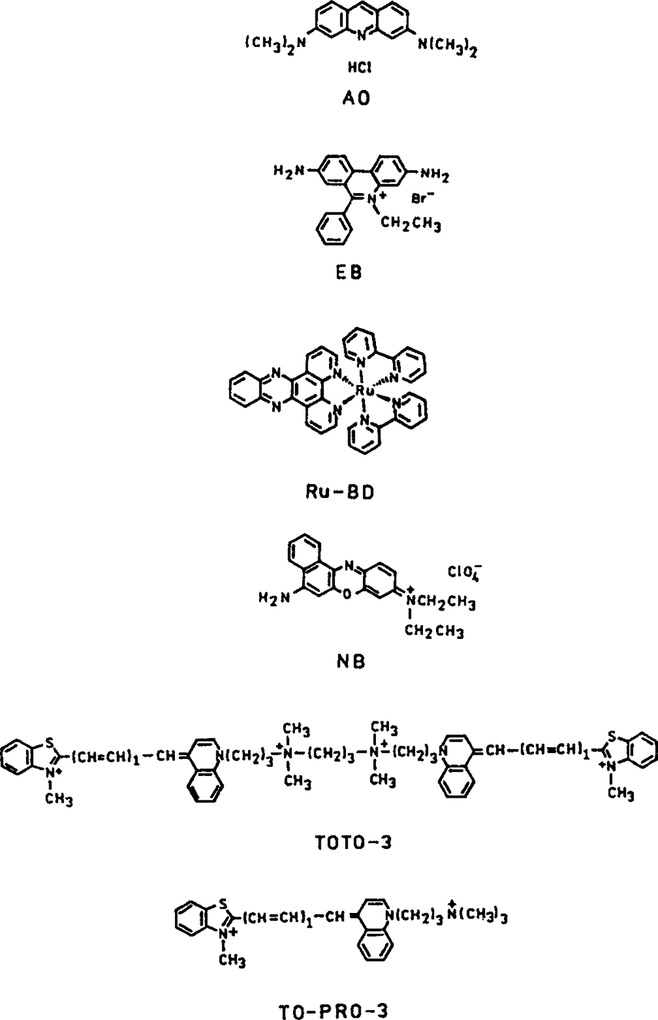
Chemical structures of the donors and acceptors used in this report.
FIG. 2.
FIG. 2.
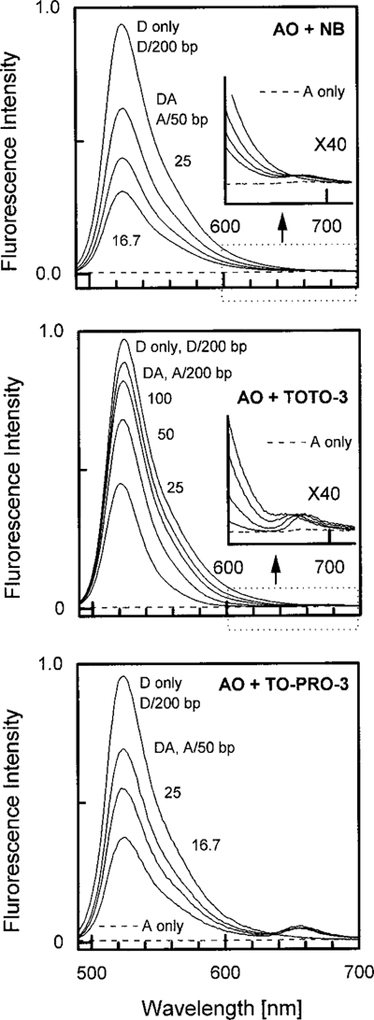
Emission spectra of the acridine orange donor [Donor] = 5 μM bound to DNA in the presence of the acceptors nile blue (top), TOTO-3 (middle), or TO-PRO-3 (bottom). The insets show the acceptor region with the amplitude increased by a factor of 40. The dashed lines show the emission of acceptor alone with DNA, but without donor, at the highest acceptor concentration used in the figure. The donor is present at 1 donor per 200 base pairs. The number for the donor–acceptor (DA) pair is the number of base pairs for each acceptor.
FIG. 3.
FIG. 3.
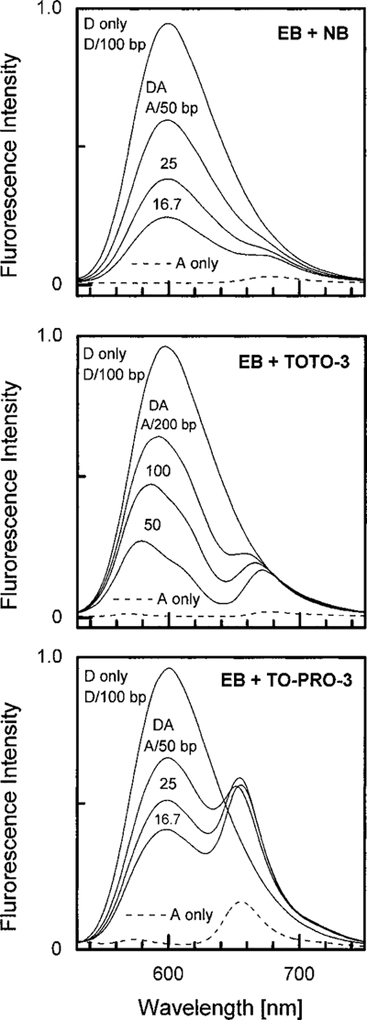
Emission spectra of ethidium bromide donor [Donor] = 10 μM bound to DNA in the presence of the acceptors nile blue (top), TOTO-3 (middle), or TO-PRO-3 (bottom). The dashed lines show the emission of the acceptor alone with DNA, but without donor, at the highest used acceptor concentration. The donor is present at 1 donor per 100 base pairs. The number for the donor–acceptor (DA) pair is the number of base pairs for each acceptor.
FIG. 4.
FIG. 4.
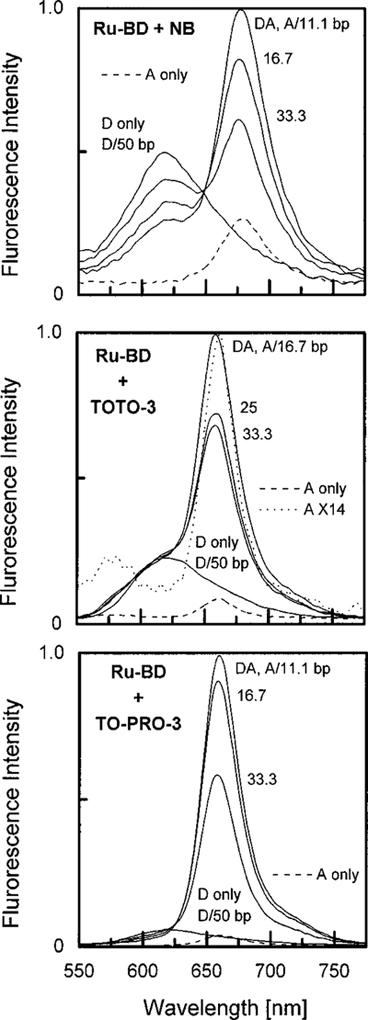
Emission spectra of Ru–BD([Ru(bpy)2 dppz]2+) donor [Donor] = 20 μM bound to DNA in the presence of the acceptors nile blue (top), TOTO-3 (middle), and TO-PRO-3 (bottom). The dashed lines show the emission spectra of the acceptor alone with DNA, but without donor, at the highest used acceptor concentration. One donor is present per 50 base pairs. The number for the donor–acceptor (DA) pair is the number of base pairs for each acceptor.
FIG. 5.
FIG. 5.
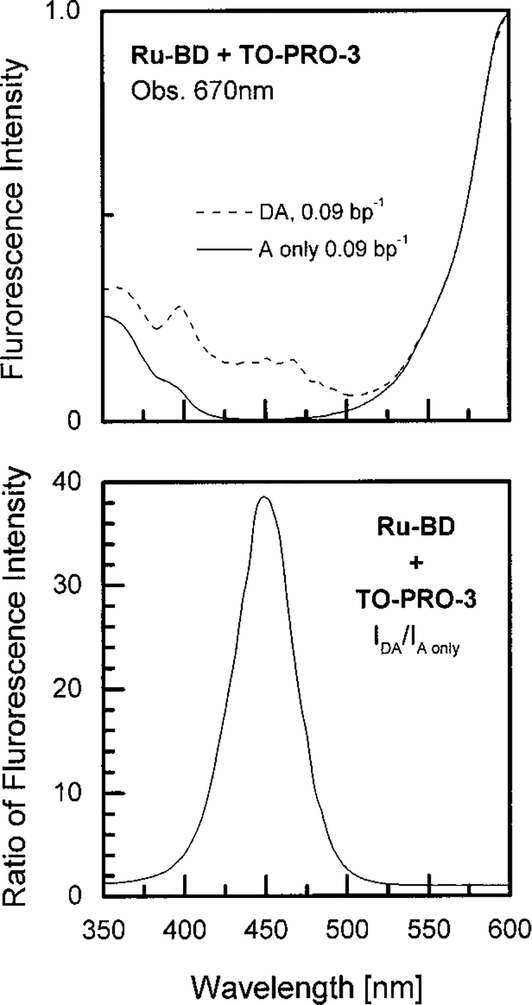
Uncorrected excitation spectra of Ru–BD and TO-PRO-3 bound to DNA (- - -) and of TO-PRO-3 alone bound to DNA (—). (Bottom) Ratio of the two excitation spectra.
FIG. 6.
FIG. 6.
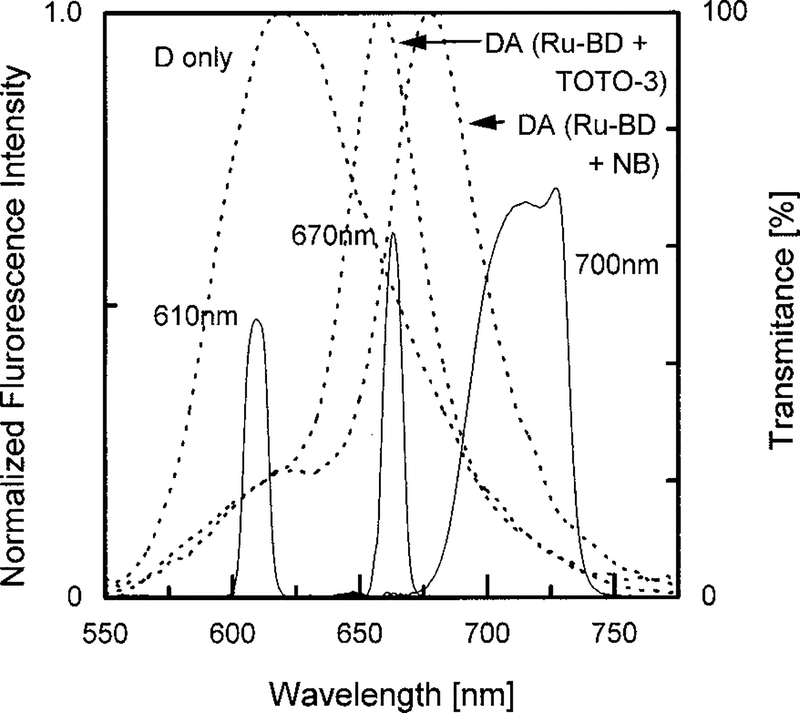
Transmission spectra of the emission filters used for measuring the frequency-domain intensity decays (—). The dashed lines show representative emission spectra of the donor alone (D) and donor plus acceptor (DA) samples.
FIG. 7.
FIG. 7.
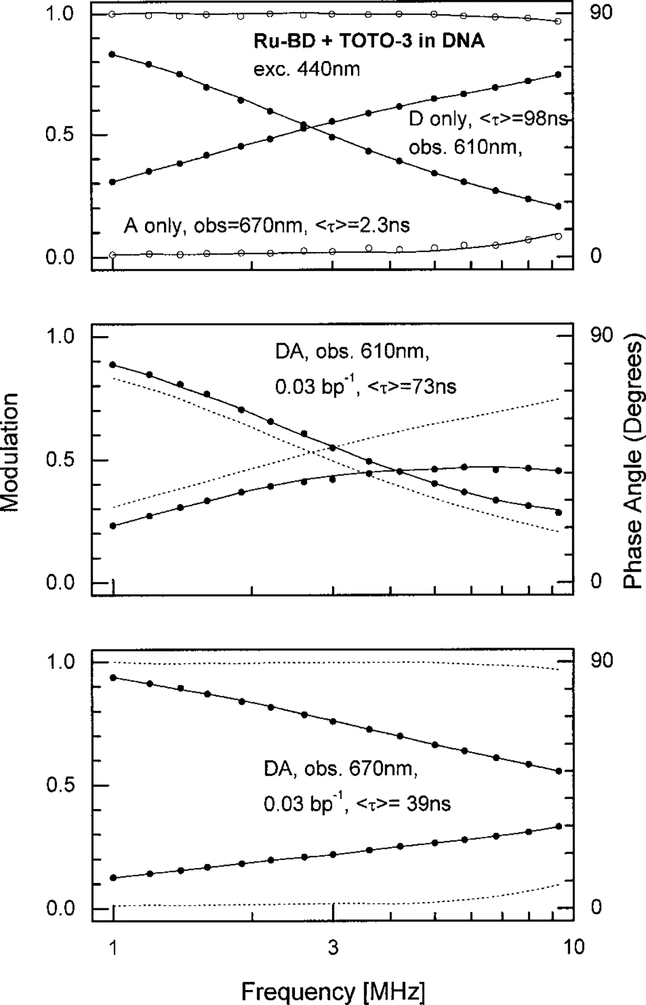
Frequency-domain intensity decays of Ru–BD bound to DNA in the absence and presence of the nile blue acceptor. The solid dots represent the phase or modulation values and the solid lines the best multiexponential fits to the data. In the middle and bottom panels the dotted lines represent the donor-alone and acceptor-alone frequency responses, respectively.
FIG. 8.
FIG. 8.
Frequency-domain intensity decay of Ru–BD bound to DNA in the absence and presence of the TOTO-3 acceptor. See legend to Fig. 7.
FIG. 9.
FIG. 9.
Frequency-domain intensity decay of Ru–BD bound to DNA in the absence and presence of the TO-PRO-3 acceptor. See legend to Fig. 7.
FIG. 10.
FIG. 10.
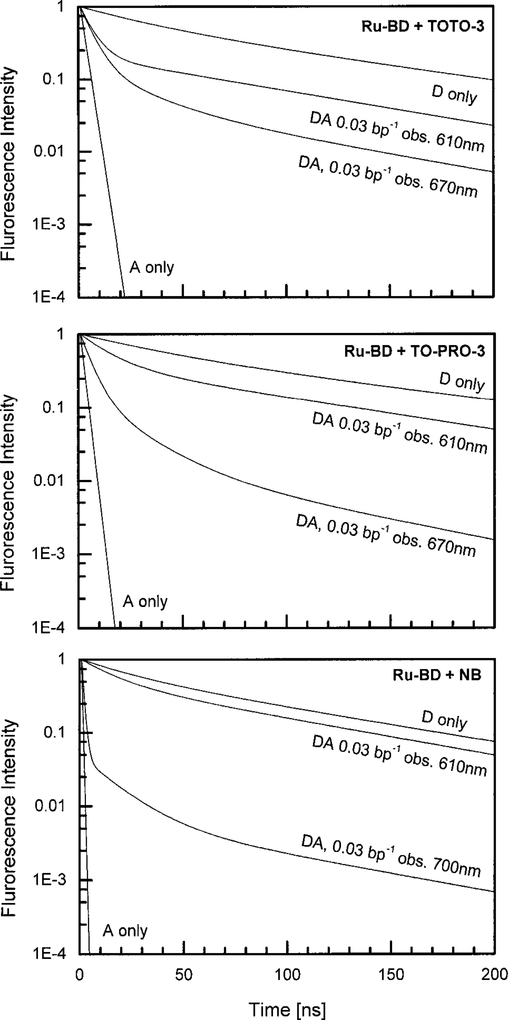
Time-domain intensity decay of Ru–BD and acceptor complexes with DNA.
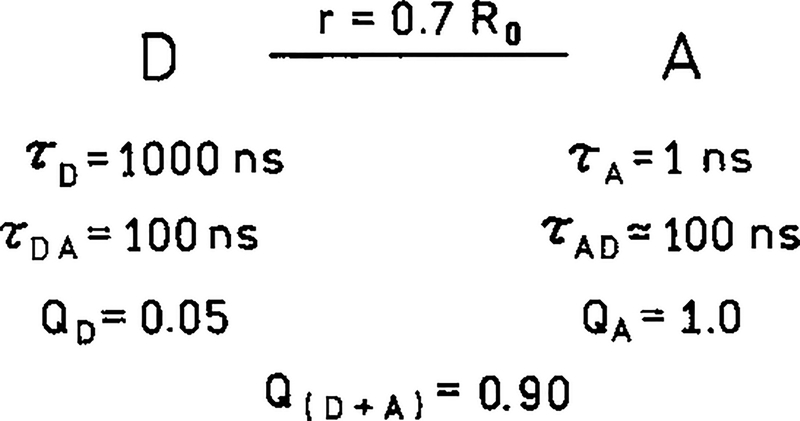
SCHEME 1.
SCHEME 1.
A potential long wavelength, long lifetime luminophore based on a long lifetime donor (D) and a short lifetime acceptor (A).
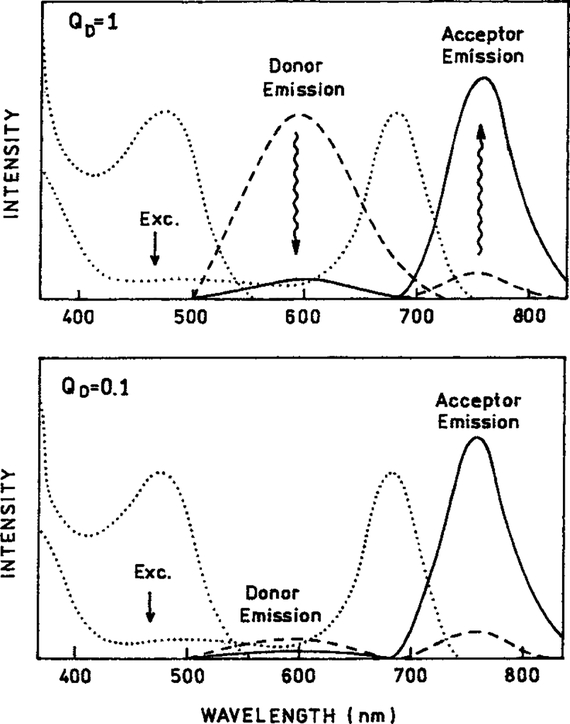
SCHEME 2.
SCHEME 2.
Intuitive description of resonance energy transfer from a high quantum yield donor (QD = 1.0, top) and a low quantum yield donor (QD = 0.1, bottom). For both panels A/D = 0.1. For the low quantum yield donor RET results in an increase in the overall quantum efficiency of the tandem luminophore.
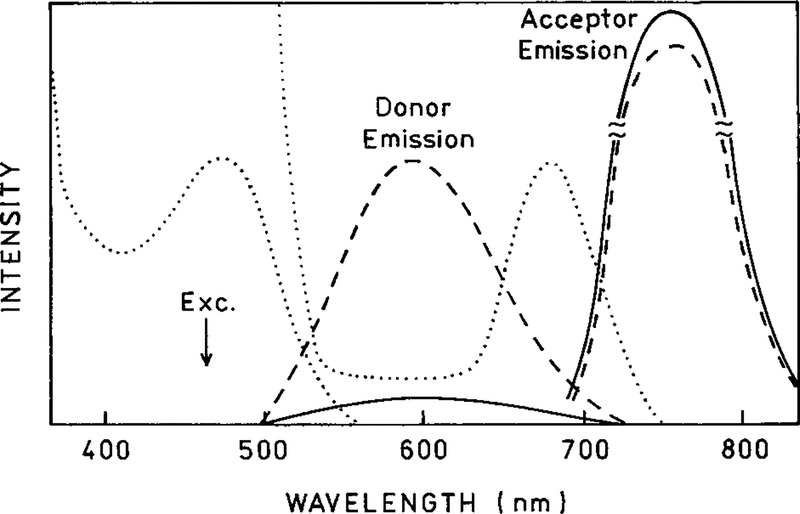
SCHEME 3.
SCHEME 3.
Effect of RET on the acceptor emission when the acceptor absorbs more strongly than the donor.

References

    1. Thompson RB (1994) Red and near-infrared fluorometry, in Topics in Fluorescence Spectroscopy (J. R. Lakowicz, Ed.), Vol. 4, pp. 151–222. Plenum Press, New York.
    1. Daehne S, Resch-Genger U, and Wolfbeis OS (1998) Near-Infrared Dyes for High Technology Applications, pp. 458, Kluwer Academic, Boston.
    1. Southwick PL, Ernst LA, Tauriello EW, Parker SR, Mujumdar RB, Mujumdar SW, Clever HA, and Waggoner AS (1990) Cyanine dye labeling reagents-carboxymethylindocyanine succinimidyl esters. Cytometry 11, 418–430. - PubMed
    1. Rahavendran SV, and Karnes HT (1996) An oxazine reagent for derivatization of carboxylic acid analytes suitable for liquid chromatographic detection using visible diode laser induced fluorescence. J. Pharm. Biomed. Anal 15, 83–98. - PubMed
    1. Rahavendran SV, and Karnes HT (1996) Application of rhodamine 800 for reversed phase liquid chromatographic detection using visible diode laser induced fluorescence. Anal. Chem 68, 3763–3768. - PubMed

Publication types

MeSH terms