. 2001 Jan;142(1):89-97.
doi: 10.1210/endo.142.1.7917.

Down-regulation of hypothalamic corticotropin-releasing hormone messenger ribonucleic acid (mRNA) precedes early-life experience-induced changes in hippocampal glucocorticoid receptor mRNA

Affiliations

Down-regulation of hypothalamic corticotropin-releasing hormone messenger ribonucleic acid (mRNA) precedes early-life experience-induced changes in hippocampal glucocorticoid receptor mRNA

S Avishai-Eliner et al. Endocrinology. 2001 Jan.

Abstract

Early-life experiences, including maternal interaction, profoundly influence hormonal stress responses during adulthood. In rats, daily handling during a critical neonatal period leads to a significant and permanent modulation of key molecules that govern hormonal secretion in response to stress. Thus, hippocampal glucocorticoid receptor (GR) expression is increased, whereas hypothalamic CRH-messenger RNA (mRNA) levels and stress-induced glucocorticoid release are reduced in adult rats handled early in life. Recent studies have highlighted the role of augmented maternal sensory input to handled rats as a key determinant of these changes. However, the molecular mechanisms, and particularly the critical, early events leading from enhanced sensory experience to long-lasting modulation of GR and CRH gene expression, remain largely unresolved. To elucidate the critical primary genes governing this molecular cascade, we determined the sequence of changes in GR-mRNA levels and in hypothalamic and amygdala CRH-mRNA expression at three developmental ages, and the temporal relationship between each of these changes and the emergence of reduced hormonal stress-responses. Down-regulation of hypothalamic CRH-mRNA levels in daily-handled rats was evident already by postnatal day 9, and was sustained through postnatal days 23 and 45, i.e. beyond puberty. In contrast, handling-related up-regulation of hippocampal GR-mRNA expression emerged subsequent to the 23rd postnatal day, i.e. much later than changes in hypothalamic CRH expression. The hormonal stress response of handled rats was reduced starting before postnatal day 23. These findings indicate that early, rapid, and persistent changes of hypothalamic CRH gene expression may play a critical role in the mechanism(s) by which early-life experience influences the hormonal stress-response long-term.


Figures
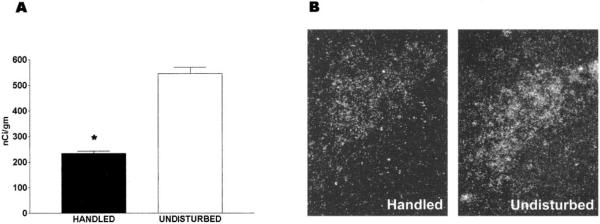
FIG. 1
FIG. 1
CRH-mRNA expression in paraventricular nucleus (PVN) of 9-day-old rats experiencing daily handling on postnatal days 2–8 is reduced compared with that of undisturbed immature rats. A, Semiquantitative analysis of signal over PVN was achieved after in situ hybridization of matched coronal sections. Optical densities from three sections were averaged to generate the mRNA level for each animal, which was then used to calculate group means (n = 6–10 pups). Values are expressed as means ± SEM; *, P < 0.05. B, Decreased CRH-mRNA signal over PVN is evident in a dark-field photomicrograph derived from a 9-day-old handled rat, compared with a matched section from an undisturbed animal.
FIG. 2
FIG. 2
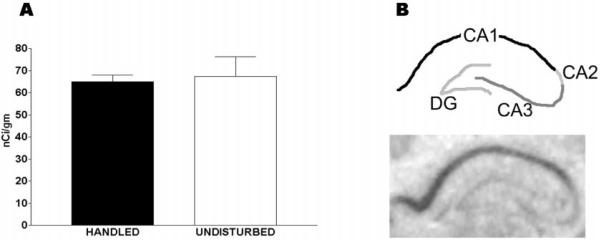
Glucocorticoid receptor (GR)-mRNA levels in hippocampal CA1 of 9-day-old rats experiencing daily handling on postnatal days 2–8 do not differ from those of undisturbed pups. A, Semiquantitative analysis of signal over hippocampal CA1 was achieved after in situ hybridization of matched coronal sections. Optical densities from three sections per animal were averaged (n = 6–10 pups). No significant difference between groups was observed. Values are expressed as means ± SEM (Note: the same data are depicted also in Fig. 4A). B, A coronal brain section from an hippocampal formation of a 9-day-old rat demonstrates that robust GR-mRNA expression at that age is confined primarily to CA1.
FIG. 3
FIG. 3
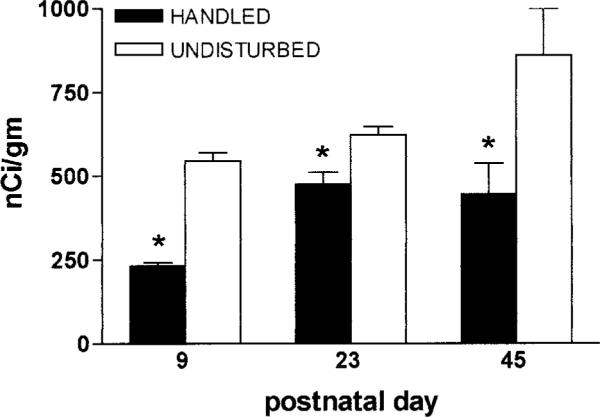
CRH expression in the PVN is persistently down-regulated after the handling/altered maternal input experience. Analysis of in situ hybridizations of sections from 9-, 23-, and 45-day-old rats reveals significantly (*) lower CRH-mRNA signal compared with rats left undisturbed. Optical densities from three sections were averaged (n = 6–10 animals per time-point). Values are expressed as means ± SEM.
FIG. 4
FIG. 4
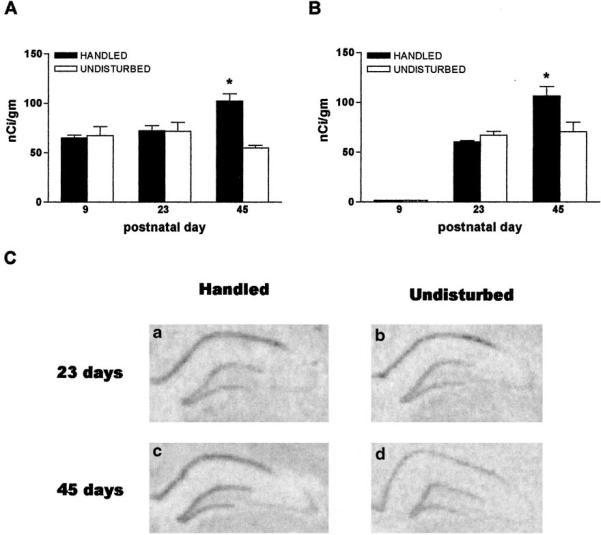
Time-course of the effects of early-life experience on glucocorticoid receptor (GR)-mRNA expression in the hippocampal formation. A, Significant (*) up-regulation of GR-mRNA levels in hippocampal CA1 of daily handled rats emerges starting at the 45-day time-point (but not on postnatal days (P) 9 or 23). B, In the dentate gyrus granule cell layer, little GR-mRNA signal is apparent in either group on P9 (see Fig. 2). Enhanced GR-mRNA expression is evident on P45 in the handled group. Semiquantitative analysis was achieved as described in Figs. 2–5; n = 6–10 animals per group per time-point. C, In situ hybridization for GR-mRNA demonstrates similar expression patterns and magnitude in handled (a) and undisturbed (b) rats on P23. By P45, GR signal is enhanced in a rat subjected to early-life handling (c) compared with one raised undisturbed (d).
FIG. 5
FIG. 5
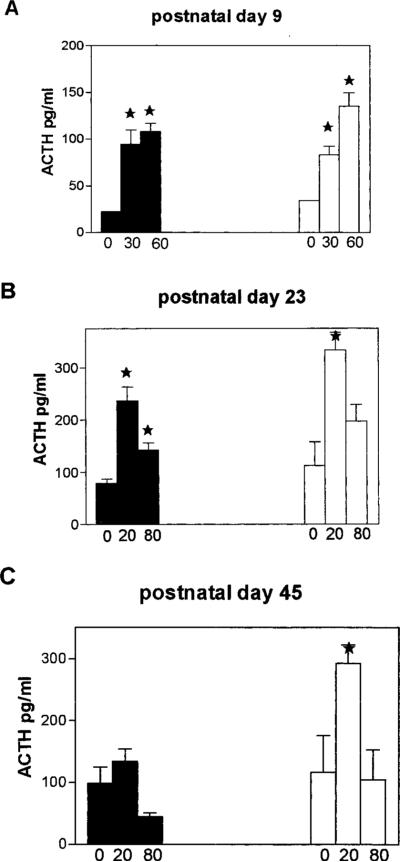
Basal and stress-induced plasma ACTH as a function of age and early-life experience. A, On P9, plasma ACTH levels increase significantly (*) after age-appropriate stress, but do not differ in handled vs. undisturbed animals (P = 0.59, effect of handling, two-way ANOVA). B, By P23, rats handled early in life demonstrate lower ACTH output, compared with undisturbed groups (effect of handling, two-way ANOVA: F1,35 = 6.32; P = 0.017). It should be noted that at this age, hippocampal GR expression does not distinguish between handled and undisturbed groups, whereas hypothalamic CRH-mRNA levels are lower in handled pups. C, Reduced neuroendocrine stress response persists in 45-day-old rats that were handled on P2-P8 (effect of handling, F = 7.7; P = 0.018). Robust effects of stress on ACTH levels is evident at all ages (note different y-axis scale on P9; two-way ANOVA, F2,13 = 11 at P9; F2,35 = 20 at P23; F2,24 = 5 at P45. P < 0.02 for all). Bars in each group denote mean ± SEM of ACTH levels before stress, and at the two time points (in minutes) after its onset as noted in the graphs (see Materials and Methods for detailed description). Error bars are not shown for P9 basal ACTH values because samples were pooled.

References

    1. Levine S, Lewis GW. Critical period for the effects of infantile experience on the maturation of a stress response. Science. 1959;129:42–43. - PubMed
    1. Hess JL, Denenberg VH, Zarrow M, Peiffer WD. Modification of the corticosterone response curve as a function of handling in infancy. Physiol Behav. 1969;4:102–109.
    1. Levine S. The psychoendocrinology of stress. Ann NY Acad Sci. 1993;697:61–69. - PubMed
    1. Meaney MJ, Diorio J, Francis D, Widdowson J, LaPlante P, Caldji C, Sharma S, Seckl JR, Plotsky PM. Early environmental regulation of forebrain glucocorticoid receptor gene expression: implications for adrenocortical responses to stress. Dev Neurosci. 1996;18:49–72. - PubMed
    1. Heim C, Owens MJ, Plotsky PM, Nemeroff CB. Persistent changes in corticotropin-releasing factor systems due to early life stress: relationship to the pathophysiology of major depression and post-traumatic stress disorder. Psychopharmacol Bull. 1997;33:185–192. - PubMed

Publication types

MeSH terms

Substances