. 2001 Jan 16;98(2):525-30.
doi: 10.1073/pnas.98.2.525. Epub 2001 Jan 9.

Genetic architecture of thermal adaptation in Escherichia coli

Affiliations

Genetic architecture of thermal adaptation in Escherichia coli

M M Riehle et al. Proc Natl Acad Sci U S A. .

Abstract

Elucidating the genetic basis of adaptation on a genomewide scale has evaded biologists, but complete genome sequences and DNA high-density array technology make genomewide surveys more tractable. Six lines of Escherichia coli adapted for 2,000 generations to a stressful high temperature of 41.5 degrees C were examined on a genomewide scale for duplication/deletion events by using DNA high-density arrays. A total of five duplication and deletion events were detected. These five events occurred in three of the six lines, whereas the remaining three lines contained no detectable events. Three of the duplications were at 2.85 Mb of the E. coli chromosome, providing evidence for the replicability of the adaptation to high temperature. Four candidate genes previously shown to play roles in stress and starvation survival were identified in the region of common duplication. Expression of the two candidate genes examined is elevated over expression levels in the ancestral lines or the lines without the duplication. In the two cases where the duplication at 2.85 Mb has been further characterized, the timing of the genome reorganization is coincident with significant increases in relative fitness. In both of these cases, the model for the origin of the duplication is a complex recombination event involving insertion sequences and repeat sequences. These results provide additional evidence for the idea that gene duplication plays an integral role in adaptation, specifically as a means for gene amplification.


Figures
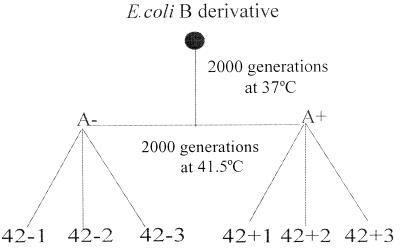
Figure 1
Figure 1
Evolutionary history of thermally adapted lines of E. coli.
Figure 2
Figure 2
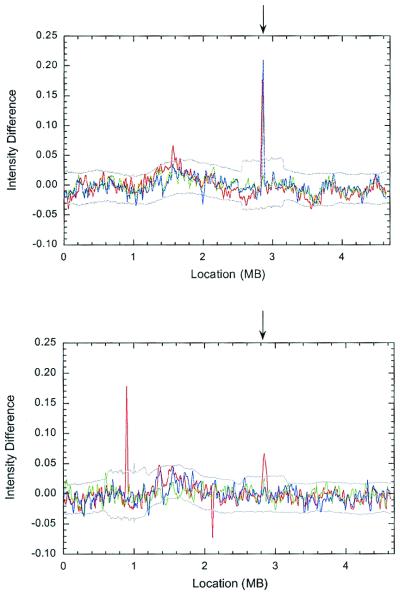
Detection of duplication and deletion events using DNA high-density array data. (Upper) The A− derived lines: 42−1 in red, 42−2 in blue, and 42−3 in green. (Lower) The A+ derived lines: 42+1 in red, 42+2 in blue, and 42+3 in green. The gray lines are confidence intervals calculated by using a permutation testing approach (Upper, confidence interval for 42−2; Lower, 42+1). Confidence intervals are similar for the other two lines in a panel. Regions in which signal intensity is above the gray line indicate a duplication in the selected line, and regions in which it is below indicate a deletion. An arrow indicates the common duplication at 2.85 Mb present in three of the six selected lines. Note the presence of a red peak beneath the blue peak (Upper).
Figure 3
Figure 3
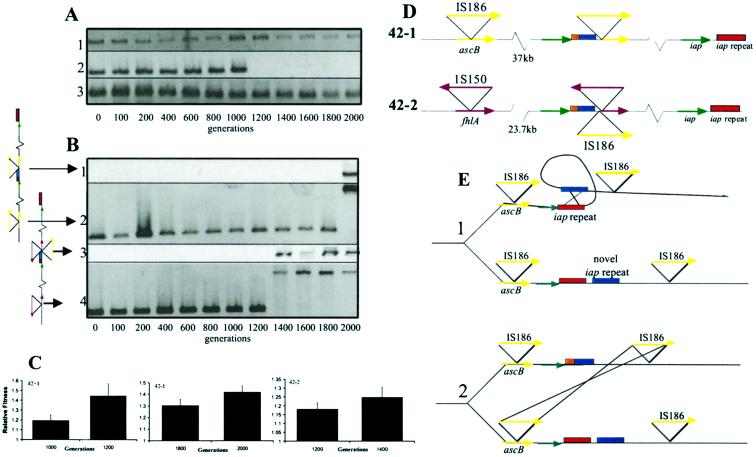
Confirmation, timing, and molecular characterization of a subset of the duplications and deletions. (A) The 12-kb deletion in the 42+1 line. PCR products for amplifications of sbcB, upstream of the deletion (1.5 kb, row 1), galF, within the deletion (1.1 kb, row 2), and cspG, immediately downstream of the deletion (0.2 kb, row 3), are shown as a function of the number of generations at 41.5°C. (B) Identification of the breakpoints for the tandem duplications in the 42−1 and 42−2 lines. The 37-kb repeat in the 42−1 line occurred between generations 1,800 and 2,000 (middle junction, row 1, 2.5 kb; left breakpoint, row 2, 1.4–2.8 kb). The 23.7-kb repeat in the 42−2 line occurred between generations 1,200 and 1,400 (middle junction, row 3, 4.4 kb; left breakpoint, row 4, 1.1–2.5 kb). Primers used in the amplification of the products in rows 1 and 3 amplify the junction generated by the duplication. Primers used in the amplification of products in rows 2 and 4 amplify the gene at the left breakpoint. The appearance of IS at the left breakpoints is coincident with the origin of the duplications. (C). Relative fitness measurements before and after chromosome rearrangement events. Bars represent means ±95% confidence intervals. (D) Genetic structure of duplications. The unique junction generated by the duplication is represented by the juxtaposition of red and blue blocks. We depict a single duplication, but the number of tandem copies is not determined. (E) Proposed model for the origin of the duplication. The intrastrand recombination is presented in part 1 and the sister strand exchange in part 2. The figure depicts the model for the generation of the 23.7-kb tandem duplication; the model for the 37-kb tandem duplication is identical except that the second recombination event occurs between IS150 located adjacent to the iap repeat sequence and IS150 at the left breakpoint.
Figure 4
Figure 4
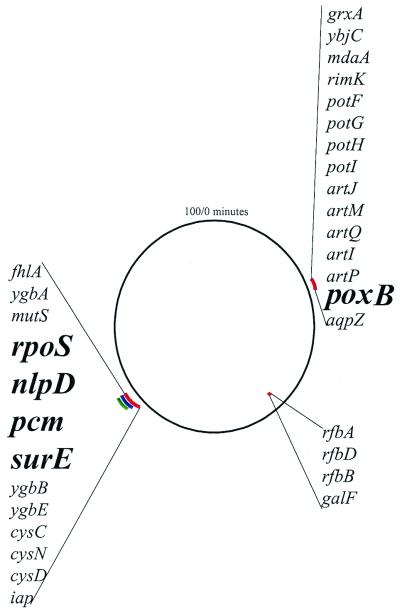
Genes present in the regions of genome reorganization. The circle represents the E. coli chromosome. Lines outside of the circle represent regions of duplication, and lines inside the circle represent regions of deletion. Red lines are reorganization events in the 42+1 line, the blue line represents the duplication in the 42−1 line, and the green line represents the duplication in the 42−2 line. ORFs of known function are listed for each duplication or deletion. (For a complete list of ORFs for each duplication and deletion, see supplemental text.)

References

    1. Muller H J. Am Nat. 1932;68:118–138.
    1. Wichman H A, Badgett M R, Scott L A, Boulianne C M, Bull J J. Science. 1999;285:422–424. - PubMed
    1. Bull J J, Badgett M R, Wichmann H A, Huelsenbeck J P, Hillis D M, Gulati A, Ho C, Molineux I J. Genetics. 1997;147:1497–1507. - PMC - PubMed
    1. Bennett A F, Lenski R E. Evolution (Lawrence, Kans) 1993;47:1–12. - PubMed
    1. Bennett A F, Lenski R E. Evolution (Lawrence, Kans) 1996;50:493–503. - PubMed

Publication types