


Critical role for the histone H4 N terminus in nucleosome remodeling by ISWI
- PMID: 11154274
- PMCID: PMC86678
- DOI: 10.1128/MCB.21.3.875-883.2001
Critical role for the histone H4 N terminus in nucleosome remodeling by ISWI
Abstract
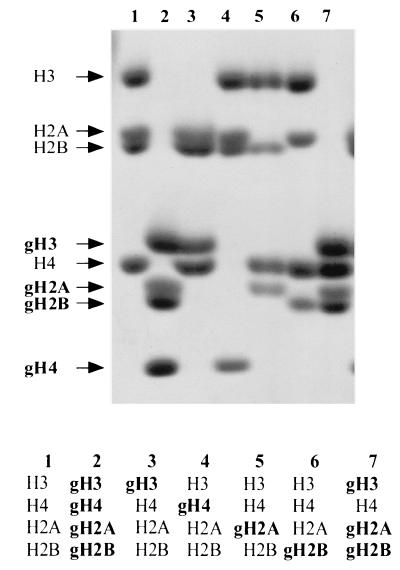
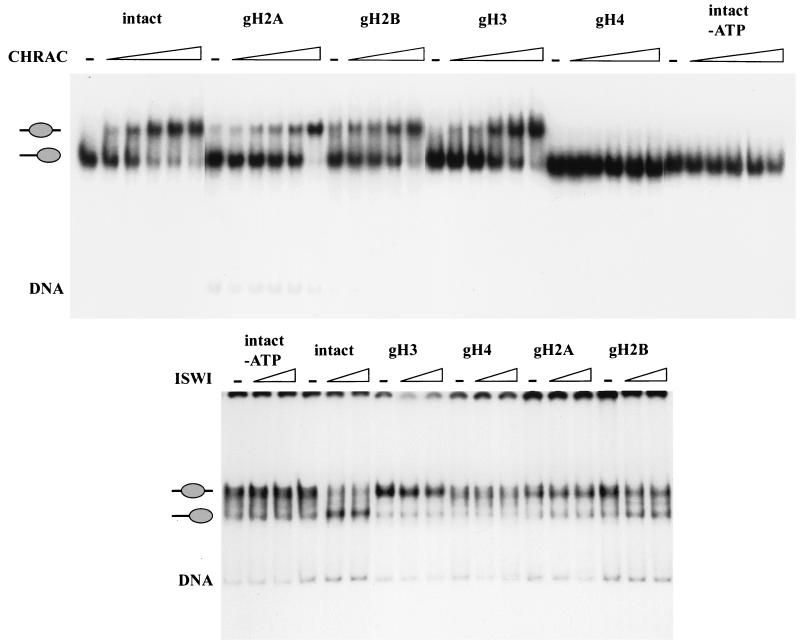
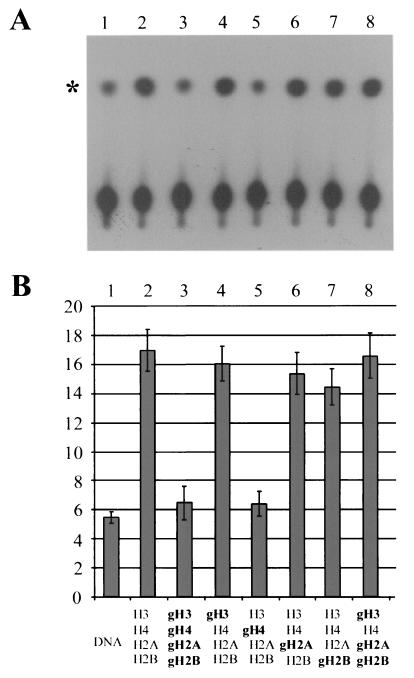
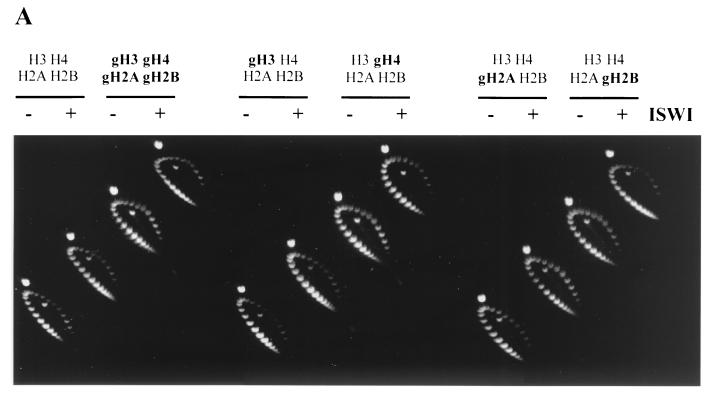
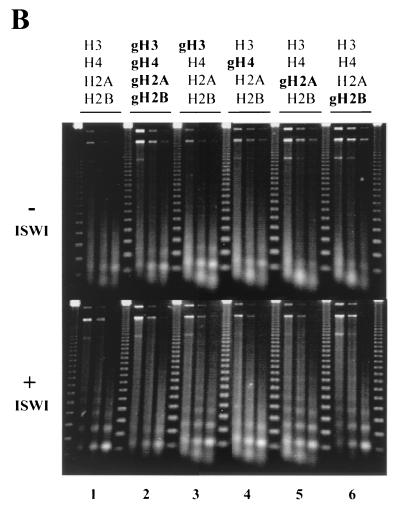
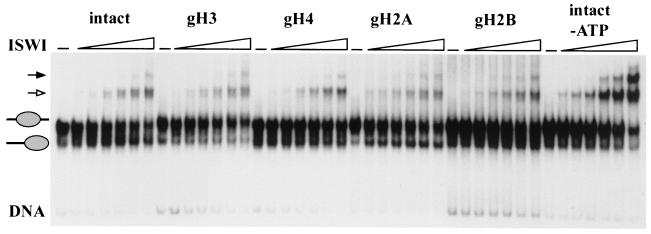
The ATPase ISWI can be considered the catalytic core of several multiprotein nucleosome remodeling machines. Alone or in the context of nucleosome remodeling factor, the chromatin accessibility complex (CHRAC), or ACF, ISWI catalyzes a number of ATP-dependent transitions of chromatin structure that are currently best explained by its ability to induce nucleosome sliding. In addition, ISWI can function as a nucleosome spacing factor during chromatin assembly, where it will trigger the ordering of newly assembled nucleosomes into regular arrays. Both nucleosome remodeling and nucleosome spacing reactions are mechanistically unexplained. As a step toward defining the interaction of ISWI with its substrate during nucleosome remodeling and chromatin assembly we generated a set of nucleosomes lacking individual histone N termini from recombinant histones. We found the conserved N termini (the N-terminal tails) of histone H4 essential to stimulate ISWI ATPase activity, in contrast to other histone tails. Remarkably, the H4 N terminus, but none of the other tails, was critical for CHRAC-induced nucleosome sliding and for the generation of regularity in nucleosomal arrays by ISWI. Direct nucleosome binding studies did not reflect a dependence on the H4 tail for ISWI-nucleosome interactions. We conclude that the H4 tail is critically required for nucleosome remodeling and spacing at a step subsequent to interaction with the substrate.
Figures
References
-
- Akhtar A, Becker P B. Activation of transcription through histone H4 acetylation by MOF, an acetyltransferase essential to dosage compensation in Drosophila. Mol Cell. 2000;5:367–375. - PubMed
-
- Bone J R, Lavender J, Richman R, Palmer M J, Turner B M, Kuroda M I. Acetylated histone H4 on the male X chromosome is associated with dosage compensation in Drosophila. Genes Dev. 1994;8:96–104. - PubMed
-
- Boyer L A, Logie C, Bonte E, Becker P B, Wade P A, Wolffe A P, Wu C, Imbalzano A N, Peterson C L. Functional delineation of three groups of the ATP-dependent family of chromatin remodeling enzymes. J Biol Chem. 2000;275:18864–18870. - PubMed
Publication types
MeSH terms
Substances
LinkOut - more resources
Full Text Sources
Research Materials
