. 2001 Jan;125(1):318-28.
doi: 10.1104/pp.125.1.318.

Free and conjugated benzoic acid in tobacco plants and cell cultures. Induced accumulation upon elicitation of defense responses and role as salicylic acid precursors

Affiliations

Free and conjugated benzoic acid in tobacco plants and cell cultures. Induced accumulation upon elicitation of defense responses and role as salicylic acid precursors

J Chong et al. Plant Physiol. 2001 Jan.

Abstract

Salicylic acid (SA) is a key endogenous component of local and systemic disease resistance in plants. In this study, we investigated the role of benzoic acid (BA) as precursor of SA biosynthesis in tobacco (Nicotiana tabacum cv Samsun NN) plants undergoing a hypersensitive response following infection with tobacco mosaic virus or in tobacco cell suspensions elicited with beta-megaspermin, an elicitor from Phytophthora megasperma. We found a small pool of conjugated BA in healthy leaves and untreated cell suspensions of tobacco, whereas free BA levels were barely detectable. Infection of plants with tobacco mosaic virus or elicitation of cells led to a rapid de novo synthesis and accumulation of conjugated BA, whereas free BA was weakly induced. In presence of diphenylene iodonium, an inhibitor of superoxide anion formation, SA accumulation was abolished in elicited cells and much higher BA levels were concomitantly induced, mainly as a conjugated form. Furthermore, piperonylic acid, an inhibitor of cinnamate-4-hydroxylase was used as a powerful tool to redirect the metabolic flow from the main phenylpropanoid pathway into the SA biosynthetic branch. Under these conditions, in vivo labeling and radioisotope dilution experiments with [(14)C]trans-cinnamic acid as precursor clearly indicated that the free form of BA produced in elicited tobacco cells is not the major precursor of SA biosynthesis. The main conjugated form of BA accumulating after elicitation of tobacco cells was identified for the first time as benzoyl-glucose. Our data point to the likely role of conjugated forms of BA in SA biosynthesis.


Figures
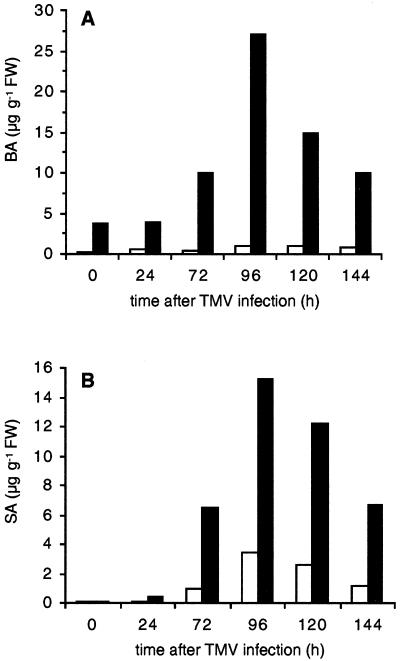
Figure 1
Figure 1
Levels of BA (A) and SA (B) after TMV infection. Free (white bars) and conjugated (black bars) BA and SA were determined in tobacco cv Samsun NN leaves after infection with TMV.
Figure 2
Figure 2
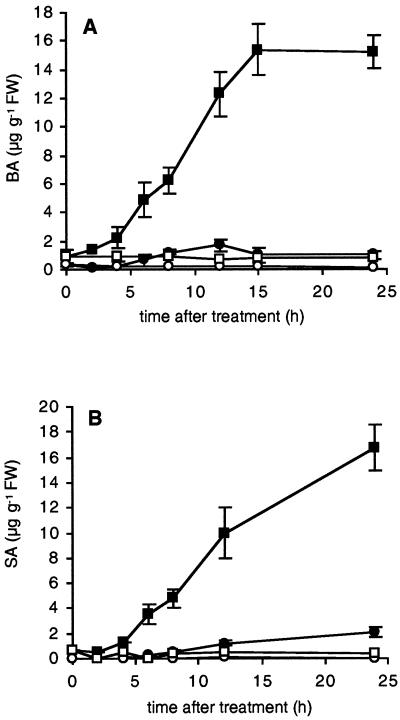
Levels of BA (A) and SA (B) in elicited tobacco cells. Free (●, ○) and conjugated (▪, □) BA and SA were determined in BY tobacco cells treated with 50 nm β-megaspermin (●, ▪) or water (○, □). Results are means ± sd of three independent experiments.
Figure 3
Figure 3
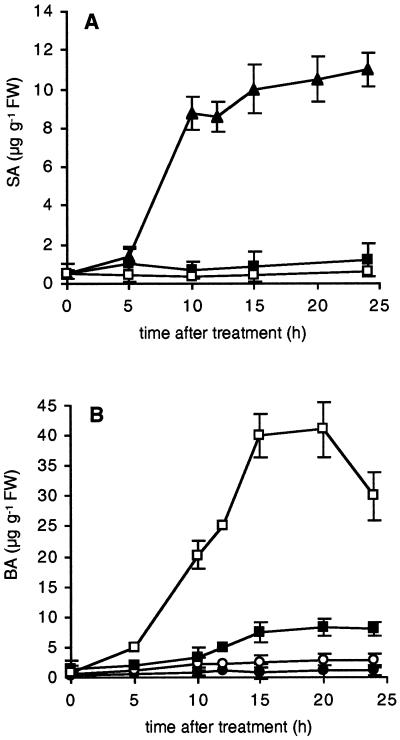
Effect of DPI on SA (A) and BA (B) accumulation in elicited tobacco cells. A, Levels of total SA in cells treated with 50 nm β-megaspermin (▴), 50 nm β-megaspermin + 5 μm DPI (▪) or DPI alone (□). B, Levels of free (●, ○) and conjugated (▪, □) BA in BY cells treated with 50 nm β-megaspermin (●, ▪) or 50 nm β-megaspermin + 5 μm DPI (○, □). Results are means ± sd of three independent experiments.
Figure 4
Figure 4
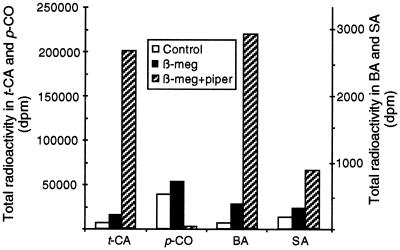
Effect of piperonylic acid on the distribution of total radioactivity (dpm) associated with total t-CA, p-CO, BA, and SA after feeding [14C]t-CA to elicited tobacco cells. BY-2 cells were elicited with 50 nm β-megaspermin for 12 h in presence (hatched bars) or in absence (black bars) of 10 μm piperonylic acid. Control cells (white bars) were treated with water. [14C]t-CA (2.2 μmol, 4.5 mCi mmol−1) was added during the last hour of elicitation. Total radioactivity associated with t-CA, p-CO, BA, and SA was determined after acid and base hydrolysis of the extracts. Note the difference of the scale used for t-CA and p-CO, and BA and SA. Piper, Piperonylic acid; β-meg, β-megaspermin. A duplicate experiment gave essentially the same results.
Figure 5
Figure 5
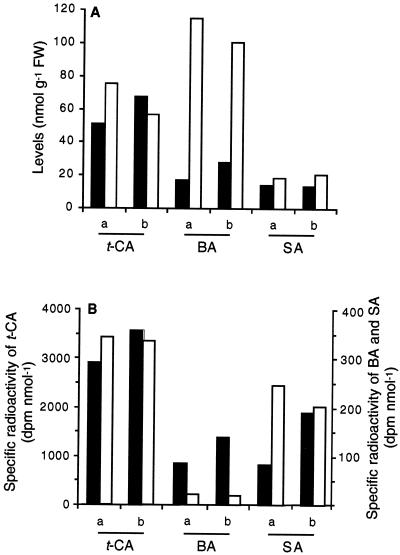
Effect of the addition of unlabeled BA on the levels of free t-CA, BA, and SA (A) and on the specific radioactivities associated to the free forms of t-CA, BA, and SA (B) after labeling with [14C]t-CA. BY-2 tobacco cells were treated simultaneously for 12 h with 50 nm β-megaspermin and 10 μm piperonylic acid in presence (white bars) or in absence (black bars) of 100 μm unlabeled BA. [14C]t-CA (2.2 μmol, 4.5 mCi mmol−1) was added during the last hour of elicitation. a and b correspond to the results of two independent experiments.
Figure 6
Figure 6
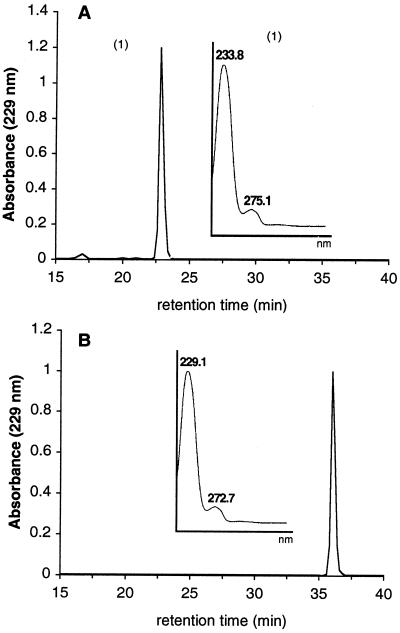
Identification of benzoyl-Glc in elicited BY tobacco cells. Cell cultures were treated simultaneously with 50 nm β-megaspermin and 10 μm piperonylic acid for 12 h. [14C]t-CA (2.2 μmol, 4.5 mCi mmol−1) was added during the last hour of elicitation. Methanolic extract of elicited cells was separated by TLC and further purified by HPLC (see “Material and Methods”). A, HPLC profile of the benzoyl-Glc fraction separated by TLC. Peak 1 was identified as benzoyl-Glc on the basis of its retention time and its UV spectrum. B, HPLC profile of the peak 1 after hydrolysis with β-glucosidase from almond. The aglycon was identified as free BA on the basis of its retention time and its UV spectrum.
Figure 7
Figure 7
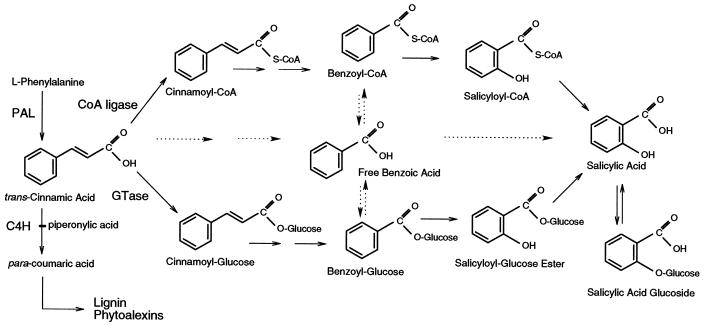
Proposed pathways of SA biosynthesis in tobacco involving CoA thioesters or Glc esters. Radioisotope dilution experiments indicate that free BA is not the major intermediate of SA biosynthesis. The metabolic pathway to SA may therefore proceed via conjugated forms of BA. In the branch involving Glc esters, salicyloyl-Glc ester might represent a biosynthetic intermediate, whereas SA glucoside would be a storage form. GTase: glucosyltransferase (UDP-Glc:cinnamic acid glucosyltransferase).

References

    1. Baillieul F, Fritig B, Kauffmann S. Occurence among Phytophthora species of a glycoprotein eliciting a hypersensitive response in tobacco and its relationships with elicitins. Mol Plant-Microbe Interact. 1996;9:214–216.
    1. Baillieul F, Genetet I, Kopp M, Saindrenan P, Fritig B, Kauffmann S. A new elicitor of the hypersensitive response in tobacco: a fungal glycoprotein elicits cell death, expression of defense genes, production of salicylic acid, and induction of systemic acquired resistance. Plant J. 1995;8:551–560. - PubMed
    1. Cao H, Bowling S, Gordon A, Dong X. Characterization of an Arabidopsis mutant that is non-responsive to inducters of systemic acquired resistance. Plant Cell. 1994;6:1583–1592. - PMC - PubMed
    1. Coquoz J-L, Buchala A, Métraux J-P. The biosynthesis of salicylic acid in potato plants. Plant Physiol. 1998;117:1095–1101. - PMC - PubMed
    1. Delaney TP, Friedrich L, Ryals JA. Arabidopsis signal transduction mutant defective in chemically and biologically induced disease resistance. Proc Natl Acad Sci USA. 1995;92:6602–6606. - PMC - PubMed

Publication types

LinkOut - more resources