


Simvastatin inhibits noradrenaline-induced hypertrophy of cultured neonatal rat cardiomyocytes
- PMID: 11156573
- PMCID: PMC1572550
- DOI: 10.1038/sj.bjp.0703792
Simvastatin inhibits noradrenaline-induced hypertrophy of cultured neonatal rat cardiomyocytes
Abstract
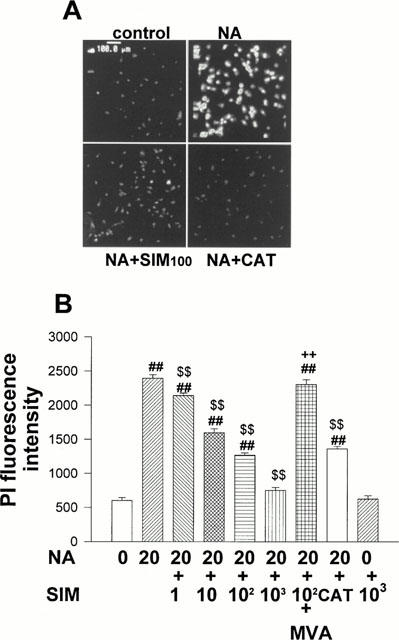
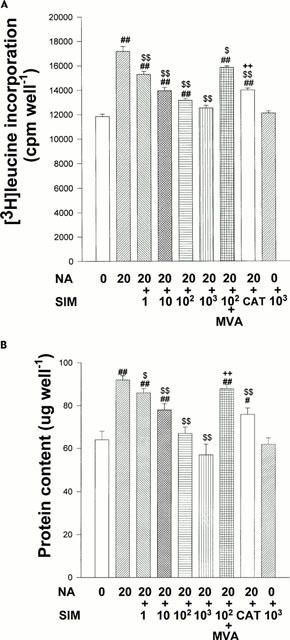
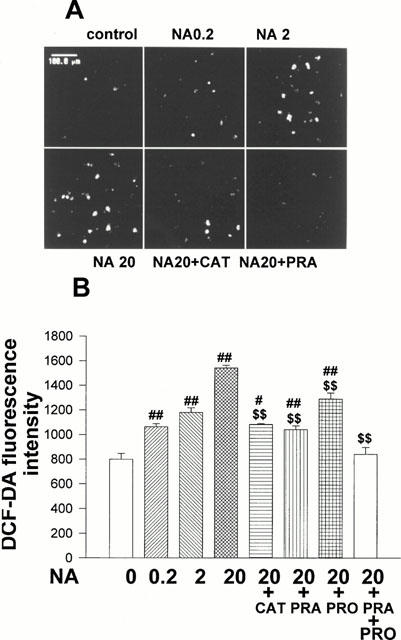
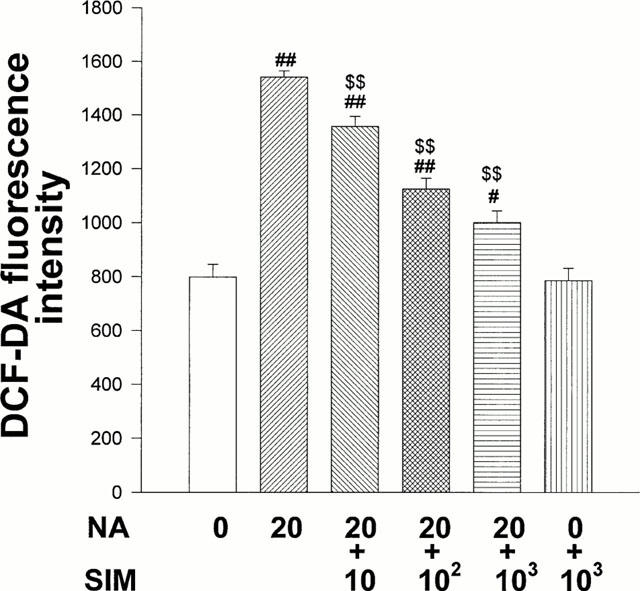
1. Oxidative mechanisms have been implicated in neonatal cardiomyocyte hypertrophy. We and others have shown that a HMG-CoA reductase inhibitor preserves endogenous antioxidant enzyme activity and inhibits cardiac hypertrophy in vivo. We therefore have examined whether noradrenaline (NA) induces the generation of reactive oxygen species (ROS) during its induction of neonatal cardiomyocyte hypertrophy and whether simvastatin, a HMG-CoA reductase inhibitor, attenuates ROS production and thus NA-induced hypertrophy of cardiomyocytes. 2. NA increased the intracellular ROS levels in a concentration-dependent manner. This increase of ROS was significantly inhibited by simvastatin and catalase. Prazosin partially suppressed NA-induced increase of ROS and beating, while preincubation with both prazosin and propranolol completely abolished NA-evoked increase of ROS and beating. Simvastatin did not affect NA-induced increase of beating. 3. The NA-induced increase of protein content was partially suppressed by prazosin and completely abolished by preincubation with both prazosin and propranolol. Simvastatin inhibited the increase of NA-induced increase of RNA content and [(3)H]-leucine incorporation in a concentration-dependent manner. Mevalonic acid (MVA) reversed the inhibition of NA-induced RNA and protein increase by simvastatin. Catalase also inhibited the NA-induced increase of RNA and protein. 4. We conclude that the inhibitory effects of simvastatin on myocyte hypertrophy were associated with its antioxidant effects and inhibition of MVA-metabolism pathway in neonatal rat cardiomyocytes. NA-induced increases of intracellular ROS and cardiomyocyte hypertrophy requires both alpha and beta adrenoceptors activation in neonatal rat cardiomyocytes. The increases of ROS induced by NA is required for hypertrophy.
Figures
References
-
- BLUM C.B. Comparison of properties of four inhibitors of 3-hydroxy-3-methylglutaryl-coenzyme A reductase. Am. J. Cardiol. 1994;73:3D–11D. - PubMed
-
- CATHCART R., SCHWIERS E., AMES B.N. Detection of picomole levels of hydroperoxides using a fluorescent dichlorofluorescein assay. Anal. Biochem. 1983;134:111–116. - PubMed
-
- CHEN L., HAUGHT W.H., YANG B., SALDEEN T.G., PARATHASARATHY S., MEHTA J.L. Preservation of endogenous antioxidant activity and inhibition of lipid peroxidation as common mechanisms of antiatherosclerotic effects of vitamin E, lovastatin and amlodipine. J. Am. Coll. Cardiol. 1997;30:569–575. - PubMed
-
- CLARK W.A., STEVEM J.R., JOHN J.L., MICHAEL L., ROBERT S.D. Hypertrophy of isolated adult feline heart cells following α-adrenergic-induced beating. Am. J. Physiol. 1991;261:C530–C542. - PubMed
-
- FRANKFURT O.S. Flow cytometric analysis of double-stranded RNA content distributions. J. Histochem. Cytochem. 1980;28:663–669. - PubMed
Publication types
MeSH terms
Substances
LinkOut - more resources
Full Text Sources
Medical
