Chronic treatment with reboxetine by osmotic pumps facilitates its effect on extracellular noradrenaline and may desensitize alpha(2)-adrenoceptors in the prefrontal cortex
- PMID: 11156576
- PMCID: PMC1572559
- DOI: 10.1038/sj.bjp.0703821
Chronic treatment with reboxetine by osmotic pumps facilitates its effect on extracellular noradrenaline and may desensitize alpha(2)-adrenoceptors in the prefrontal cortex
Abstract
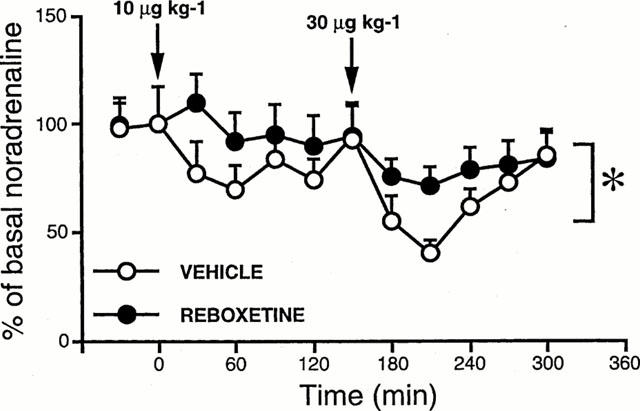
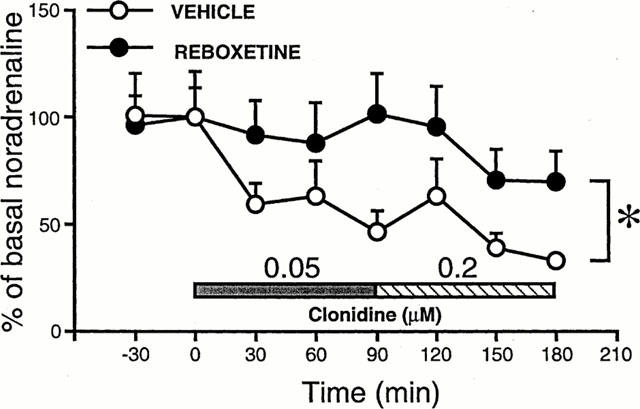
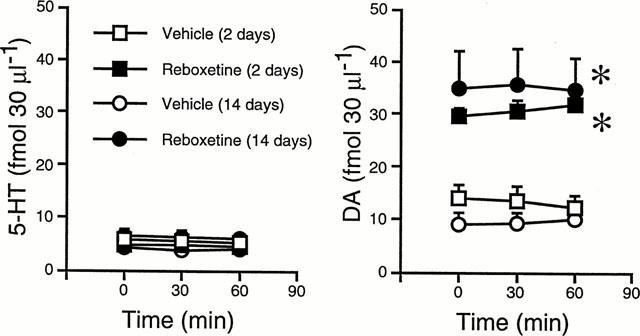
1. This study investigated the effect of acute (2 days) and chronic (14 days) treatment with a selective inhibitor of noradrenaline uptake, reboxetine (10 mg kg(-1) day(-1)) by osmotic pumps, on extracellular noradrenaline and the sensitivity of alpha(2)-adrenoceptors in the prefrontal cortex of rats. 2. The effect of continuous infusion of reboxetine for 14 days on cortical extracellular noradrenaline was significantly higher (599% of vehicle levels) than after 2 days (263% of vehicle levels). 3. Brain concentrations of reboxetine after 2 and 14 days of infusion were 37.9+/-17.8 and 37.1+/-7.7 ng g(-1), respectively. 4. Reboxetine infused for 2 and 14 days significantly increased extracellular dopamine in the prefrontal cortex, to a similar extent (257 and 342% of vehicle levels, respectively), whereas extracellular 5-HT was not modified by either treatment. 5. Clonidine (10 and 30 microg kg(-1) i.p.) reduced cortical extracellular noradrenaline similarly in animals treated with reboxetine or vehicle for 2 days whereas the effects in rats infused with reboxetine for 14 days were markedly less than in vehicle-treated animals. 6. Clonidine (0.05 and 0.2 microM), infused through the dialysis probe into the prefrontal cortex, reduced cortical extracellular noradrenaline much less in rats treated with reboxetine for 14 days than in vehicle-treated animals. 7. Reboxetine's effect on extracellular noradrenaline in the prefrontal cortex was greater after chronic treatment and could be associated with desensitization of terminal alpha(2)-adrenoceptors that normally serve to inhibit noradrenaline release.
Figures
References
-
- BLIER P., DE MONTIGNY C. Current advances and trends in the treatment of depression. Trends Pharmacol. Sci. 1994;15:220–226. - PubMed
-
- CACCIA S. Metabolism of newer antidepressants. An overview of the pharmacological and pharmacokinetics implications. Clin. Pharmacokinet. 1998;34:281–302. - PubMed
-
- CAMPBELL I.C., MCKERNAN R.M. Clorgyline and desipramine alter the sensitivity of [3H]-noradrenaline release to calcium but not to clonidine. Brain Res. 1986;372:253–259. - PubMed
-
- CARBONI E., TANDA G., FRAU R., DI CHIARA G. Blockade of the noradrenaline carrier increases extracellular dopamine concentrations in the prefrontal cortex: evidence that dopamine is taken up in vivo by noradrenergic terminals. J. Neurochem. 1990;55:1067–1070. - PubMed
-
- DENNIS T., L'HEUREUX R., CARTER C., SCATTON B. Presynaptic alpha-2 adrenoceptors play a major role in the effects of idazoxan on cortical noradrenaline release (as measured by in vivo dialysis) in the rat. J. Pharmacol. Exp. Ther. 1987;241:642–649. - PubMed
Publication types
MeSH terms
Substances
LinkOut - more resources
Full Text Sources