


Inhibition by glucocorticoids of the mast cell-dependent weal and flare response in human skin in vivo
- PMID: 11156588
- PMCID: PMC1572547
- DOI: 10.1038/sj.bjp.0703789
Inhibition by glucocorticoids of the mast cell-dependent weal and flare response in human skin in vivo
Abstract
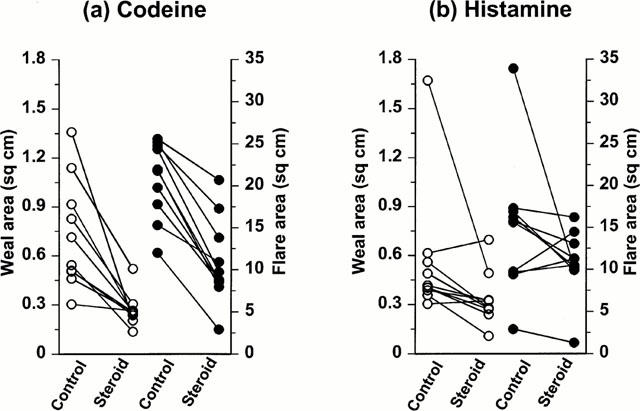
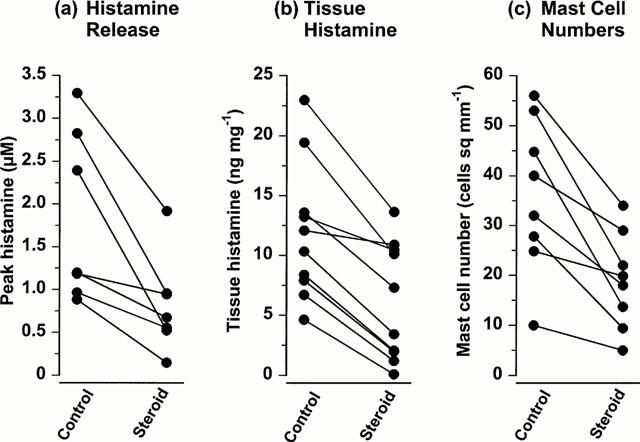
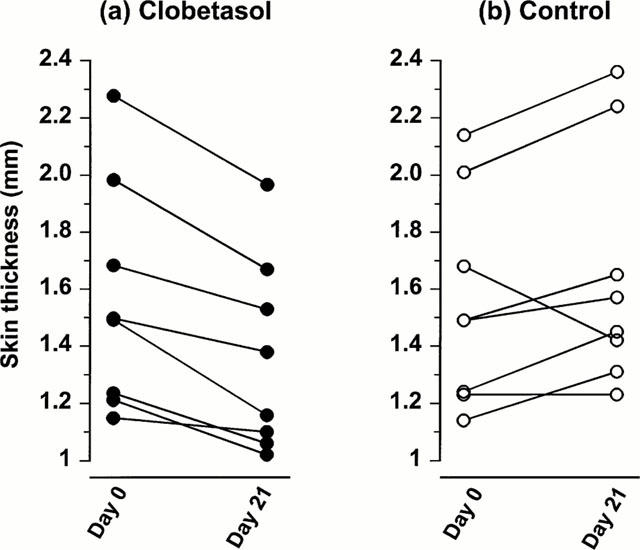
1. This study examines the relative contributions made by inhibition of mast cell degranulation, reduction of mast cell recruitment and maturation, and lowering the responsiveness of the vasculature to histamine, in the inhibition by glucocorticoids of the weal and flare in human skin. 2. One forearm of healthy human volunteers was treated for 24 h (n=6) or daily for 21 days (n=10) with 0.05% clobetasol propionate. The other arm served as control. Weal and flare responses were elicited by intradermal injection of 20 microl of 0.3 mM codeine. The areas of the responses were measured using scanning laser Doppler imaging. Microdialysis was used to assess histamine release. Mast cell numbers and tissue histamine content were assessed in 4-mm punch biopsies. Histamine (20 microl of 1 microM i.d.) was used to assess the status of the vasculature. 3. No significant effects were seen at 24 h. At 21 days, clobetasol reduced the areas of the codeine-induced weal and flare responses by 59 and 58% respectively (both P=0.006). Mast cell numbers were reduced by 47%, (P=0.014) and total tissue histamine content by 52% (P=0.006). Codeine-induced histamine release was reduced by 44% (P=0.022). The weal, but not the flare, induced by histamine was significantly inhibited (P=0.019). Echography revealed a 15% thinning of the skin by clobetasol. 4. These results demonstrate that reduction of the weal and flare responses to codeine following clobetasol treatment, results primarily from reduced mast cell numbers and tissue histamine content rather than inhibition by corticosteroids of mast cell degranulation.
Figures
References
-
- ANDERSSON M., PIPKORN U. Inhibition of the dermal immediate allergic reaction through prolonged treatment with topical glucocorticosteroids. J. Allergy Clin. Immunol. 1987;79:345–349. - PubMed
-
- ATKINS P.C., SCHWARTZ L.B., ADKINSON N.F., VON ALLMEN C., VALENZANO M., ZWEIMAN B. In vivo antigen-induced cutaneous mediator release: simultaneous comparisons of histamine, tryptase, and prostaglandin D2 release and the effect of oral corticosteroid administration. J. Allergy Clin. Immunol. 1990;86:360–370. - PubMed
-
- BARNES P.J. Anti-inflammatory actions of glucocorticoids: molecular mechanisms. Clin. Sci. 1998;94:557–572. - PubMed
-
- BARNES P.J., LARIN M. Mechanisms of disease–Nuclear factor-kappa b – A pivotal transcription factor in chronic inflammatory diseases. N. Engl. J. Med. 1997;336:1066–1071. - PubMed
-
- BOOIJ NOORD H., ORIE N.G.M., VRIES K. Immediate and late bronchial obstructive reactions to inhalation of house dust and protective effects of disodium cromoglycate and prednisolone. J. Allergy Clin. Immunol. 1971;48:344–354. - PubMed
Publication types
MeSH terms
Substances
LinkOut - more resources
Full Text Sources
Medical
