. 2001 Jan;11(1):152-62.
doi: 10.1101/gr.150201.

Robust and accurate single nucleotide polymorphism genotyping by dynamic allele-specific hybridization (DASH): design criteria and assay validation

Affiliations

Robust and accurate single nucleotide polymorphism genotyping by dynamic allele-specific hybridization (DASH): design criteria and assay validation

J A Prince et al. Genome Res. 2001 Jan.

Abstract

We recently introduced a generic single nucleotide polymorphism (SNP) genotyping method, termed DASH (dynamic allele-specific hybridization), which entails dynamic tracking of probe (oligonucleotide) to target (PCR product) hybridization as reaction temperature is steadily increased. The reliability of DASH and optimal design rules have not been previously reported. We have now evaluated crudely designed DASH assays (sequences unmodified from genomic DNA) for 89 randomly selected and confirmed SNPs. Accurate genotype assignment was achieved for 89% of these worst-case-scenario assays. Failures were determined to be caused by secondary structures in the target molecule, which could be reliably predicted from thermodynamic theory. Improved design rules were thereby established, and these were tested by redesigning six of the failed DASH assays. This involved reengineering PCR primers to eliminate amplified target sequence secondary structures. This sophisticated design strategy led to complete functional recovery of all six assays, implying that SNPs in most if not all sequence contexts can be effectively scored by DASH. Subsequent empirical support for this inference has been evidenced by approximately 30 failure-free DASH assay designs implemented across a range of ongoing genotyping programs. Structured follow-on studies employed standardized assay conditions, and revealed that assay reproducibility (733 duplicated genotypes, six different assays) was as high as 100%, with an assay accuracy (1200 genotypes, three different assays) that exceeded 99.9%. No post-PCR assay failures were encountered. These findings, along with intrinsic low cost and high flexibility, validate DASH as an effective procedure for SNP genotyping.


Figures
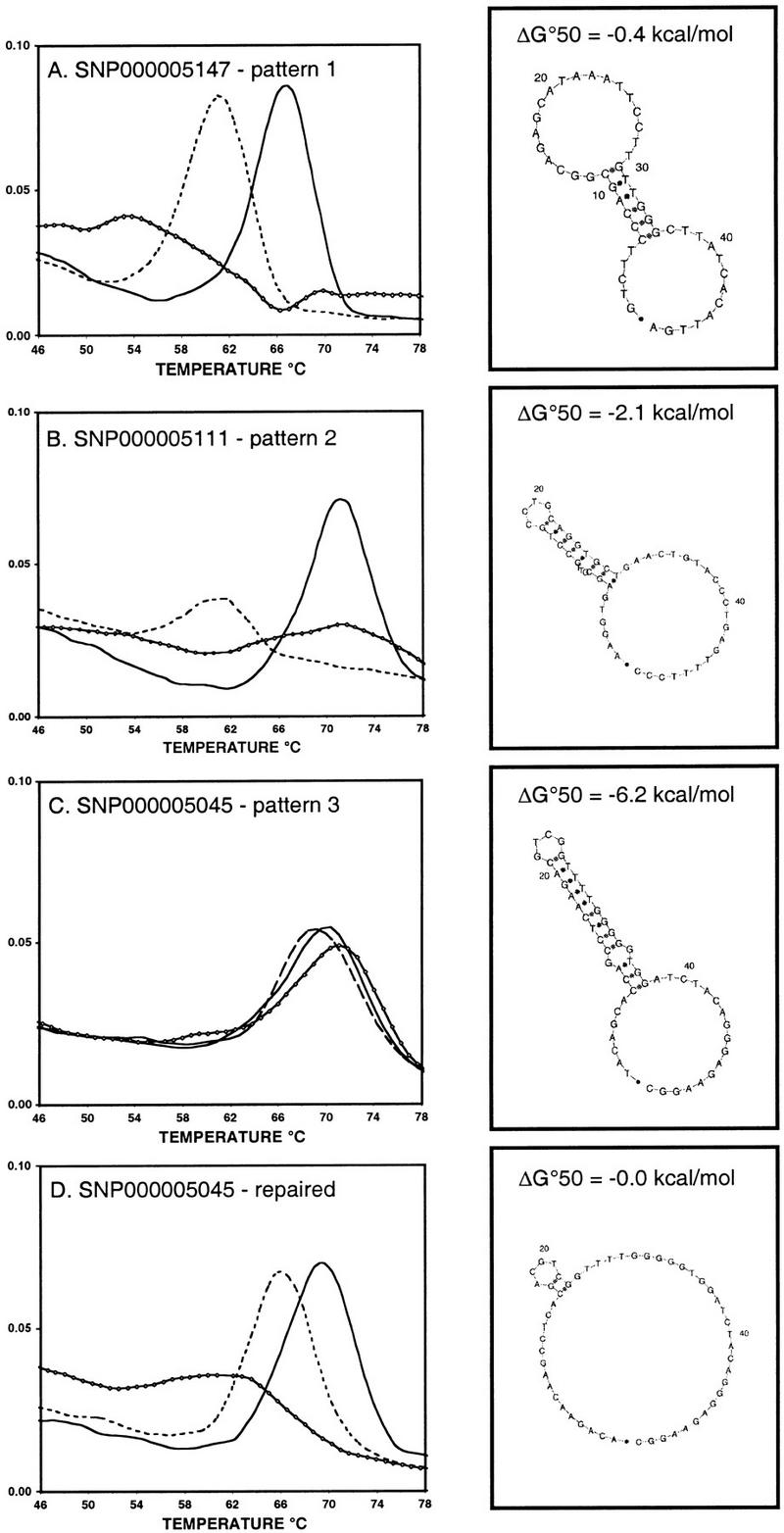
Figure 1
Figure 1
DASH results are shown for a major allele probe (solid line) and a minor allele probe (dashed line) used seperately to examine a major allele homozygous sample. Signals produced in the absence of any probe (representing target-sequence secondary structure) are also shown (diamond-marked line). All plots show the negative first derivative of the fluorescence versus temperature. The most stable target sequence secondary structures (predicted by mfold at 50°C) are shown to the right of each plot. HGBASE (http://hgbase.cgr.ki.se) SNP accession numbers are also given. (A) Pattern 1 (Ideal) assay. (B) Pattern 2 (Successful) assay. (C) Pattern 3 (Failed) assay. (D) An assay for the same SNP as in C, redesigned to minimize amplified target-sequence secondary structure as follows: original primers, 5′-GGCCTTCTCCCTGTAGATCCAC 3′ and biotin-5′-AGATACAGCACCAGCCTCAAGAC-3′; repaired primers, 5′-GGCCTTCTCCCTGTAGATCCAC-3′ and biotin-5′-ACAGAACAAGCCTCACGACGTCGG-3′.
Figure 2
Figure 2
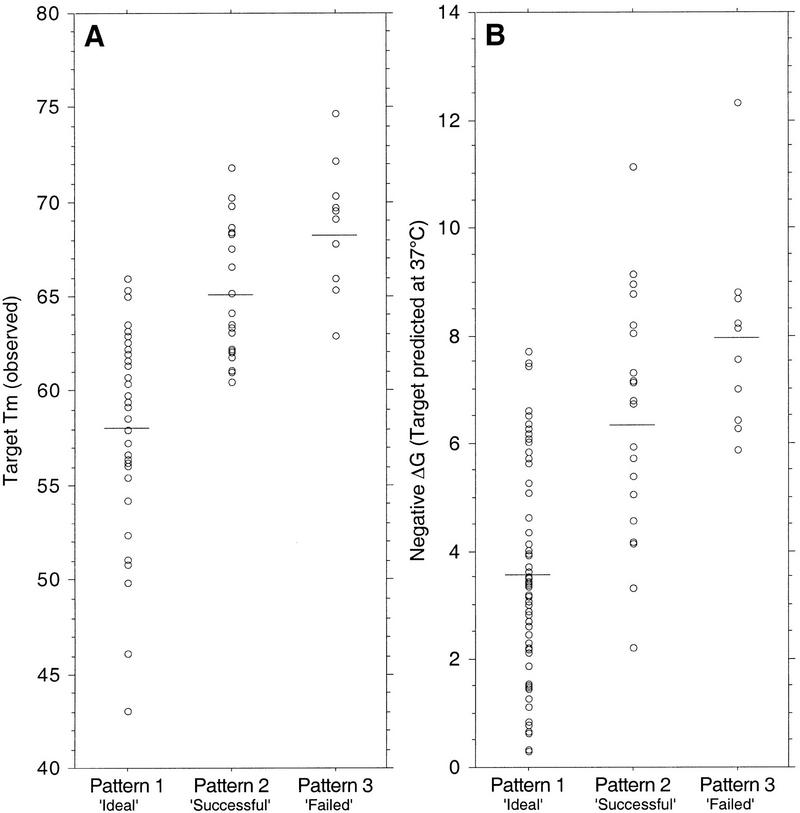
Observed distributions of the two investigated measures of target-sequence secondary structure are shown, plotted against the three categories of assay functionality (quality patterns 1, 2, and 3) for 89 crudely designed DASH assays. (A) experimentally determined Tm values. (B) theoretically predicted (mfold at 37°C) ΔG values. Each data point represents the respective measure of target secondary-structure stability for one assay. Mean values are denoted by short horizontal lines. It is apparent that the mean values for failed assays (pattern 3) were significantly higher than for functional assays (patterns 1 and 2), indicating that target secondary structure is a primary cause of assay failure.
Figure 3
Figure 3
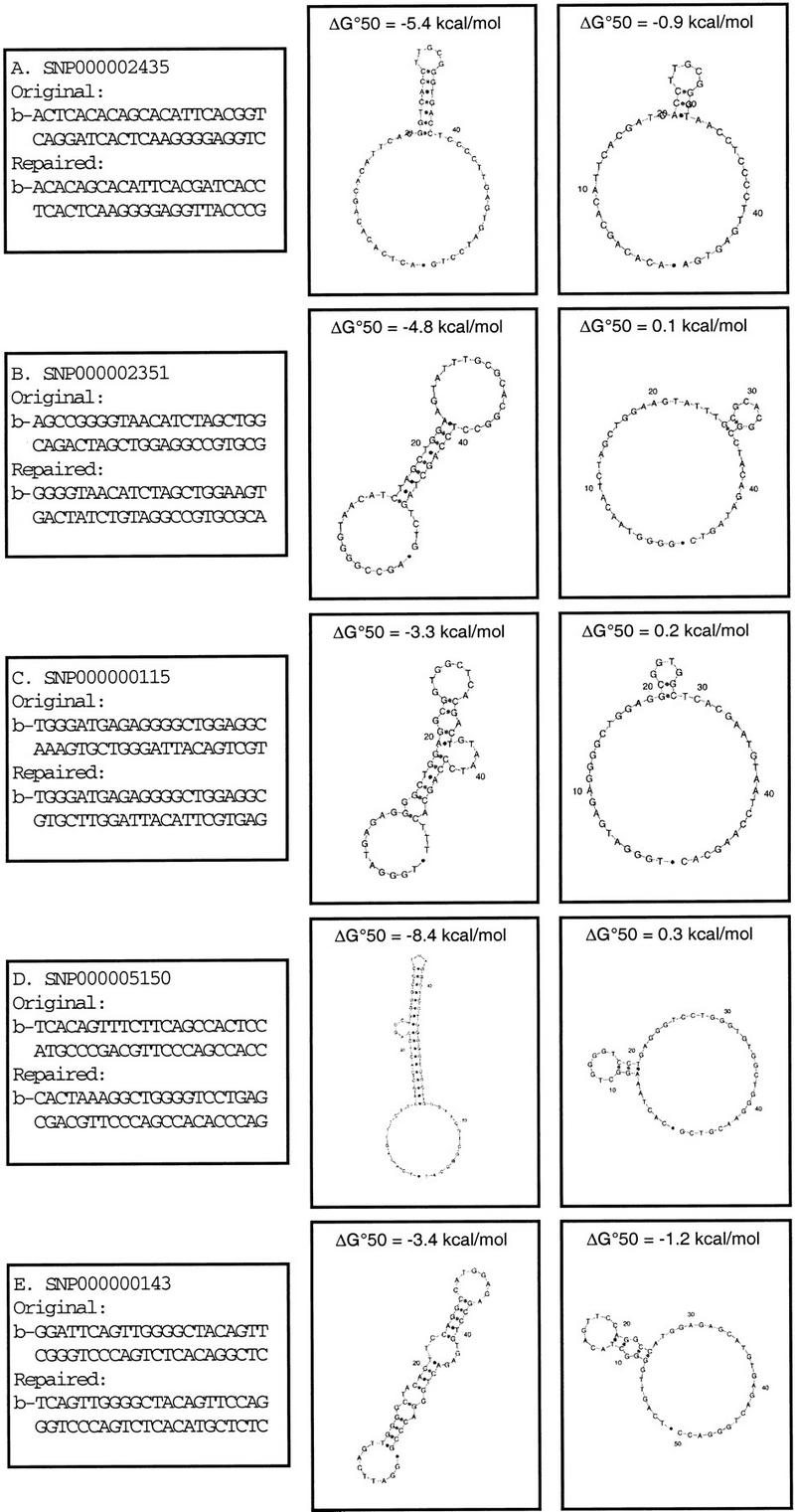
Redesign details are shown for five DASH assays. In each case, primer sequences (5′—3′) are indicated for the original nonfunctional assay and for the repaired functional assay, along with the respective theoretically predicted (mfold) secondary structures of the resulting PCR product. The leftmost secondary structure represents the original design, and the rightmost structure represents the situation after primer sequence modification. Sequences in which a 5′-biotin moiety has been added are marked with the letter b. SNP accession numbers according to HGBASE (http://hgbase.cgr.ki.se) are shown for each assay.
Figure 4
Figure 4
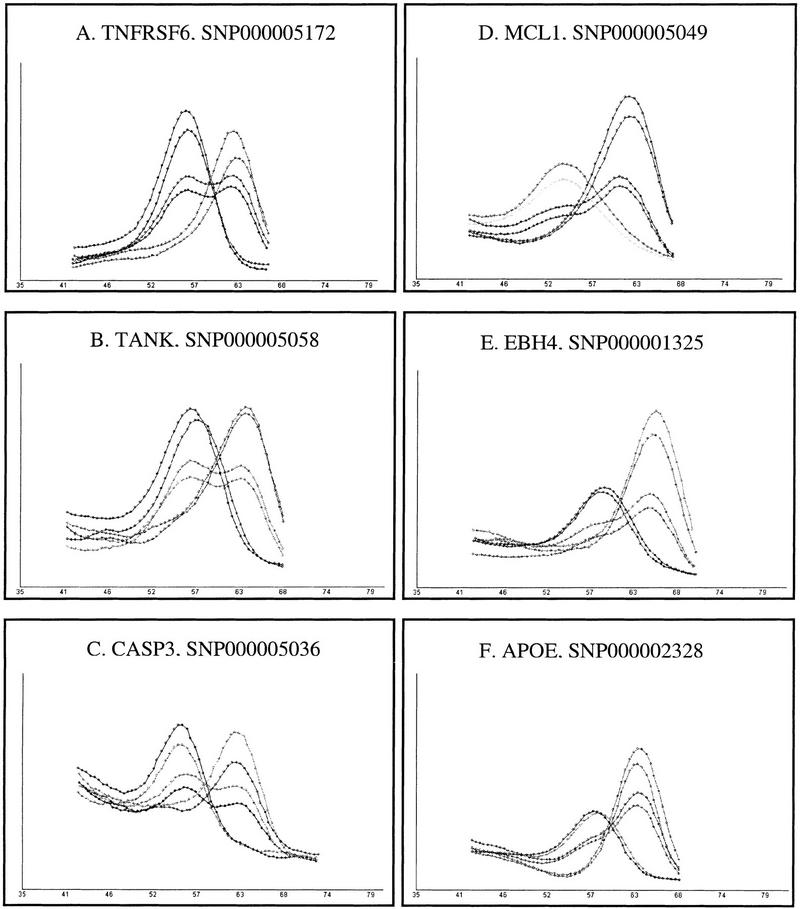
Example genotyping results are shown for six different SNPs scored by DASH, demonstrating assay reproducibility. A, B, and C are quality 1 assays. D, E, and F are quality 2 assays. In each case, results are plotted for three individuals (one homozygote for each allele, and a heterozygote) genotyped on two separate occasions. High-temperature single peaks represent homozygous samples matched to the utilized probe. Low-temperature single peaks represent homozygous samples mismatched to the utilized probe. Curves with both high- and low-temperature peaks represent heterozygous samples. All plots show the negative first derivative of fluorescence versus temperature. The gene symbols as well as SNP accession numbers for each assay from HGBASE (http://hgbase.cgr.ki.se) are shown.
Figure 5
Figure 5
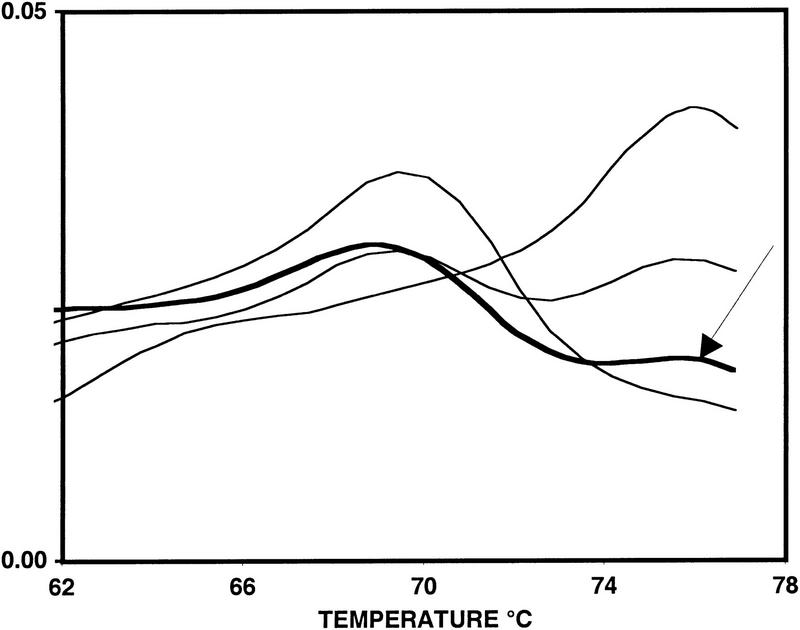
An example of incorrect genotype assignment by DASH. The curve representing the incorrectly assigned genotype is shown both in and by the arrow. A weak aberrant high-temperature peak gave the impression of a heterozygote, when, in fact, the sample was a homozygote, which should have produced a single low-temperature peak. Three confirmed genotypes (both homozygotes, and one heterozygote) are included for comparison.
Figure 6
Figure 6
A demonstration of the uniformity of DASH genotyping curves. The two sets of results show distinct assays used upon complete microtiter plates carrying PCR products from 96 unrelated genomic DNA samples. Panel A is a pattern 1 assay, and panel B is a pattern 2 assay. Gene symbols and SNP accession numbers from HGBASE (http://hgbase.cgr.ki.se) are included.
Figure 6
Figure 6
A demonstration of the uniformity of DASH genotyping curves. The two sets of results show distinct assays used upon complete microtiter plates carrying PCR products from 96 unrelated genomic DNA samples. Panel A is a pattern 1 assay, and panel B is a pattern 2 assay. Gene symbols and SNP accession numbers from HGBASE (http://hgbase.cgr.ki.se) are included.

References

    1. Blennow K, Ricksten A, Prince JA, Brookes AJ, Emahazion T, Wasslavik C, Bogdanovic N, Andreasen N, Båtsman S, Marcusson J, et al. No association between the α2-macroglobulin (A2M) deletion and Alzheimer's disease, and no change in A2M mRNA, protein, or protein expression. J Neural Trans. 2000;107:1065–1079. - PubMed
    1. Brookes AJ. The Essence of SNPs. Gene. 1999;234:177–186. - PubMed
    1. Brookes AJ, Lehvaslaiho H, Siegfried M, Boehm JG, Yuan YP, Sarkar CM, Bork P, Ortigao F. HGBASE: A database of SNPs and other variations in and around human genes. Nucleic Acids Res. 2000;28:356–360. - PMC - PubMed
    1. Cambien F, Poirier O, Nicaud V, Herrmann SM, Mallet C, Ricard S, Behague I, Hallet V, Blanc H, Loukaci V, et al. Sequence diversity in 36 candidate genes for cardiovascular disorders. Am J Hum Genet. 1999;65:183–191. - PMC - PubMed
    1. Cargill M, Altshuler D, Ireland J, Sklar P, Ardlie K, Patil N, Shaw N, Lane CR, Lim EP, Kalyanaraman N, et al. Characterization of single-nucleotide polymorphisms in coding regions of human genes. Nat Genet. 1999;22:231–238. - PubMed

Publication types

LinkOut - more resources