


Phylogenetic and functional heterogeneity of sediment biofilms along environmental gradients in a glacial stream
- PMID: 11157246
- PMCID: PMC92650
- DOI: 10.1128/AEM.67.2.799-807.2001
Phylogenetic and functional heterogeneity of sediment biofilms along environmental gradients in a glacial stream
Abstract
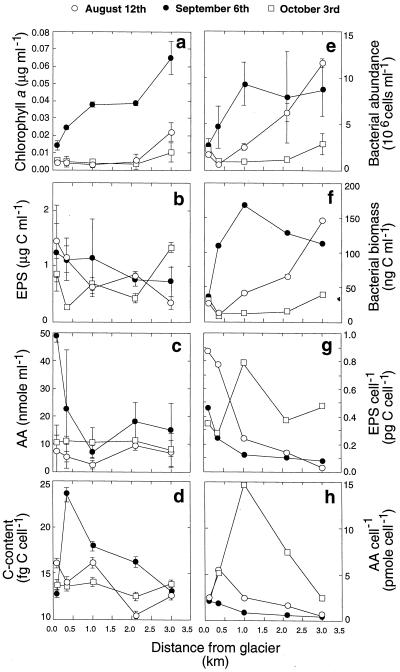
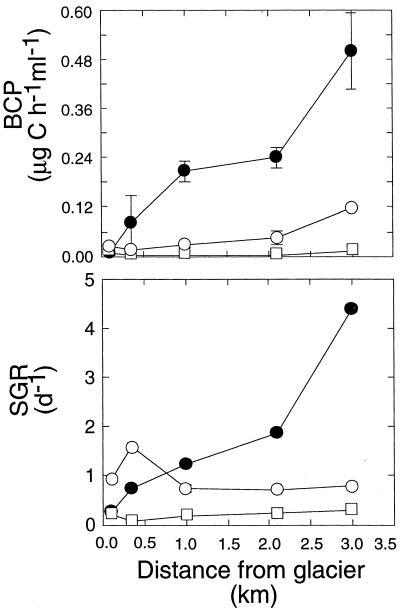
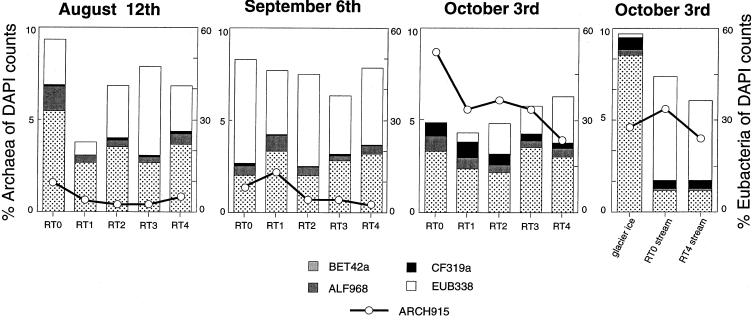
We used in situ hybridization with fluorescently labeled rRNA-targeted oligonucleotide probes concurrently with measurements of bacterial carbon production, biomass, and extracellular polymeric substances (EPS) to describe the bacterial community in sediments along a glacial stream. The abundance of sediment-associated Archaea, as detected with the ARCH915 probe, decreased downstream of the glacier snout, and a major storm increased their relative abundance by a factor of 5.5 to 7.9. Bacteria of the Cytophaga-Flavobacterium group were also sixfold to eightfold more abundant in the storm aftermath. Furthermore, elevated numbers of Archaea and members of the Cytophaga-Flavobacterium group characterized the phylogenetic composition of the supraglacial ice community. We postulate that glacial meltwaters constitute a possible source of allochthonous bacteria to the stream biofilms. Although stream water temperature increased dramatically from the glacier snout along the stream (3.5 km), sediment chlorophyll a was the best predictor for bacterial carbon production and specific growth rates along the stream. Concomitant with an increase in sediment chlorophyll a, the EPS carbohydrate-to-bacterial-cell ratio declined 11- to 15-fold along the stream prior to the storm, which is indicative of a larger biofilm matrix in upstream reaches. We assume that a larger biofilm matrix is required to assure prolonged transient storage and enzymatic processing of allochthonous macromolecules, which are likely the major substrate for microbial heterotrophs. Bacteria of the Cytophaga-Flavobacterium cluster, which are well known to degrade complex macromolecules, were most abundant in these stream reaches. Downstream, higher algal biomass continuously supplies heterotrophs with easily available exudates, therefore making a larger matrix unnecessary. As a result, bacterial carbon production and specific growth rates were higher in downstream reaches.
Figures
References
-
- Arrigo K R, Worthen D L, Lizotte M P, Dixon P, Dieckmann G. Primary production in Antarctic sea ice. Science. 1997;276:394–397. - PubMed
-
- Battin T J. Hydrodynamics is a major determinant of streambed biofilms: from the sediment to the reach scale. Limnol Oceanogr. 2000;45:1308–1319.
-
- Battin T J, Butturini A, Sabater F. Immobilization and metabolism of dissolved organic carbon by natural sediment biofilms in Mediterranean and temperate streams. Aquat Microb Ecol. 1999;19:297–305.
Publication types
MeSH terms
Substances
LinkOut - more resources
Full Text Sources
