Roles for inositol-phosphoryl ceramide synthase 1 (IPC1) in pathogenesis of C. neoformans
- PMID: 11157776
- PMCID: PMC312614
- DOI: 10.1101/gad.856001
Roles for inositol-phosphoryl ceramide synthase 1 (IPC1) in pathogenesis of C. neoformans
Abstract
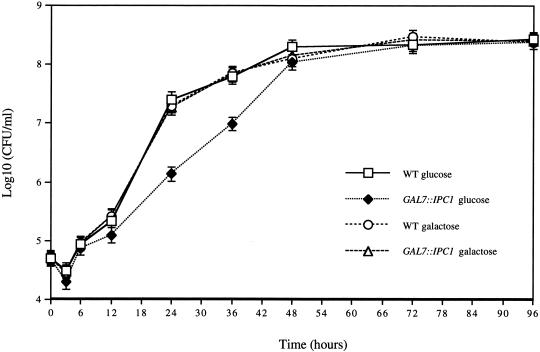
Cryptococcus neoformans is a leading cause of life-threatening fungal infection in immunocompromised patients. Inositol-phosphoryl ceramide synthase 1 (Ipc1) is a fungus-specific enzyme, encoded by the essential IPC1 gene, that catalyzes the formation of complex sphingolipids and may also regulate the levels of phytoceramide and diacylglycerol. Here, we investigated the functions of this essential gene by modulating its expression in C. neoformans using a galactose-inducible promoter. Down-regulation of IPC1 significantly lowers the expression of certain virulence traits such as melanin pigmentation and, remarkably, impairs pathogenicity of C. neoformans in an established rabbit model. Interestingly, we found that IPC1 down-regulation significantly decreases the intracellular growth of C. neoformans in the J774.16 murine macrophage-like cells. Finally, we studied the effect of IPC1 expression under different stress conditions and found that down-regulation of IPC1 confers a defect on in vitro growth at low pH. Because this environment is similar to that in the phagolysosome of J774.16 macrophage-like cells, our findings indicate that down-regulation of IPC1 confers a growth defect in vivo through a pH-dependent mechanism. In conclusion, our study is the first to define a novel and crucial function of Ipc1 in fungal pathogenesis.
Figures

References
-
- Agin PP, Dowdy JC, Costlow ME. Diacylglycerol-induced melanogenesis in Skh-2 pigmented hair-less mice. Photodermatol Photoimmunol Photomed. 1991;8:51–56. - PubMed
-
- Alspaugh JA, Perfect JR, Heitman J. Signal transduction pathways regulating differentiation and pathogenicity of Cryptococcus neoformans. Fungal Genet Biol. 1998;25:1–14. - PubMed
-
- Barluzzi R, Brozzetti A, Mariucci G, Tantucci M, Neglia RG, Bistoni F, Blasi E. Establishment of protective immunity against cerebral cryptococcosis by means of an avirulent, non melanogenic Cryptococcus neoformansstrain. J Neuroimmunol. 2000;109:75–86. - PubMed
-
- Bradford MM. A rapid and sensitive method for the quantitation of microgram quantities of protein utilizing the principle of protein-dye binding. Anal Biochem. 1976;72:248–254. - PubMed
Publication types
MeSH terms
Substances
Grants and funding
LinkOut - more resources
Full Text Sources
Other Literature Sources