Comparative Study
. 2001 Feb;11(2):240-52.
doi: 10.1101/gr.162001.

Prediction of the archaeal exosome and its connections with the proteasome and the translation and transcription machineries by a comparative-genomic approach

Affiliations
Comparative Study

Prediction of the archaeal exosome and its connections with the proteasome and the translation and transcription machineries by a comparative-genomic approach

E V Koonin et al. Genome Res. 2001 Feb.

Abstract

By comparing the gene order in the completely sequenced archaeal genomes complemented by sequence profile analysis, we predict the existence and protein composition of the archaeal counterpart of the eukaryotic exosome, a complex of RNAses, RNA-binding proteins, and helicases that mediates processing and 3'->5' degradation of a variety of RNA species. The majority of the predicted archaeal exosome subunits are encoded in what appears to be a previously undetected superoperon. In Methanobacterium thermoautotrophicum, this predicted superoperon consists of 15 genes; in the Crenarchaea, Sulfolobus solfataricus and Aeropyrum pernix, one and two of the genes from the superoperon, respectively, are relocated in the genome, whereas in other Euryarchaeota, the superoperon is split into a variable number of predicted operons and solitary genes. Methanococcus jannaschii partially retains the superoperon, but lacks the three core exosome subunits, and in Halobacterium sp., the superoperon is divided into two predicted operons, with the same three exosome subunits missing. This suggests concerted gene loss and an alteration of the structure and function of the predicted exosome in the Methanococcus and Halobacterium lineages. Additional potential components of the exosome are encoded by partially conserved predicted small operons. Along with the orthologs of eukaryotic exosome subunits, namely an RNase PH and two RNA-binding proteins, the predicted archaeal exosomal superoperon also encodes orthologs of two protein subunits of RNase P. This suggests a functional and possibly a physical interaction between RNase P and the postulated archaeal exosome, a connection that has not been reported in eukaryotes. In a pattern of apparent gene loss complementary to that seen in Methanococcus and Halobacterium, Thermoplasma acidophilum lacks the RNase P subunits. Unexpectedly, the identified exosomal superoperon, in addition to the predicted exosome components, encodes the catalytic subunits of the archaeal proteasome, two ribosomal proteins and a DNA-directed RNA polymerase subunit. These observations suggest that in archaea, a tight functional coupling exists between translation, RNA processing and degradation, (apparently mediated by the predicted exosome) and protein degradation (mediated by the proteasome), and may have implications for cross-talk between these processes in eukaryotes.


Figures
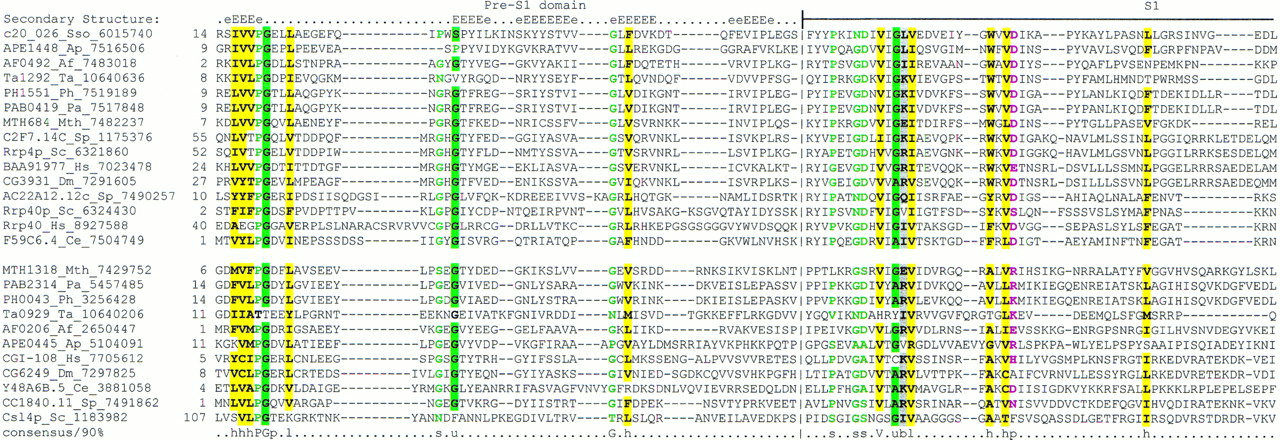
Figure 1
Figure 1
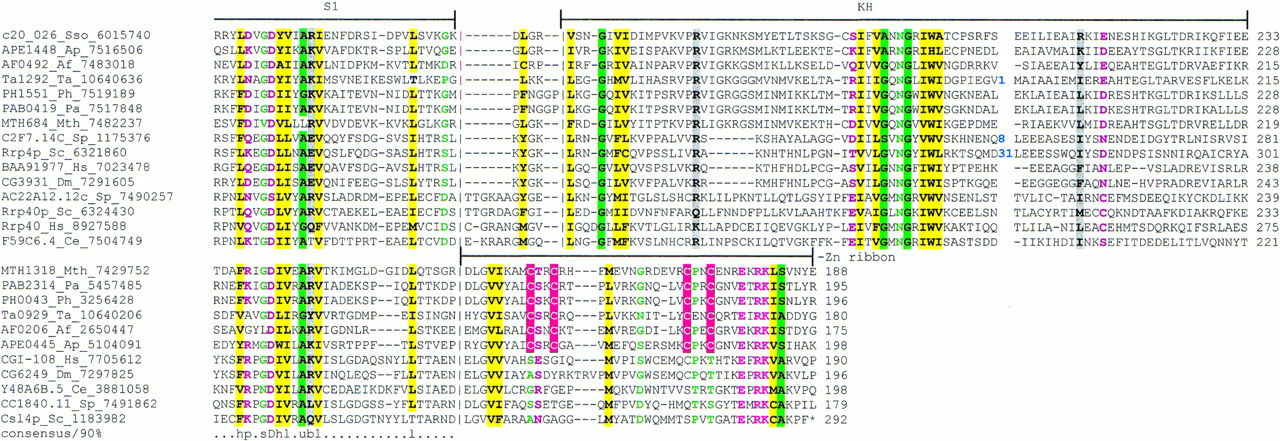
Multiple alignment of the Rrp4p and Csl4p subunits of the eukaryotic and predicted archaeal exosomes. The proteins are denoted by the gene names, Gene Identification (GI) numbers, and abbreviated species names. The positions of the first and the last residue of the aligned region are indicated for each sequence; variable spacers between the aligned blocks that were omitted from some of the sequences are indicated by numbers. The boundaries of the two predicted RNA-binding domains, S1 and KH, and the novel, amino-terminal pre-S1 domain are shown. The alignment coloring is based on the 90% consensus, which is shown underneath the alignment; b indicates a big residue (E,K,R,I,L,M,F,Y,W), h indicates hydrophobic residues (A,C,F,I,L,M,V,W,Y), a indicates aromatic residues (F,Y,W), s indicates small residues (A,C,S,T,D,N,V,G,P), u indicates tiny residues (G,A,S), p indicates polar residues (D,E,H,K,N,Q,R,S,T), and c indicates charged residues (K,R,D,E,H). The conserved cysteines that form a Zn-ribbon in the archaeal but not in the eukaryotic proteins are shown by white letters against a red background. The secondary structure elements predicted for the pre-S1 domain using the PHD program and a preconstructed multiple alignment as the input are shown above the alignment. H(h) indicates α-helix and E(e) indicates extended conformation (β-strand); upper case indicates the subset of the predictions with an estimated 80% confidence level. The species abbreviations are: Af, Archaeoglobus fulgidus; Ap, Aeropyrum pernix; Ce, Caenorhabditis elegans; Hs, Homo sapiens; Dm, Drosophila melanogaster; Mth, Methanobacterium thermoautotrophicum; Pa, Pyrococcus abyssii; Ph, Pyrococcus horikoshii; Ta, Thermoplasma acidophilum; Sc, Saccharomyces cerevisiae; Sp, Schizosaccharomyces pombe; Sso, Sulfolobus solfataricus.
Figure 1
Figure 1
Multiple alignment of the Rrp4p and Csl4p subunits of the eukaryotic and predicted archaeal exosomes. The proteins are denoted by the gene names, Gene Identification (GI) numbers, and abbreviated species names. The positions of the first and the last residue of the aligned region are indicated for each sequence; variable spacers between the aligned blocks that were omitted from some of the sequences are indicated by numbers. The boundaries of the two predicted RNA-binding domains, S1 and KH, and the novel, amino-terminal pre-S1 domain are shown. The alignment coloring is based on the 90% consensus, which is shown underneath the alignment; b indicates a big residue (E,K,R,I,L,M,F,Y,W), h indicates hydrophobic residues (A,C,F,I,L,M,V,W,Y), a indicates aromatic residues (F,Y,W), s indicates small residues (A,C,S,T,D,N,V,G,P), u indicates tiny residues (G,A,S), p indicates polar residues (D,E,H,K,N,Q,R,S,T), and c indicates charged residues (K,R,D,E,H). The conserved cysteines that form a Zn-ribbon in the archaeal but not in the eukaryotic proteins are shown by white letters against a red background. The secondary structure elements predicted for the pre-S1 domain using the PHD program and a preconstructed multiple alignment as the input are shown above the alignment. H(h) indicates α-helix and E(e) indicates extended conformation (β-strand); upper case indicates the subset of the predictions with an estimated 80% confidence level. The species abbreviations are: Af, Archaeoglobus fulgidus; Ap, Aeropyrum pernix; Ce, Caenorhabditis elegans; Hs, Homo sapiens; Dm, Drosophila melanogaster; Mth, Methanobacterium thermoautotrophicum; Pa, Pyrococcus abyssii; Ph, Pyrococcus horikoshii; Ta, Thermoplasma acidophilum; Sc, Saccharomyces cerevisiae; Sp, Schizosaccharomyces pombe; Sso, Sulfolobus solfataricus.
Figure 2
Figure 2
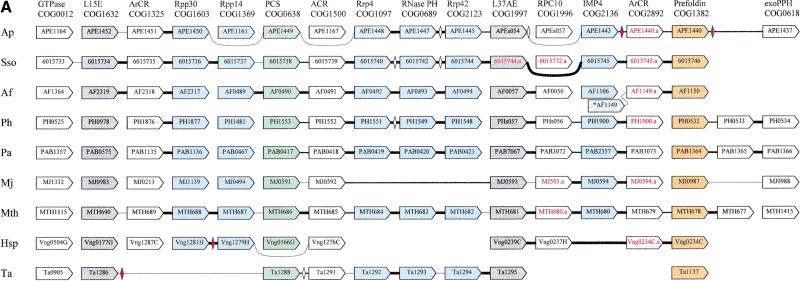
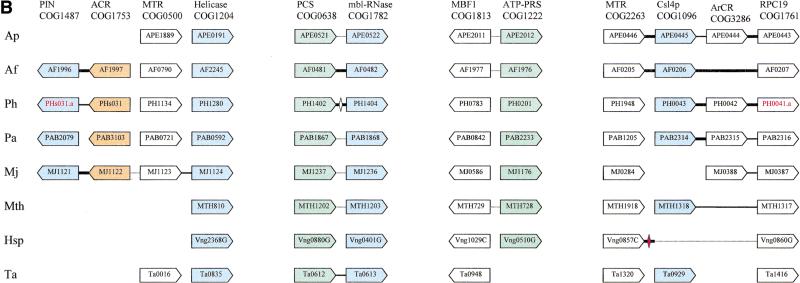
Organization of genes encoding predicted exosome subunits and functionally related proteins in archaeal genomes. (A) The potential exosomal superoperon. (B) Additional predicted operons coding for proteins functionally linked to the predicted exosome and the proteasome. Genes are not drawn to scale; the direction of transcription is indicated by arrows. The multiple gene-by-gene alignment was produced by manually combining template-anchored genome alignments; orthologous genes are aligned. For each column of the alignment, the number of the respective COG and the systematic subunit name or a functional designation are shown. Adjacent genes are connected with lines; thick lines indicate intergenic regions <20 nucleotides, thin lines those in the range of 20–50 nucleotides, and dotted lines those >50 nucleotides. The unconnected genes are located elsewhere in the genomes (which is also clear from the indicated gene numbers). The color coding shows functionally related groups of proteins: blue predicted exosome subunits (including the RNase P subunits Rpp30 and Rpp14), with blue hatching indicating tentative predictions (see text); green, proteasome subunits; gray, ribosomal proteins; gold, cotranslational chaperones; white, uncharacterized proteins and other functions, including flanking genes with no predicted functional connection with the exosome. The gene names shown in red and with the suffix a indicate predicted genes that are missing in the original genome annotation, but were identified during this analysis using TBLASTN searches. Diamonds show genes present in the original annotation that are inserted between the conserved genes; the open diamonds show predicted genes that significantly overlap with the conserved ones and are probably spurious; red diamonds indicate nonoverlapping genes that are likely to be real. Abbreviations: ACR, ancient conserved region; ArCR, archaeal conserved region; MTR, methyltransferase; PCS, proteasome catalytic subunit; PRS, proteasome regulatory subunit; exoPPH, exopolyphosphatase. The species abbreviations are as in Fig. 1. Hal, Halobacterium sp.
Figure 2
Figure 2
Organization of genes encoding predicted exosome subunits and functionally related proteins in archaeal genomes. (A) The potential exosomal superoperon. (B) Additional predicted operons coding for proteins functionally linked to the predicted exosome and the proteasome. Genes are not drawn to scale; the direction of transcription is indicated by arrows. The multiple gene-by-gene alignment was produced by manually combining template-anchored genome alignments; orthologous genes are aligned. For each column of the alignment, the number of the respective COG and the systematic subunit name or a functional designation are shown. Adjacent genes are connected with lines; thick lines indicate intergenic regions <20 nucleotides, thin lines those in the range of 20–50 nucleotides, and dotted lines those >50 nucleotides. The unconnected genes are located elsewhere in the genomes (which is also clear from the indicated gene numbers). The color coding shows functionally related groups of proteins: blue predicted exosome subunits (including the RNase P subunits Rpp30 and Rpp14), with blue hatching indicating tentative predictions (see text); green, proteasome subunits; gray, ribosomal proteins; gold, cotranslational chaperones; white, uncharacterized proteins and other functions, including flanking genes with no predicted functional connection with the exosome. The gene names shown in red and with the suffix a indicate predicted genes that are missing in the original genome annotation, but were identified during this analysis using TBLASTN searches. Diamonds show genes present in the original annotation that are inserted between the conserved genes; the open diamonds show predicted genes that significantly overlap with the conserved ones and are probably spurious; red diamonds indicate nonoverlapping genes that are likely to be real. Abbreviations: ACR, ancient conserved region; ArCR, archaeal conserved region; MTR, methyltransferase; PCS, proteasome catalytic subunit; PRS, proteasome regulatory subunit; exoPPH, exopolyphosphatase. The species abbreviations are as in Fig. 1. Hal, Halobacterium sp.
Figure 3
Figure 3
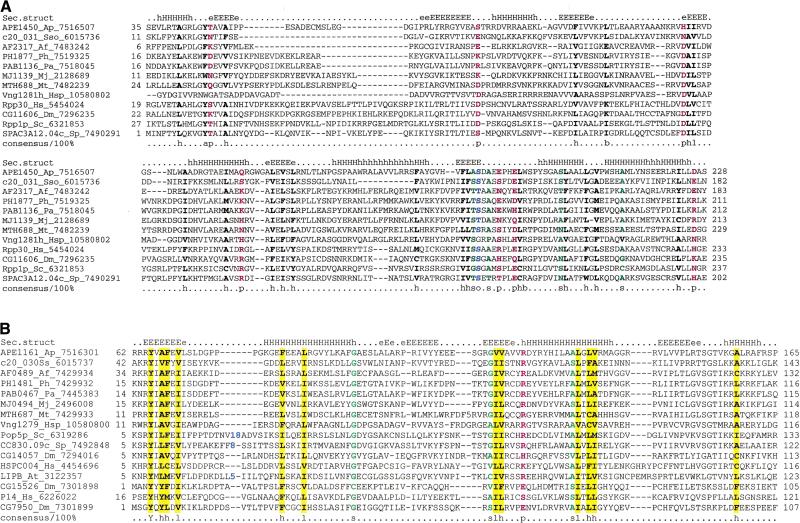
Multiple alignments of RNase P subunits with their previously undetected archaeal orthologs. (A) The P30 subunit. (B) The P14 subunit. The designations are as in Figs. 1 and 2.

References

    1. Altschul SF, Koonin EV. PSI-BLAST — A tool for making discoveries in sequence databases. Trends Biochem Sci. 1998;23:444–447. - PubMed
    1. Altschul SF, Madden TL, Schaffer AA, Zhang J, Zhang Z, Miller W, Lipman DJ. Gapped BLAST and PSI-BLAST: A new generation of protein database search programs. Nucleic Acids Res. 1997;25:3389–3402. - PMC - PubMed
    1. Aravind L. An evolutionary classification of the metallo-beta lactamase fold proteins. In Silico Biol. 1998;1:8. - PubMed
    1. ————— Guilt by association: Contextual information in genome analysis. Genome Res. 2000;10:1074–1077. - PubMed
    1. Aravind L, Koonin EV. DNA-binding proteins and evolution of transcription regulation in the archaea. Nucleic Acids Res. 1999;27:4658–4670. - PMC - PubMed

Publication types

LinkOut - more resources