. 2001 Feb;183(4):1215-24.
doi: 10.1128/JB.183.4.1215-1224.2001.

umuDC-mediated cold sensitivity is a manifestation of functions of the UmuD(2)C complex involved in a DNA damage checkpoint control

Affiliations

umuDC-mediated cold sensitivity is a manifestation of functions of the UmuD(2)C complex involved in a DNA damage checkpoint control

M D Sutton et al. J Bacteriol. 2001 Feb.

Abstract

The umuDC genes are part of the Escherichia coli SOS response, and their expression is induced as a consequence of DNA damage. After induction, they help to promote cell survival via two temporally separate pathways. First, UmuD and UmuC together participate in a cell cycle checkpoint control; second, UmuD'(2)C enables translesion DNA replication over any remaining unrepaired or irreparable lesions in the DNA. Furthermore, elevated expression of the umuDC gene products leads to a cold-sensitive growth phenotype that correlates with a rapid inhibition of DNA synthesis. Here, using two mutant umuC alleles, one that encodes a UmuC derivative that lacks a detectable DNA polymerase activity (umuC104; D101N) and another that encodes a derivative that is unable to confer cold sensitivity but is proficient for SOS mutagenesis (umuC125; A39V), we show that umuDC-mediated cold sensitivity can be genetically separated from the role of UmuD'(2)C in SOS mutagenesis. Our genetic and biochemical characterizations of UmuC derivatives bearing nested deletions of C-terminal sequences indicate that umuDC-mediated cold sensitivity is not due solely to the single-stranded DNA binding activity of UmuC. Taken together, our analyses suggest that umuDC-mediated cold sensitivity is conferred by an activity of the UmuD(2)C complex and not by the separate actions of the UmuD and UmuC proteins. Finally, we present evidence for structural differences between UmuD and UmuD' in solution, consistent with the notion that these differences are important for the temporal regulation of the two separate physiological roles of the umuDC gene products.


Figures

FIG. 1
FIG. 1
Steady state levels of various umuDC gene products expressed from the indicated plasmid contained in the lexA+ ΔumuDC E. coli strain GW8017. Cells equivalent to 0.1 OD595 units for each strain were subjected to SDS-PAGE in 15% gels, transferred to PVDF membranes, and processed as Western blots with either affinity-purified polyclonal anti-UmuC or affinity-purified polyclonal anti-UmuD/D′ antibodies prior to chemiluminescence detection as described elsewhere (28). The anti-UmuC antibody preparation used here detected UmuCΔ397–422 nearly as well as it did the full-length UmuC protein (Fig. 3B). Lanes: 1 and 2, no UmuDC; 3, UmuD+ and UmuC+; 4, UmuD′ and UmuC+; 5, UmuD+ and UmuC125; 6, UmuD+ and UmuC104; 7, UmuD+ only; 8, UmuD+ and UmuCΔ397–422.
FIG. 2
FIG. 2
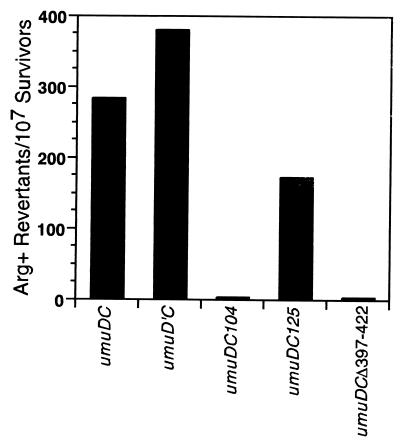
Effects of plasmids carrying various wild-type or mutant umuDC or umuD′C operons on UV (20 J/m2)-induced reversion of argE3(Oc)→Arg+ in ΔumuDC E. coli strain GW8017, measured as described elsewhere (48).
FIG. 3
FIG. 3
UmuD and UmuD′ both interact with the C terminus of UmuC. (A) Primary structures of the UmuC derivatives containing nested deletions of C-terminal sequences, shown relative to the proposed domain structure of the full-length UmuC. Proposed domains of UmuC are adapted from references and and are based on sequence similarity of UmuC to other members of the UmuC-DinB-Rad30-Rev1 superfamily. Amino acids introduced onto each of the UmuC derivatives prior to their stop codons as a result of their construction are indicated by one-letter code. (B) The ability of each UmuC derivative to interact with 32P-labeled UmuD or UmuD′, measured using a membrane-based assay described previously (40). Two membranes were processed as Western blots with either polyclonal anti-MBP (α-MBP) or affinity-purified polyclonal anti-UmuC (α-UmuC) antibody prior to chemiluminescence detection as described elsewhere (28, 40). The majority of the epitopes recognized by the anti-UmuC antibody preparation used here were located within the C-terminal 145 amino acid residues. The remaining two membranes were probed with either 32P-labeled UmuD or 32P-labeled UmuD′ as described previously (40). (C) Quantitation of the amount of UmuD (black bars) and UmuD′ (gray bars) retained by each UmuC derivative in panel B, performed as described in Materials and Methods and expressed as a percentage of that observed for the full-length MBP-UmuC, which was set at 100%.
FIG. 4
FIG. 4
DNA binding activities of various MBP-UmuC derivatives bearing nested deletions of C-terminal UmuC sequences. The ability of wild-type MBP-UmuC to bind ssDNA (A) or dsDNA (B) was measured as described in Materials and Methods. The following amounts of MBP-UmuC were added to each reaction: lanes 1 and 7, 0 pmol; lane 2, 0.5 pmol; lanes 3 and 8, 1 pmol; lanes 4 and 9, 3 pmol; lanes 5 and 10, 6 pmol; and lanes 6 and 11, 12 pmol. The positions of unbound (or free) DNA (F) and protein-DNA complexes (C) are indicated. I, II, and III represent forms I (supercoiled), II (knicked), and III (linear), respectively, of dsDNA. (C) The ability of the indicated UmuC derivatives to bind ssDNA was measured as described for panel A. Wild-type UmuC was assayed at 1, 3, 6, and 12 pmol, and UmuC derivatives bearing C-terminal deletions were assayed at 3, 6, 12, and 24 pmol. Lane 1 corresponds to the 0-pmol MBP-UmuC control. (D) Quantitation of the results shown in panel C, using the Molecular Analyst software package (Bio-Rad). Symbols: ■, MBP-UmuC; ●, MBP–UmuCΔ397–422; ▴, MBP–UmuCΔ278–422; ⧫, MBP–UmuCΔ150–422; □, MBP–UmuCΔ87–422.
FIG. 5
FIG. 5
Both UmuD and UmuD′ can be trapped as multimers in vitro. Treatment of purified UmuD (lanes 1, 3, and 5) or UmuD′ (lanes 2, 4, and 6) with formaldehyde (Form) or glutaraldehyde (Glut) was performed as described in Materials and Methods. The positions of free UmuD and UmuD′, UmuD2 and UmuD′2 homodimers, and UmuD and UmuD′ multimers are indicated. Positions of molecular weight markers (GIBCO-BRL) are indicated at the right.
FIG. 6
FIG. 6
Model of a possible mechanism for umuDC-mediated cold sensitivity (see text for details). The two physiologically relevant roles of the umuDC gene products (DNA damage checkpoint control and translesion DNA synthesis) are indicated by the shaded boxes. “More UmuD2C” and “More UmuD′2C” denote increases in gene dosage by virtue of their presence on either a moderate- to low-copy-number pSC101 derivative, or a higher-copy-number pBR322 derivative, as indicated.

References

    1. Bruck I, Woodgate R, McEntee K, Goodman M F. Purification of a soluble UmuD′C complex from Escherichia coli. Cooperative binding of UmuD′C to single-stranded DNA. J Biol Chem. 1996;271:10767–10774. - PubMed
    1. Burckhardt S E, Woodgate R, Scheuermann R H, Echols H. UmuD mutagenesis protein of Escherichia coli: overproduction, purification, and cleavage by RecA. Proc Natl Acad Sci USA. 1988;85:1811–1815. - PMC - PubMed
    1. Churchward G, Belin D, Nagamine Y. A pSC101-derived plasmid which shows no sequence homology to other commonly used cloning vectors. Gene. 1984;31:165–171. - PubMed
    1. Dutreix M, Moreau P L, Bailone A, Galibert F, Battista J R, Walker G C, Devoret R. New recA mutations that dissociate the various RecA protein activities in Escherichia coli provide evidence for an additional role for RecA protein in UV mutagenesis. J Bacteriol. 1989;171:2415–2423. - PMC - PubMed
    1. Ferentz A E, Opperman T, Walker G C, Wagner G. Dimerization of the UmuD′ protein in solution and its implications for regulation of SOS mutagenesis. Nat Struct Biol. 1997;4:979–983. - PubMed

Publication types

LinkOut - more resources